
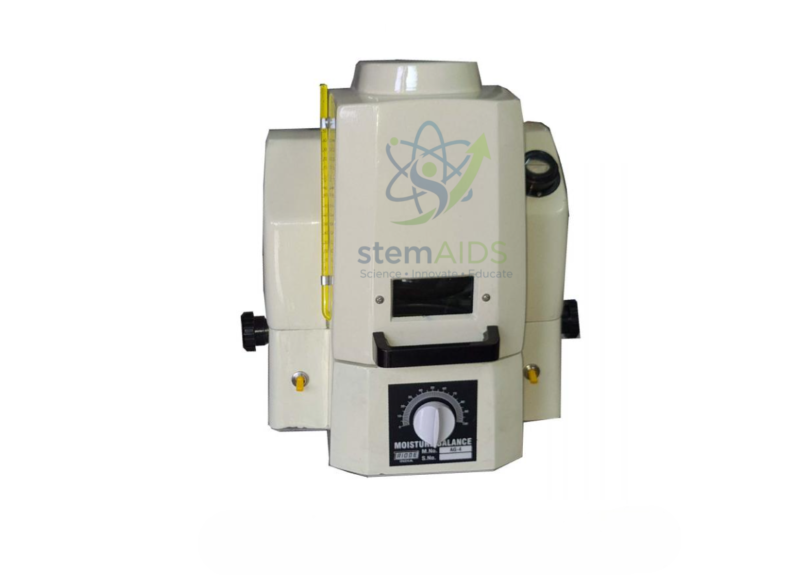
Quick Answer: The Infrared Moisture Balance, Analog is a moisture-testing balance in which an infrared lamp dries a sample on the pan while the loss in mass is read from an analogue scale. As pictured, this analog infrared moisture balance has a lamp housing above the weighing chamber, a scale window at the front and a control knob, a layout typical of the traditional design.
Reading Moisture on an Analogue Scale
In the traditional analogue design, the sample is loaded until the balance reads a set starting point, so that every test begins with the same initial mass. As the infrared lamp drives off moisture, the beam or pointer moves and the scale, viewed through the front window, shows the percentage of mass lost directly, with no calculation. Because the scale is graduated for that fixed starting mass, careful loading to the starting mark is part of an accurate result. The scale arrangement and setting procedure for this model should be confirmed at enquiry.
Analogue instruments of this kind have no electronic weighing cell, which keeps them simple and robust in grain stores, mills and teaching labs. Digital models, such as the infrared moisture balance with its automatic end point, add data logging and stored methods.
Lamp Setting and the End Point
The control knob typically sets lamp intensity or drying time. A stronger setting dries faster but risks scorching sugary or oily samples, which then lose more than just water. The sample should be spread thinly and evenly on the pan, and the reading watched until the scale stops moving; a reading that holds steady marks the dry end point.
Wet Basis and Dry Basis
Moisture can be expressed in two ways. On a wet basis, the water lost is divided by the initial mass of the sample; on a dry basis, it is divided by the mass of the dry material left. For a 10 g sample that loses 2 g, the wet-basis figure is 20 % and the dry-basis figure is 25 %. Grain and food trade usually quote wet basis, while soil testing often uses dry basis, so it is important to know which one a scale shows.
Materials Tested
- Quick moisture checks on wheat, rice, pulses, flour and animal feed
- Moisture in tea, spices and dried fruit before packing
- Soil moisture content in agriculture and civil-engineering practicals
- Teaching gravimetric moisture determination in college laboratories
Specifications
| Type | Analogue infrared moisture balance |
| Heating | Infrared lamp above the sample pan |
| Reading | Moisture shown on an analogue scale through a front window, as pictured |
| Controls | Front control knob, as pictured |
| Capacity, scale range, lamp rating and readability | Confirm at enquiry |
Care & Handling
- Let the lamp warm up and keep the analog infrared moisture balance away from draughts and vibration.
- Never touch the lamp housing or pan until they have cooled after a test.
- Brush sample residue from the pan and chamber after each test once cool.
- Keep flammable solvents and solvent-wet samples well away from the infrared lamp.
Why Choose LabEquip
Grain traders, flour mills, agricultural colleges and soil labs buy analogue moisture balances for quick, simple routine checks. LabEquip lists this model in its Physics Equipments range; the digital infrared moisture system is an alternative with a digital readout. Tell us what you test through the contact page.
Frequently Asked Questions
How does an analogue moisture balance show a percentage directly?
Each test starts with the same initial mass, set by loading the sample to a starting mark. The scale is graduated so that the movement as mass is lost reads directly as a percentage of that starting mass.
What is the difference between wet-basis and dry-basis moisture?
Wet basis divides the water lost by the original mass of the sample; dry basis divides it by the dry mass left at the end. The dry-basis figure is always the larger of the two.
How do I know the sample is dry?
Watch the scale. While moisture is still leaving, the reading keeps moving; when it stays steady for a while, the sample has reached its dry end point at that lamp setting.
Why must the starting mass be set exactly?
The scale is graduated for a fixed starting mass. If the sample is heavier or lighter than intended, every percentage read from the scale will be slightly wrong.
How does an analogue model compare with a digital one?
The analogue model is simple, robust and needs no electronic weighing cell. A digital model can log the drying curve, stop automatically and store methods, which helps when many different materials are tested.
Can samples containing solvents be tested?
Not safely or meaningfully. Solvents evaporate along with water and are counted as moisture, and flammable vapour near a hot infrared lamp is a fire risk.
Last Updated: October 2026





Reviews
There are no reviews yet.