
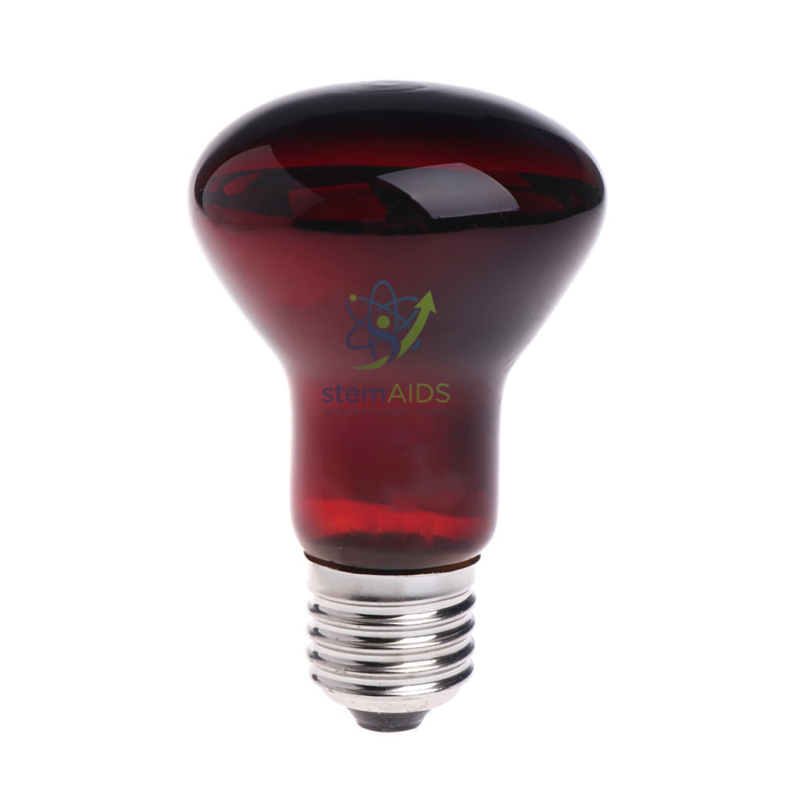
Quick Answer: The infrared heating bulb 75 W is a reflector lamp with red-tinted glass and a screw cap, built to give off mainly infrared radiation rather than visible light. In the physics lab it is a directional radiant heat source for experiments on absorption, reflection and the greenhouse effect.
Radiant Heat You Can Point
Any filament lamp gives off much of its power as infrared, but a heating bulb is made for it. The glass in the product photograph is tinted deep red, which lets the long wavelengths through while holding back most of the visible light, and the dome is shaped as a reflector to send the radiation forward in a broad beam. At 75 W, as titled, the bulb is a moderate source: strong enough to warm a surface noticeably across a bench, small enough for a classroom.
Infrared lies beyond the red end of the visible spectrum. It is carried by electromagnetic waves like light, travels in straight lines at the same speed and needs no medium, which is what separates radiation from conduction and convection. Surfaces absorb and reflect it in different amounts, and the bulb makes those differences measurable.
Experiments With the Bulb
The classic comparison places two identical cans, one painted matt black and one shiny, at equal distances from the infrared heating bulb, each with a thermometer, and records the temperature rise. The matt black can warms faster, showing that dark, dull surfaces are good absorbers. A greenhouse model uses two containers, one covered by clear film or glass, under the same lamp. A digital infrared thermometer gives quick, non-contact readings of the surface temperatures of the cans and containers, and a card screen placed in the beam shows that the heating stops at once, as it would for light.
Specifications
| Product | Infrared heating bulb |
| Power | 75 W, as titled |
| Glass | Red-tinted reflector dome, as in the product photograph |
| Output | Mainly infrared, directed forward by the reflector |
| Holder required | Heat-resistant (ceramic) screw holder rated for the bulb |
| Supply voltage and cap size | Confirm at enquiry |
Applications
- Comparing absorption by matt black and shiny surfaces under the same radiant source
- Greenhouse-effect models with covered and uncovered containers
- Showing that radiant heat travels in straight lines and is blocked by a screen
- Warming a surface steadily before cooling-curve and heat-loss measurements
Care & Handling
- Fit the infrared heating bulb only in a ceramic or heat-rated holder, with the reflector pointing away from people and flammable materials
- Never splash water on the hot glass; a sudden temperature change can crack it
- Allow the bulb to cool fully before touching or unscrewing it, as the glass stays hot for some time
- Keep a clear space in front of the lamp and never leave it running unattended
Why Choose LabEquip
Schools and colleges teaching heat transfer buy this bulb as a repeatable radiant source that is easy to aim and switch. LabEquip can advise on holders and suitable thermometers when you order through our contact page; more heat and physics lab equipment is listed in the category.
Frequently Asked Questions
Why is the bulb red?
The red-tinted glass passes the infrared and red part of the output and blocks much of the rest of the visible light, so the lamp glows dull red while delivering mostly radiant heat. It also stops the lamp being dazzling during experiments.
Can it be used in an ordinary desk lamp?
No, unless the fitting is rated for heat lamps of this power. Use a ceramic holder in a fitting designed for heat, since plastic lamp holders and shades can soften or scorch.
How far should the bulb be from the experiment?
That depends on how fast you want temperatures to rise. Start at a moderate distance, keep it the same for every sample being compared, and never place materials close enough to scorch. Recording the distance makes the results repeatable.
Why does a matt black surface heat up faster?
Dark, dull surfaces absorb a larger share of the incident infrared and reflect less, so more of the energy becomes internal energy of the surface. Shiny surfaces reflect most of it, which is why they warm more slowly under the same lamp.
Is infrared from the bulb harmful?
At classroom distances the main risks are burns from the hot glass and overheating of nearby materials. Avoid staring into the lamp at close range for long periods, and keep skin away from the front of the bulb.
Does the bulb give useful visible light?
Some, but it is not intended as a lighting lamp. Most of its output is infrared, and the red glass limits the visible light, so use an ordinary lamp for illumination.
Last Updated: October 2026








Reviews
There are no reviews yet.