













Sale
In Stock
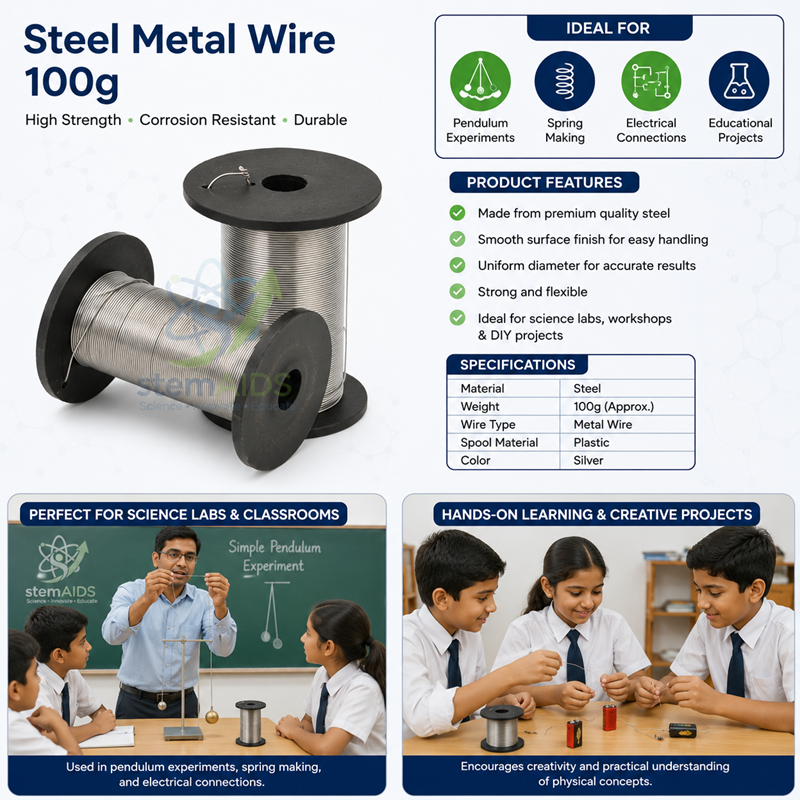
Steel Metal Wire 100g
Original price was: $1.80.$0.79Current price is: $0.79.
Quick Answer: The Steel Metal Wire 100g is steel wire supplied in a 100 g quantity for laboratory activities and practical builds. Plain steel is strong, can be bent to shape and is attracted by magnets, which makes it useful in magnetism, rusting and sonometer experiments.
Strength, Magnetism and Rust
Steel is mostly iron, and it brings iron’s key properties into the lab in wire form. It is much stronger and stiffer than copper or brass of the same thickness, so steel metal wire holds a shape under load, which suits frames, supports and stiff pointers in student projects. It is also ferromagnetic: a magnet attracts it, and stroking a short length with a magnet turns it into a weak magnet itself, the basis of the classic home-made compass needle.
Plain steel rusts when both water and oxygen are present, a weakness teachers turn into an experiment. Short lengths are placed in three tubes, one with air and water, one with boiled water under a layer of oil, and one with dry air over a drying agent; after a few days only the first shows clear rust. Some stainless steels rust little and are only weakly magnetic, so check the behaviour of the wire before using it for a rusting or magnetism demonstration.
On a sonometer, a steel wire is needed when the vibration is driven by an Electromagnet for Sonometer, because the magnet can only pull on ferromagnetic material.
Specifications
| Material | Steel |
| Quantity | 100 g (from the product name) |
| Magnetic | Yes, for plain carbon steel; some stainless grades are weakly magnetic |
| Corrosion | Plain steel rusts in damp air |
| Diameter and grade | Confirm at enquiry |
Applications
- Rusting experiments comparing wet, dry and air-free conditions
- Magnetising a short length to make a simple compass needle
- Sonometer work with an electromagnet drive
- Sturdy frames and supports in STEM and model-making projects
Care & Handling
- Keep the steel metal wire dry in a sealed bag, ideally with a desiccant sachet, so it does not rust before use.
- Cut with side cutters while wearing safety glasses; hold the short end so it does not fly off.
- Bend or tape sharp cut ends on finished models so students do not scratch themselves.
Why Choose LabEquip
Science teachers use steel wire for rusting and magnetism practicals and design teachers for stiff structures, so the same coil often serves two departments. LabEquip lists it in its General Items together with brass wire for comparison work. Send quantities through the contact page.
Frequently Asked Questions
Will the steel wire rust?
Plain carbon steel rusts when water and oxygen are both present, so keep the coil dry in storage. The same property makes it ideal for rusting investigations, where students compare lengths kept in different conditions.
How is steel wire different from brass wire?
Steel is stronger and stiffer and is attracted by magnets, but it rusts. Brass is non-magnetic, does not rust, is easier to solder and conducts electricity better. The choice depends on whether strength or magnetism matters.
Can a piece of this wire be magnetised?
Yes. Stroke a short length many times in one direction with one pole of a strong magnet. It becomes a weak magnet and, floated on a cork in water, will turn to point north-south like a compass.
Why does the electromagnet sonometer method need steel wire?
An electromagnet can only attract ferromagnetic materials. Steel is pulled towards the core twice in each AC cycle and so vibrates; a brass or copper wire would not move at all.
How should students cut and shape the wire safely?
Use side cutters or pliers, not scissors, and wear safety glasses because short ends spring away when cut. Bend the tip of any sharp end back on itself or cover it with tape.
What diameter is the wire?
Gauge is not given in the product name, so request it with your order. Thin wire suits magnetising and rust tests, while thicker wire is better for frames and supports.
Last Updated: September 2026
You must be logged in to post a review.
Bestsellers

Sale

Sale


Sale

Sale


Reviews
There are no reviews yet.