





Sale
In Stock
High-Resistance Coil Unit
Original price was: ₹70.00.₹25.00Current price is: ₹25.00.
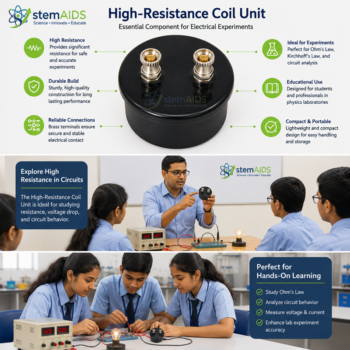
The High-Resistance Coil Unit is a laboratory electrical component used to provide a comparatively high, fixed resistance in supervised circuit experiments. It is intended for school and college physics laboratories, STEM classrooms and technical training where students investigate current, voltage, resistance and series or parallel circuit behaviour.
Product Description
The STEMAids High-Resistance Coil Unit contains resistance wire arranged as a coil and connected to accessible circuit terminals. Its resistance opposes current flow and produces a measurable potential difference when incorporated into a compatible low-voltage circuit. The exact resistance value, wire alloy and winding configuration must be confirmed before use.
The unit can support practical work on Ohm’s law, equivalent resistance, voltage division and electrical power. A mounted coil format simplifies connection and handling compared with loose resistance wire. Reliable results depend on using the component within its verified voltage, current, power and temperature limits.
Key Features
- High fixed resistance: Provides a defined circuit load once the nominal resistance is verified.
- Coiled resistance element: Accommodates resistance wire in a compact laboratory component.
- Accessible connections: Supports integration with compatible leads, meters and low-voltage supplies.
- Useful for Ohm’s law: Enables measurement of current and potential difference across a resistance.
- Supports circuit comparison: Can be used in approved series and parallel resistance arrangements.
- Reusable teaching component: Suitable for repeated practical sessions when operated within confirmed limits.
- Clear classroom application: Helps connect theoretical resistance calculations with measured circuit behaviour.
Technical Specifications
| Specification | Detail |
|---|---|
| Product name | High-Resistance Coil Unit |
| Brand | STEMAids |
| Product category | Electricity and resistance laboratory component |
| Component type | Fixed resistance coil unit |
| Product-specific standards | No product-specific standard or certification confirmed |
What’s Included in the Kit
- One High-Resistance Coil Unit.
- Mounted resistance element and connection terminals.
- Resistance-value label.
- Operating instructions.
- Connecting leads, meters and power supply are not confirmed as included.
Applications / Uses
- Verifying Ohm’s law by measuring voltage and current.
- Determining an unknown resistance from experimental readings.
- Comparing current through high- and low-resistance circuit branches.
- Constructing series and parallel resistance networks.
- Demonstrating voltage division in a compatible circuit.
- Investigating electrical power dissipation within verified ratings.
How to Use the High-Resistance Coil Unit
- Confirm the nominal resistance, power rating and maximum permissible current.
- Inspect the coil unit, support and terminals for damage or loose connections.
- Set the laboratory power supply to zero and switch it off.
- Connect the coil into the approved circuit using suitable laboratory leads.
- Connect the ammeter in series and the voltmeter across the coil where required.
- Apply a low voltage gradually while monitoring current and coil temperature.
- Record stable readings without exceeding the verified component rating.
- Switch off and disconnect the supply before changing the circuit.
Safety note: Resistance coils can become hot during operation. Never touch an energised or recently used unit, exceed its confirmed power rating or connect it directly to mains electricity.
Care & Maintenance
- Allow the coil unit to cool completely before storage.
- Keep the component dry and protect its winding from dust, impact and deformation.
- Do not lift the unit by its terminals or adjust exposed coil turns.
- Check the resistance periodically with a suitable meter after disconnecting the unit from all power sources.
Why Choose STEMAids
STEMAids supplies scientific laboratory instruments, electrical experiment components, educational models and STEM learning kits for institutional use. Its catalogue supports practical physics teaching in electricity, magnetism, mechanics, optics and heat. Buyers can explore related physics laboratory equipment, general physics laboratory components, hands-on STEM kits and the complete STEMAids scientific education range. Resistance values and electrical ratings should be confirmed before tender, bulk or export procurement.
Frequently Asked Questions
What is a High-Resistance Coil Unit used for?
It is used as a fixed resistance in laboratory circuits for experiments involving Ohm’s law, voltage division, current control and equivalent resistance.
What is the resistance value of the coil?
The nominal resistance is not confirmed for this STEMAids unit. Verify the marked value and tolerance on the approved product specification.
Why is the resistance wire formed into a coil?
Coiling accommodates a longer length of resistance wire in a compact unit. The wire length, material and cross-sectional area contribute to the component’s resistance.
Is the coil non-inductively wound?
The winding configuration is not confirmed. This specification should be verified when the unit will be used in alternating-current or precision measurement circuits.
Can the unit be used in series and parallel circuits?
Yes, provided the circuit remains within the confirmed voltage, current and power ratings of every connected component.
Can it be connected directly to mains electricity?
No. Use the coil only with an approved, current-limited laboratory supply under trained supervision.
You must be logged in to post a review.
Bestsellers

Sale
Sale


Sale

Sale


Reviews
There are no reviews yet.