
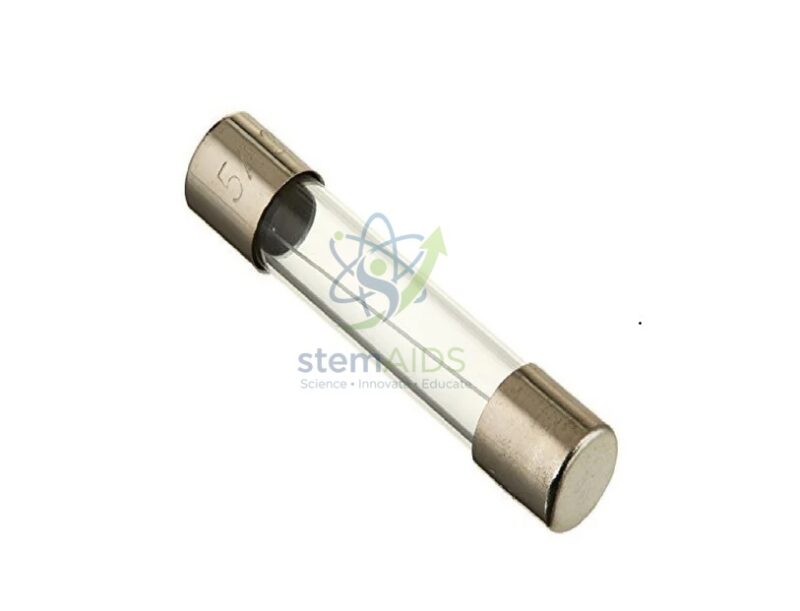
Quick Answer: These fast acting fuses are glass cartridge fuses, 5 x 20 mm in size with a 250 V rating, that open quickly when the current exceeds their rating. They protect meters, power supplies and other laboratory apparatus, and the clear glass lets you see whether the wire inside has blown.
How a Fuse Protects a Circuit
A fuse is a short, thin conductor placed in series with the circuit it protects. Current heats it at a rate of I squared R. Under normal conditions the heat escapes and the wire stays intact; when the current climbs well beyond the rating, the wire reaches its melting point and breaks, opening the circuit before wiring or components overheat. The 250 V figure is the highest voltage the fuse is designed to interrupt safely once it has blown, not the voltage it needs to work, so the same fuse can serve low-voltage and mains equipment within that limit.
Fast acting fuses, often marked F, react to an overload in a short time, which suits sensitive instruments such as the current ranges of multimeters and the outputs of electronic power supplies. Time-delay fuses, marked T, tolerate brief surges such as the inrush when a motor or transformer switches on. Replacing one type with the other changes the protection, so a blown fuse should always be replaced by one of the same current rating and the same speed.
A Visible Lesson in Overcurrent
The glass body makes the fuse a good teaching object. A fuse that has blown from a mild overload often shows a wire simply parted in the middle; one that blew from a short circuit may show blackened or silvered glass where the wire vaporised. Students can compare examples and discuss what each says about the fault. For a live demonstration, a low-voltage supply and a thin strand of fuse wire show the melting effect safely, while the cartridge fuses stay in their proper job of protecting instruments such as the digital multimeter.
Specifications
| Product | Glass cartridge fuses, quick-blow type |
| Size | 5 x 20 mm (Ø 5 x 20 mm), as titled |
| Voltage rating | 250 V, as titled |
| Speed | Fast acting |
| Body | Clear glass with metal end caps |
| Current ratings available | Confirm at enquiry |
Where These Fuses Are Used
- Replacing blown fuses in multimeters, power supplies and battery eliminators
- Spare stock for apparatus with 5 x 20 mm fuse holders
- Teaching how fuses work and how quick-blow and time-delay types differ
- Inspecting blown fuses to discuss overload and short-circuit faults
Care & Handling
- Switch off and unplug the apparatus before opening a fuse holder
- Replace a blown fuse only with one of the same current rating, voltage rating and speed
- Find the cause of the fault before fitting a new fuse; a fuse that blows again points to a problem in the circuit
- Never bridge a fuse holder with wire or foil
Why Choose LabEquip
Technicians keeping meters, power supplies and battery eliminators in service are the main buyers of these fast acting fuses, usually in mixed current ratings. LabEquip can supply a set matched to your instruments; list the ratings printed on the old fuses through our contact page, and see other physics lab equipment.
Frequently Asked Questions
What does 250 V on a fuse mean?
It is the maximum voltage the fuse can safely interrupt when it blows. A 250 V fuse can be used in circuits at that voltage or lower, including low-voltage apparatus. The current rating, not the voltage rating, decides when it blows.
What is the difference between quick-blow and time-delay fuses?
A quick-blow fuse opens rapidly on overload, which protects sensitive electronics and meter circuits. A time-delay fuse tolerates short surges, such as motor or transformer inrush, before blowing. Fit the type the equipment specifies.
Can I fit a higher current fuse if one keeps blowing?
No. A higher rating lets more current flow before the fuse opens, so wiring or components could be damaged first. Repeated blowing means there is a fault or misuse to find.
How do I tell whether a glass fuse has blown?
Look through the glass for a broken or missing wire, or a darkened, silvered interior. If it is unclear, test it with a multimeter on continuity: an intact fuse reads close to zero ohms.
Will these fit my multimeter?
They fit holders made for 5 x 20 mm cartridge fuses. Many multimeters use this size for some ranges, but others use larger or ceramic high-breaking-capacity fuses; replace with the type printed beside the holder or in the meter’s manual.
Which current ratings are available?
The listing covers 5 x 20 mm quick-blow fuses rated 250 V; the current ratings in stock can be confirmed at enquiry. Copy the rating printed on the end cap of the old fuse when ordering.
Last Updated: October 2026




Reviews
There are no reviews yet.