
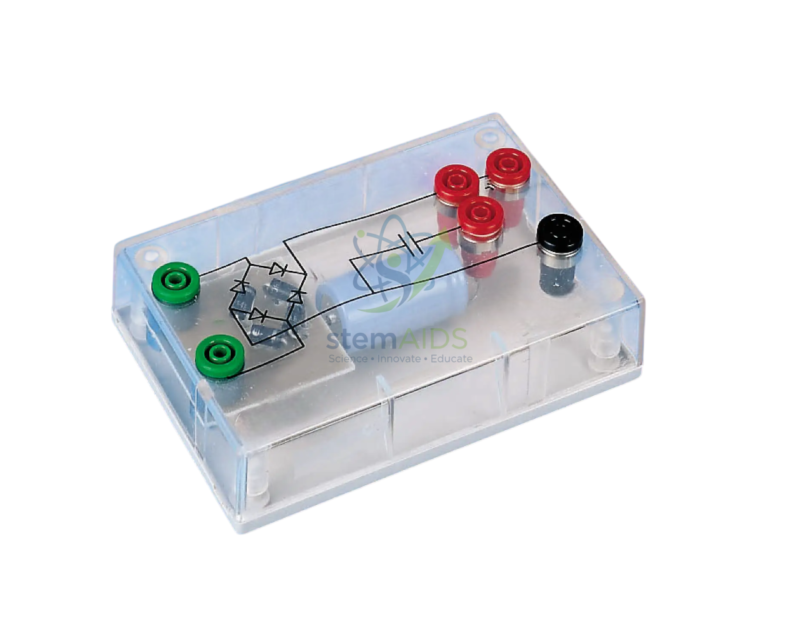
Quick Answer: The Diode Bridge Module and Capacitor combines a four-diode bridge rectifier with a smoothing capacitor on one teaching module, so students can turn a low-voltage alternating supply into direct current and see how the capacitor smooths it. This diode bridge and capacitor module is used in practicals on rectification, ripple and simple power-supply design.
From AC to Smooth DC in Two Steps
The bridge provides full-wave rectification: whichever way the alternating input swings, current leaves the module’s output in the same direction, as a series of humps at twice the supply frequency. On its own that output would make a lamp flicker and an amplifier hum. The capacitor across the output stores charge as each hump rises and releases it as the voltage falls, filling in the dips between humps.
What remains is a direct voltage with a small residual ripple. Its size depends on the capacitance, the current the load draws and the time between humps, and students can see the relationship directly: a light load leaves an almost flat trace, while a heavier load lets the capacitor discharge further between peaks, so the ripple grows.
Practicals With the Module
- Building a complete rectifier and smoothing stage from a low-voltage AC supply
- Measuring how ripple voltage changes with load resistance
- Comparing smoothed and unsmoothed outputs on an oscilloscope
- Introducing the voltage regulator as the next stage of a power supply
Measuring Ripple
With an oscilloscope across the load, compare the output with the capacitor connected under a light load and then under a heavier one, and, if the module lets the capacitor be linked out, without it. The peak-to-peak ripple read from the screen can be checked against the approximate prediction that ripple equals load current divided by the product of capacitance and ripple frequency. For a simpler starting point, the separate diode bridge shows the unsmoothed waveform on its own.
Specifications
| Contents | Diode bridge rectifier and smoothing capacitor on one module |
| Input | Low-voltage AC |
| Rectification | Full-wave |
| Output | Smoothed DC with residual ripple |
| Capacitance, ratings and capacitor switching | Confirm at enquiry |
Care & Handling
- The smoothing capacitor can hold its charge after switch-off; discharge it through a resistor before touching the output terminals.
- If the capacitor is an electrolytic type, never reverse the output polarity, as a reversed electrolytic capacitor can overheat and vent.
- Feed the module only from a low-voltage AC supply within its rating, never from the mains.
- Keep the module dry and check that the terminals are tight before each practical.
Why Choose LabEquip
Colleges and senior schools teaching power-supply electronics use a module like this to show rectification and smoothing without breadboard wiring errors. LabEquip supplies it with matching sources, loads and other physics lab equipment; ask us through the contact page about the capacitor value and input rating.
Frequently Asked Questions
What does the capacitor in the module do?
It smooths the output. During each rising hump from the bridge it charges, and as the bridge output falls it discharges into the load, stopping the voltage from dropping back towards zero. The output becomes a nearly steady direct voltage with a small ripple.
Why does the ripple increase when I connect a smaller load resistance?
A smaller resistance draws more current, so the capacitor discharges faster between peaks of the rectified wave and the voltage dips further before the next peak arrives. A larger capacitor or a lighter load reduces the ripple.
Why is the smoothed voltage higher than the reading before smoothing?
A voltmeter on the unsmoothed output shows the average of the humps. With the capacitor fitted and only a light load, the output stays close to the peak of the humps, which is higher than their average. As the load increases, the smoothed voltage falls back towards the average.
Is it safe to touch the terminals after switching off?
Not straight away, because the capacitor may still be charged. Discharge it through a suitable resistor, or wait for any bleed resistor on the module to do so, and check with a voltmeter before handling the terminals.
Can I run the module from the mains?
No. It is meant for a low-voltage alternating supply from a transformer or laboratory AC source. Mains voltage would exceed the ratings of a teaching module and be dangerous on an open bench.
What comes after smoothing in a real power supply?
A voltage regulator. It holds the output at a fixed value despite the remaining ripple and changes in load or input, which is how most fixed-voltage supplies for electronics are built.
Last Updated: October 2026






Reviews
There are no reviews yet.