
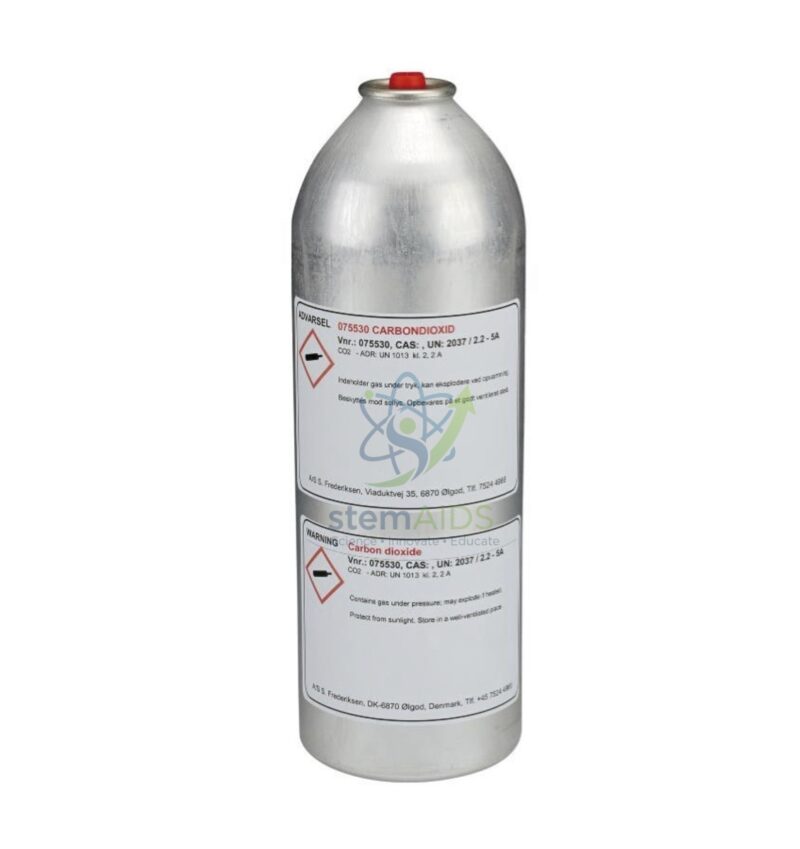
Quick Answer: This compressed gas can is an aluminium can holding a gas at the 10 bar pressure given in its name, pictured with hazard labels on its side. The compressed gas can is opened with a matching 10 bar valve, which turns it into a small, portable gas supply for class practicals.
What 10 Bar Means in Practice
One bar is close to normal atmospheric pressure, so a compressed gas can at 10 bar holds its gas at about ten times the pressure of the room. That is low compared with a full-size gas cylinder, which is why small 10 bar cans with simple screw-on valves suit school benches. By Boyle’s law at steady temperature, the gas that can be drawn off fills roughly nine times the can’s own volume at room pressure, because one can-volume always stays behind.
The pressure also explains why the flow slows as the can empties. The driving pressure falls in step with the gas remaining, so the valve has to be opened a little further near the end to keep the same stream of bubbles.
Setting Up a Gas Practical With the Can
Stand the can upright and restrain it before fitting anything. Screw on a compressed gas valve or a gauge valve by hand with its handwheel closed, connect tubing, and open slowly. Gas can then be collected over water, bubbled through a test solution or used to fill a gas syringe for volume measurements.
Read the can label before use. It names the gas and carries the hazard information that applies to it, and the supplier’s safety data sheet gives full handling and storage advice for that gas.
Practicals the Can Supplies
- Collecting a gas over water to study its properties and tests
- Filling a gas syringe for volume and pressure measurements
- Estimating the gas available from its pressure with Boyle’s law
- Bubbling a gas through limewater or an indicator during a demonstration
Specifications
| Product | Compressed gas can |
| Pressure, from title | 10 bar |
| Appearance in photograph | Aluminium can with hazard labels and a top connection |
| Opened with | 10 bar compressed gas valve or gauge valve |
| Gas contained | Named on the can label |
Care & Handling
- Store upright, restrained, below the temperature limit on the label and away from sun and heat
- Never puncture, burn or attempt to refill the can
- Read the label and the safety data sheet for the gas before use
- Close the valve fully after use and remove it only with the can upright
Why Choose LabEquip
Schools without a cylinder store use 10 bar cans because one can and valve on the bench provides enough gas for a practical. LabEquip supplies cans with the matching valves among our physics lab equipment; contact LabEquip to specify the gas you need.
Frequently Asked Questions
Which gas is in the can?
The listing gives the pressure, 10 bar, but not the gas; the label on the can names it. Tell us which gas your practical needs and it can be confirmed at enquiry.
How much gas does a 10 bar can supply?
At steady temperature, gas released down to atmospheric pressure fills about nine times the can’s internal volume. That is usually enough for several gas jars or test tubes in a small-scale practical.
Why does the flow slow down as the can empties?
The pressure pushing the gas out falls as gas is used. With less pressure behind it, the same valve setting gives a smaller flow, so the valve is opened a little further.
Which valve should I use with the can?
Either of the 10 bar valves. The plain valve gives flow control with a vertical outlet, and the gauge valve adds a pressure dial and a horizontal outlet.
How should cans be stored?
Upright, restrained, in a cool, ventilated place away from heat, flames and direct sun, with the valve removed or fully closed. Follow any extra advice on the label for the gas concerned.
What precautions apply to a 10 bar can on the bench?
Restrain it upright, keep it away from burners and hot plates, open it only with the correct valve, and close the valve whenever gas is not being collected. Keep the room ventilated, particularly with gases that are not part of normal air.
Last Updated: October 2026








Reviews
There are no reviews yet.