
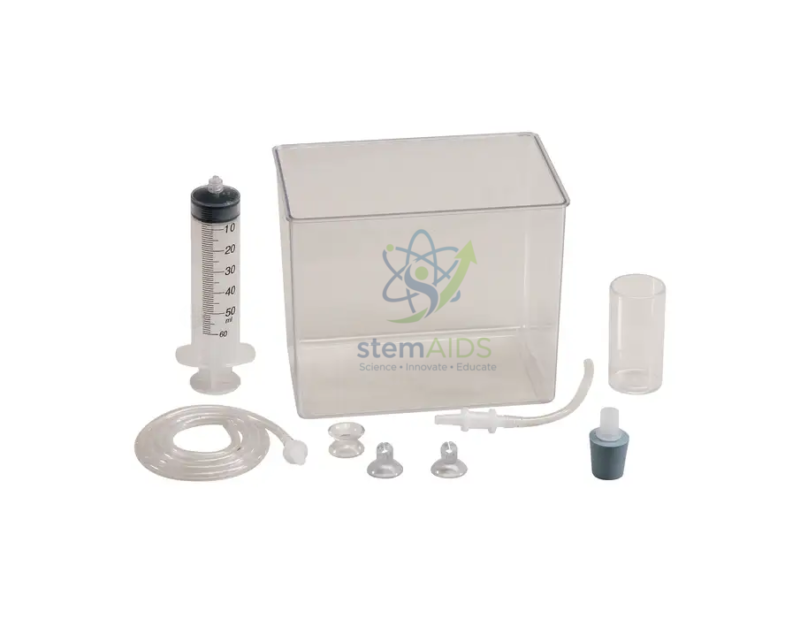
Quick Answer: This complete gas collection set brings together the parts needed to capture a gas made in a school reaction: a clear plastic tank, a graduated syringe, flexible tubing, a stopper with an outlet, a small collecting vessel and push-fit connectors, as pictured. Students use the gas collection set to gather a gas over water or in the syringe, read its volume and then test it.
Two Ways the Set Collects a Gas
The tank is used as a water trough. A collecting vessel is filled with water, turned upside down under the surface and placed over the end of the delivery tubing. Gas leaving the reaction rises into the vessel and pushes the water out, so the gas is trapped above the water line. This downward displacement of water works well for gases that dissolve only slightly, such as hydrogen and oxygen, and it shows students clearly when the vessel is full.
For a gas that dissolves more readily, or when the volume matters, the tubing is led to the graduated syringe instead. The plunger is pushed back by the incoming gas, and its scale gives the volume directly. Reading the syringe at regular intervals turns a simple preparation into a rate-of-reaction experiment, for example magnesium ribbon in dilute acid or hydrogen peroxide decomposing over a catalyst.
Assembling the Apparatus
The stopper closes the reaction tube or flask, and its outlet takes the flexible tubing. The connectors join tubing lengths and lead the gas where it is needed, and the small fittings pictured beside the tank help hold the tubing in place under water. Check every joint before starting by pressing the syringe plunger gently with the outlet closed: if the plunger springs back, the system is sealed.
Specifications
| Product | Gas collection set (complete assembly) |
| Shown in photograph | Clear rectangular tank, graduated syringe, tubing, stopper with outlet, collecting vessel, connectors and small fittings |
| Collection methods | Over water by displacement, or directly into the syringe |
| Measurement | Gas volume read on the syringe scale |
| Suits | Gases of low solubility over water; others by syringe |
| Exact contents and syringe capacity | Confirm at enquiry |
Experiments That Use the Set
- Collecting hydrogen from a metal and dilute acid and testing it with a lighted splint
- Collecting oxygen from hydrogen peroxide with a catalyst and relighting a glowing splint
- Following the rate of a gas-producing reaction by timed syringe readings
- Comparing how much gas different masses of a reactant release
Care & Handling
- Rinse the tank, syringe and tubing with clean water after each practical and leave them to dry apart
- Remove the tubing from the water before a heated reaction cools, so water is not drawn back into the hot tube
- Keep flames away from the outlet when hydrogen is being produced
- Do not force the syringe plunger against a closed outlet
Why Choose LabEquip
Teachers buy a complete set so that every bench has matching parts instead of a box of assorted tubing. LabEquip supplies it alongside the 60 mL graduated syringe, the flexible delivery tube and other physics lab equipment, and you can contact LabEquip to check what each set contains.
Frequently Asked Questions
Which gases can be collected over water with this set?
Gases that dissolve only slightly in water, such as hydrogen and oxygen, collect well over water. Carbon dioxide dissolves a little, so collecting it in the syringe gives a more accurate volume.
How do I know the apparatus is airtight?
Close the outlet and press the syringe plunger in a short way, then let go. If it moves back to where it started, the joints are sealed. If it stays in, find the leaking joint and refit it.
Why does the first gas collected contain air?
The reaction vessel and tubing are full of air at the start, and the first gas pushes that air out. Let the first portion escape or discard the first vessel before collecting gas for testing.
Can the set be used to measure the rate of a reaction?
Yes. Lead the gas into the syringe and read the volume every fixed number of seconds. A graph of volume against time shows the rate falling as the reactants are used up.
What causes water to be sucked back into the reaction tube?
When a heated tube cools, the gas inside contracts and the pressure drops, so water from the tank can rise up the tubing. Lift the tubing out of the water before stopping the heating.
Is the tank suitable for hot liquids?
Treat the clear plastic tank as a cold-water trough. Plastic can soften or craze with heat and strong solvents, so use it with water at room temperature.
Last Updated: October 2026








Reviews
There are no reviews yet.