
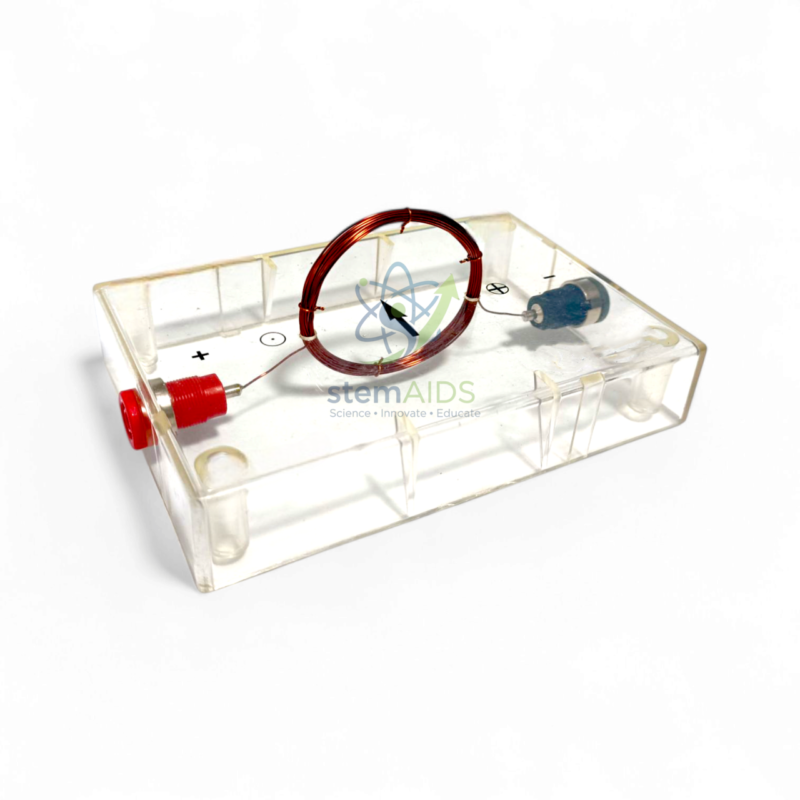
Quick Answer: This circular loop magnetic field apparatus is a ring of copper wire passing vertically through a horizontal transparent plate on a clear base, with terminal sockets for the current. It shows the shape of the magnetic field of a current loop, the building block of every coil.
Field of a Current Loop
The loop crosses the plate at two points. Near each crossing, iron filings or plotting compasses show circles around the wire, just as around a straight conductor, but the circles round the two crossings turn in opposite senses, because the current goes down through the plate at one point and up at the other.
Between the crossings, inside the loop, the fields from all parts of the ring reinforce one another. The lines there become nearly straight and run perpendicular to the plane of the loop, so the loop acts like a very short magnet with a north face and a south face. At the centre the flux density is B = μ₀NI/2R for N turns of radius R, so it doubles when the current doubles.
Specifications
| Apparatus | Circular wire loop through a transparent plate |
| Base | Clear base with terminal sockets, as pictured |
| Field shown | Circles near the wire, straight lines at the centre |
| Accessories needed | Iron filings, plotting compasses and a current-limited DC supply |
| Number of turns and loop diameter | Confirm at enquiry |
From One Loop to a Coil
Comparing this apparatus with the solenoid field pattern plate shows students how stacking many loops side by side builds up the long, uniform field of a solenoid. The single ring is also the clearest way to explain why a flat coil in a galvanometer or a loudspeaker has a face that behaves as a pole.
Practical Uses
- Drawing the field pattern of a loop with plotting compasses
- Using the right-hand grip rule to find which face is north
- Showing that the field at the centre reverses with the current
- Linking the loop to flat coils, galvanometers and loudspeakers
Care & Handling
- Switch the current on only while a pattern or reading is being taken
- Keep the current within what the wire and the supply can carry without heating
- Lift filings off the plate on a sheet of paper before moving the apparatus
- Store it under a cover so the plate stays free of scratches and dust
Why Choose LabEquip
Schools that already show the straight-wire field often add this loop to complete the sequence from wire to loop to solenoid. LabEquip supplies all three in its physics lab equipment range and quotes class sets on request via the contact page.
Frequently Asked Questions
Why are the field lines straight at the centre of the loop?
Every part of the ring contributes a field in the same direction at the centre, perpendicular to the plane of the loop. The contributions add, and the curvature of the lines from opposite sides cancels.
How does the field at the centre depend on the loop size?
For a given current, a smaller loop gives a stronger field at its centre, because the flux density there is inversely proportional to the radius.
Which face of the loop is the north pole?
Look at the face: if the current flows anticlockwise as you look at it, that face is a north pole; if clockwise, it is a south pole. The right-hand grip rule gives the same answer.
Why do the circles around the two crossings turn opposite ways?
The current passes down through the plate at one crossing and up at the other. Since the sense of the circular field depends on the current direction, the two sets of circles turn in opposite senses.
Is a large current needed?
Iron filings respond only to a fairly strong field, so a sizeable current is used for short periods. Plotting compasses respond to much smaller currents and are gentler on the supply.
What does the loop teach that a straight wire does not?
It shows how bending a conductor concentrates the field inside the loop and gives it two distinct faces, which is the step from a single wire to coils, solenoids and electromagnets.
Last Updated: October 2026








Reviews
There are no reviews yet.