
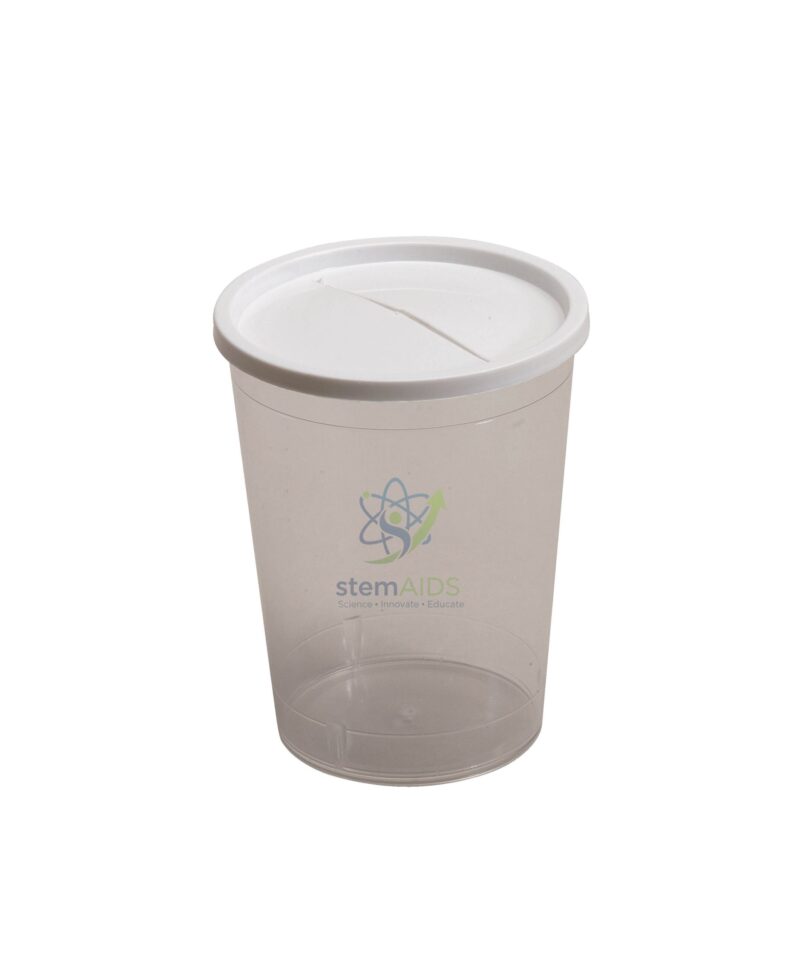
Quick Answer: These chromatography tanks are clear plastic containers with a white push-on lid that has a slot through it, as pictured. A chromatography tank with slotted lid holds a strip of chromatography paper hanging upright with its lower end in the solvent, so students can run paper chromatography without clips or rods.
How the Slotted Lid Helps
In paper chromatography the paper must hang straight, with only its bottom edge in the solvent and the sample line just above the liquid. Traditionally this means taping the paper to a rod across a beaker. The slot in this lid does the same job more simply: the top of the strip passes through the slot and is held by the lid, the length can be adjusted before the lid is pressed down, and the lid also reduces evaporation so the solvent rises more evenly.
Because the containers are plastic, a whole class can have one each without the risk of broken glass, which makes them suited to younger students working with water-based solvents.
Running a Separation
Draw a pencil line across the strip a short way from the bottom and add small dots of the inks or dyes to be tested. Pour a little water or the chosen solvent into the tank, feed the strip through the slot so the line stays above the liquid, and fit the lid. When the solvent has climbed most of the way, lift the strip out, mark the front and let it dry. Comparing the spots with known dyes shows which colours a mixture contains.
Specifications
| Product | Chromatography tanks |
| Shown in photograph | Clear plastic container with white slotted push-on lid |
| Holds | A paper chromatography strip hung through the slot |
| Suited to | Water and mild aqueous solvents |
| Number per set and dimensions | Confirm at enquiry |
Classroom Uses
- Separating the colours in black felt-tip ink or food colourings
- Comparing dyes from different sweets or marker pens in a forensic-style activity
- Teaching the terms solvent, solute, stationary phase and Rf value
- Investigating how the choice of solvent changes a separation
Care & Handling
- Check that organic solvents will not attack the plastic before using anything other than water or mild aqueous mixtures
- Rinse the tank and lid after use and let them dry apart
- Keep the slot free of dried dye so strips slide through cleanly
- Store tanks nested with lids separate so the lids are not bent
Why Choose LabEquip
Primary and lower-secondary teachers buy these tanks because a class set makes paper chromatography a hands-on activity for every pair of students. LabEquip supplies them with chromatography paper and the rest of its physics lab equipment; contact LabEquip for class set quantities.
Frequently Asked Questions
What is the slot in the lid for?
The slot holds the top of the paper strip, so the strip hangs straight with its bottom edge in the solvent. No clips, tape or rods are needed.
Which solvents can be used in plastic tanks?
Water and dilute aqueous mixtures are the safe choice. Some organic solvents soften or craze plastics, so test the solvent on the tank first or use a glass tank instead.
Why should the sample line be above the solvent?
If the dots are under the liquid, they dissolve into the solvent in the tank instead of being carried up the paper, and no separation appears.
Can filter paper be used instead of chromatography paper?
For simple ink separations, filter paper works. Chromatography paper gives more even flow and sharper spots, which matters when Rf values are measured.
Why put the lid on during the run?
The lid limits evaporation from the paper, so the solvent climbs evenly and the front stays straighter.
How long does a paper chromatography run take?
It depends on the paper, the solvent and the strip length. Water on a short strip usually takes part of a lesson, so students can record results in the same session.
Last Updated: October 2026





Reviews
There are no reviews yet.