
Quick Answer: Chromatography paper is a pure cellulose paper made with an even thickness and texture so that solvents travel through it at a steady, repeatable rate. It is the stationary phase in paper chromatography, used to separate the coloured or colourless components of a mixture into spots that can be compared by their Rf values.
What Sets It Apart From Filter Paper
Ordinary filter paper is made to let liquid through quickly. Chromatography paper is made so that liquid rises through it evenly by capillary action, with very little variation from one part of the sheet to another and few soluble impurities. That evenness is what keeps spots round and Rf values repeatable, which matters once students start measuring rather than just looking at colours.
The separation itself depends on partition. Water held among the cellulose fibres acts as the stationary phase, and the solvent moving up the paper is the mobile phase. Each substance in the sample divides itself between the two according to how soluble it is in each, so substances with different solubilities move at different speeds and come apart.
Cutting and Using the Paper
The image filename for this listing refers to rolls, so the paper may be supplied on a roll from which strips are cut to the length a tank needs. Cut with clean scissors, handle the paper by its edges, draw the baseline in pencil, and keep the grain of the paper running in the same direction for every strip in an experiment so that results are comparable.
Specifications
| Product | Paper for chromatography |
| Material | Cellulose paper made for even solvent flow |
| Principle | Partition between water held in the fibres and a moving solvent |
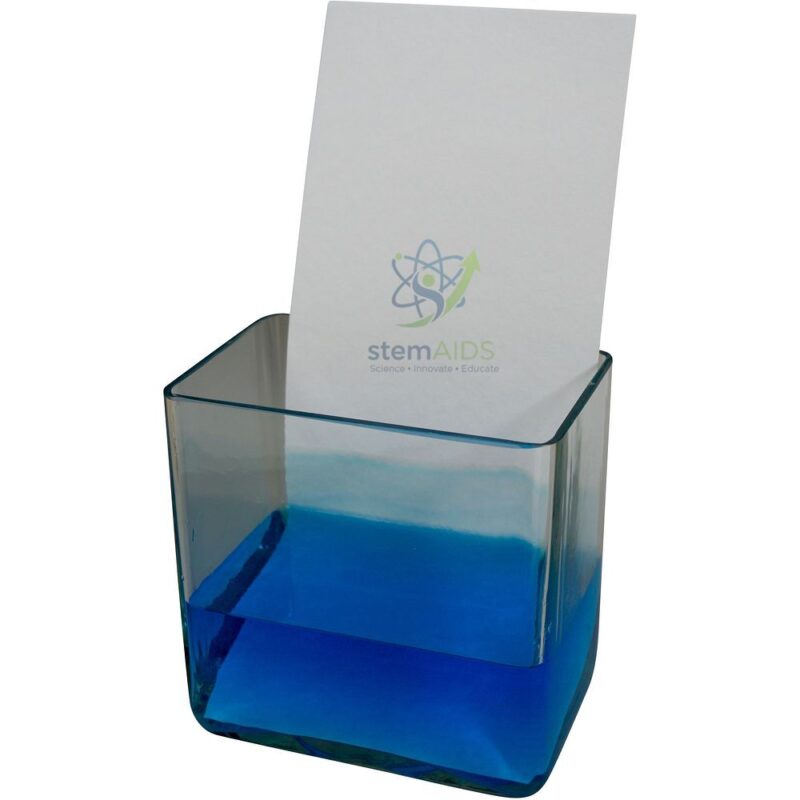
| Shown in photograph | Paper sheet developing in a glass tank of coloured solvent |
| Format, width and grade | Confirm at enquiry |
Applications
- Separating food colourings and felt-tip inks in introductory practicals
- Separating chlorophylls and carotenoids from leaf extracts with an organic solvent
- Separating amino acids and revealing them with a locating agent at advanced level
- Two-way chromatography, running the paper in two directions with different solvents
Care & Handling
- Store the paper flat or on its roll in a dry, dust-free place, away from chemical fumes
- Handle strips by the edges or with tweezers to avoid fingerprint spots
- Use pencil, not ink, for baselines and labels
- Dry developed chromatograms in a fume cupboard when organic solvents or locating agents are used
Why Choose LabEquip
Schools buy dedicated paper for chromatography once students move from looking at colours to measuring Rf values. LabEquip supplies it with chromatography tanks, the paper chromatography kit and its wider physics lab equipment; contact LabEquip to confirm the format.
Frequently Asked Questions
Is chromatography paper the same as filter paper?
No. Both are cellulose, but paper made for chromatography has a more even thickness and flow rate and fewer impurities, which gives sharper spots and repeatable Rf values.
Why does the baseline have to be drawn in pencil?
Pencil marks are graphite, which does not dissolve in the solvent. An ink line would dissolve and separate along with the samples.
Does the direction of the paper grain matter?
Yes. Solvent can travel at different speeds along and across the grain, so cut all strips for one experiment the same way round.
Can colourless substances be seen on the paper?
Yes, after development. Amino acids, for example, are revealed by spraying with a locating agent in a fume cupboard, which makes the spots coloured.
How should the paper be stored?
Keep it dry, clean and flat or on its roll, away from fumes and moisture, which can be absorbed by the cellulose and change how solvents run.
Why do my spots spread into long streaks?
Streaking usually means the sample spot was too large or too concentrated. Apply small dots, let each dry, and build the spot up gradually.
Last Updated: October 2026








Reviews
There are no reviews yet.