














Sale
In Stock
Fraction Wheel Kit
Original price was: $5.08.$2.43Current price is: $2.43.
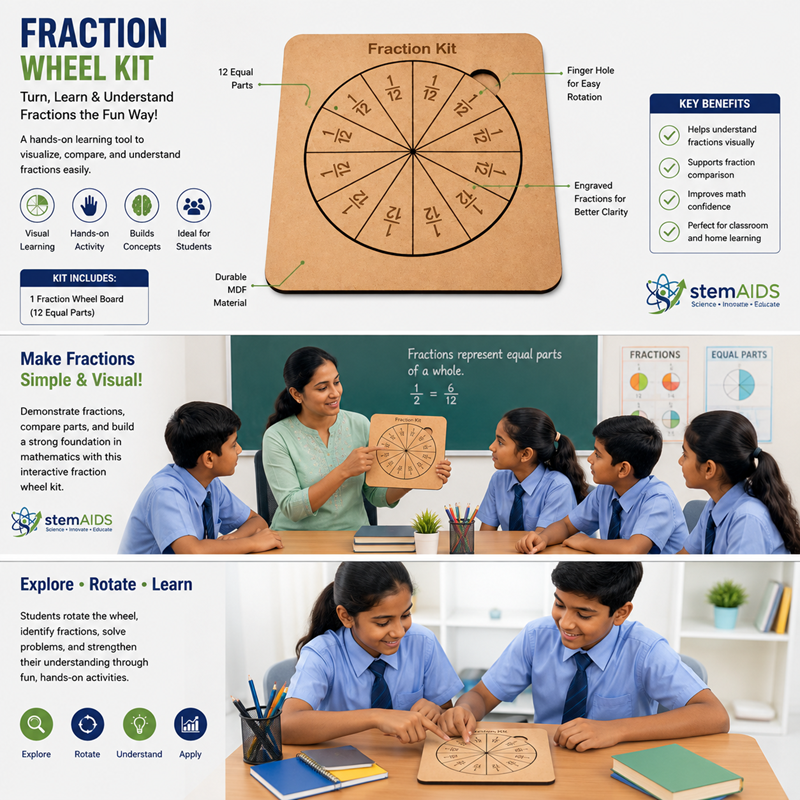
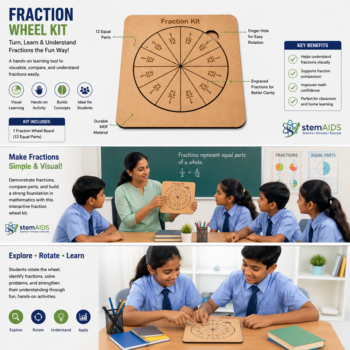
Quick Answer: The Fraction Wheel Kit uses circular fraction pieces divided into equal parts so students can see, compare and combine fractions visually instead of only working with numbers on paper. It is designed for primary and middle-school mathematics classrooms and is part of the LabEquip Maths Kit range.
Product Description
This Fraction Wheel Kit from LabEquip represents fractions as circular pieces divided into equal segments, so a fraction such as 1/2 or 1/4 is shown as a physical wedge of a circle rather than only as symbols. This makes it easier for students to grasp what the numerator and denominator actually mean, since they can directly compare how many equal parts make up a whole and how different fractional pieces relate to one another.
In classroom use, students commonly arrange different fraction pieces side by side to find equivalent fractions, or combine smaller pieces to build up to a whole circle. This hands-on comparison approach is especially useful when introducing fraction equivalence and simple fraction addition, since learners can check their answers visually before working the same problem symbolically.
The kit is intended as a focused fractions manipulative for primary and middle-school mathematics lessons. Exact piece count, denominator range and overall dimensions are best confirmed directly with LabEquip if your lesson plan depends on precise values.
What This Kit Helps Students Learn
- Recognise a fraction as a number of equal parts of a whole.
- Compare fractions visually by placing pieces of different sizes side by side.
- Identify equivalent fractions using matching physical pieces.
- Combine fraction pieces to model simple fraction addition.
- Connect symbolic fraction notation with a concrete, visual representation.
Specifications
| Attribute | Detail |
|---|---|
| Product Name | Fraction Wheel Kit |
| Brand | LabEquip |
| Product Type | Circular fraction manipulative / mathematics teaching aid |
| Primary Concept | Fractions as parts of a whole |
| Learning Topics | Fraction recognition, comparison and equivalence |
| Recommended For | Primary and middle-school mathematics classrooms, maths labs |
| Piece Count, Denominator Range & Dimensions | Contact us for detailed specifications |
Care & Maintenance
- Wipe fraction pieces with a soft, dry cloth to remove dust.
- Store all pieces together in their tray or box so none go missing between classes.
- Keep away from excess heat or moisture to prevent warping.
Why Choose LabEquip
LabEquip supplies a full range of Maths Kit manipulatives for schools, including the Cuisenaire Strips Model and the Decimal Abacus Model. Browse our full Maths Kit category for more number-sense and fractions teaching aids.
Frequently Asked Questions
What age group is this suitable for?
It is most commonly used in primary and early middle-school classrooms when fractions are first introduced.
Can this help students find equivalent fractions?
Yes, students can directly compare pieces of different sizes to see which fractions cover the same amount of a whole circle.
Is this suitable for whole-class demonstration?
Yes, teachers commonly use larger pieces at the front of the class before students practise with their own sets.
Can this be paired with other maths manipulatives?
Yes, it pairs well with other kits in our Maths Kit range, such as the Cuisenaire Strips Model and Decimal Abacus Model, for a broader number-sense unit.
Does this help with fraction addition?
Yes, students can combine smaller fraction pieces to build up to a whole, giving a visual introduction to simple fraction addition.
Last updated: September 2026
Bestsellers

Sale

Sale

Sale

Sale
Sale

Sale
Sale

