














In Stock
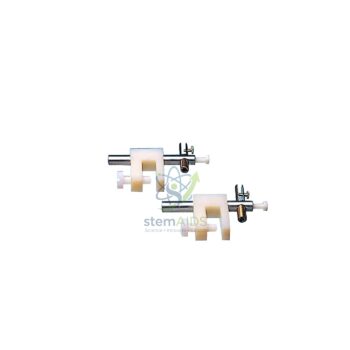
Perpendicular line segment Demonstration for School Maths Lab
Calibrated Orthogonal Intersections: Features segments precision-machined to ensure a mathematical 90° angle, enabling the accurate demonstration of slopes, intersections, and the construction of right-angled polygons within a laboratory environment.
High-Contrast Visuo-Tactile Design: Utilizes non-reflective, institutional-grade materials with engraved graduation markings, allowing for parallax-free observation and durable performance during high-frequency student manipulation in geometry lessons.
₹170.00
Quick Answer: The Perpendicular Line Segment Demonstration is a classroom aid for showing two line segments that meet at a right angle. Teachers use it to introduce the perpendicular line segment, the perpendicular bisector and the idea that the shortest path from a point to a line is the perpendicular one.
Teaching Perpendicular Segments
Two lines or segments are perpendicular when they meet at 90°, written AB ⊥ CD. Students first meet the idea in everyday objects: the edges of a book, the corner of a door frame, the margin line of a notebook. A piece the teacher can hold up, rotate and set against the board helps them see that perpendicularity depends only on the angle, not on whether one segment happens to be horizontal.
The idea then deepens. The perpendicular bisector of a segment passes through its midpoint at right angles, and every point on it lies at equal distances from the two endpoints, a fact behind the compass construction and, later, the circumcentre of a triangle. The perpendicular dropped from a point to a line gives the shortest distance to that line. In coordinate geometry, two non-vertical lines are perpendicular when the product of their slopes equals −1.
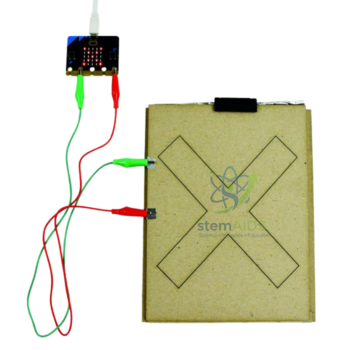
The listing does not describe the physical form of this aid, such as whether it is a board, hinged strips or a set of rods, so confirm its construction and size at enquiry.
Specifications
| Item | Demonstration aid for perpendicular line segments |
| Key idea | Two segments meeting at 90° (AB ⊥ CD) |
| Related constructions | Perpendicular bisector; perpendicular from a point to a line |
| Typical level | Primary introduction through secondary coordinate geometry |
| Form, material and size | Confirm at enquiry |
Applications
- Distinguishing perpendicular, parallel and simply intersecting lines
- Checking right angles with a set square and by paper folding
- Explaining the compass construction of a perpendicular bisector
- Showing why the perpendicular gives the shortest distance from a point to a line
Care & Handling
- Store the aid flat or hung up, so that any straight edges stay true.
- Wipe with a dry or slightly damp cloth; do not use solvents on printed markings.
- Check the right angle against a set square now and then, because a knocked joint can drift away from 90°.
Why Choose LabEquip
Teachers who already use a Geometrical Instruments set for constructions can use this aid to show the class what a finished perpendicular should look like before students draw one. It is part of LabEquip’s Mathematics School Lab Products range, and details can be requested through the contact page.
Frequently Asked Questions
What does it mean for two line segments to be perpendicular?
They meet, or would meet if extended, at an angle of 90 degrees. The symbol ⊥ is used, so AB ⊥ CD reads as AB is perpendicular to CD. Segments that cross at any other angle are simply intersecting.
How is a perpendicular bisector constructed with a compass?
Open the compass to more than half the length of the segment. From each endpoint, draw arcs above and below the segment. Join the two points where the arcs cross; that line passes through the midpoint of the segment at a right angle.
Why is the perpendicular the shortest distance from a point to a line?
Any other path from the point to the line forms the hypotenuse of a right-angled triangle in which the perpendicular is one of the shorter sides. The hypotenuse is always the longest side, so every slanted path is longer than the perpendicular.
How can students check a right angle without a protractor?
Fold a sheet of paper, then fold it again so that the first crease lies along itself; the second crease is perpendicular to the first. A set square corner, or a 3-4-5 triangle measured with a ruler, gives the same check.
How are perpendicular lines recognised in coordinate geometry?
Two lines with slopes m₁ and m₂ are perpendicular when m₁ × m₂ equals −1, provided neither line is vertical. For example, lines with slopes 2 and −½ are perpendicular. A horizontal line and a vertical line are also perpendicular.
At what level is perpendicularity taught?
Primary classes meet perpendicular lines as part of basic shapes and right angles. Middle school adds constructions such as the perpendicular bisector, and secondary students use slopes and the distance from a point to a line in coordinate geometry.
Last Updated: September 2026
You must be logged in to post a review.
Bestsellers




Reviews
There are no reviews yet.