
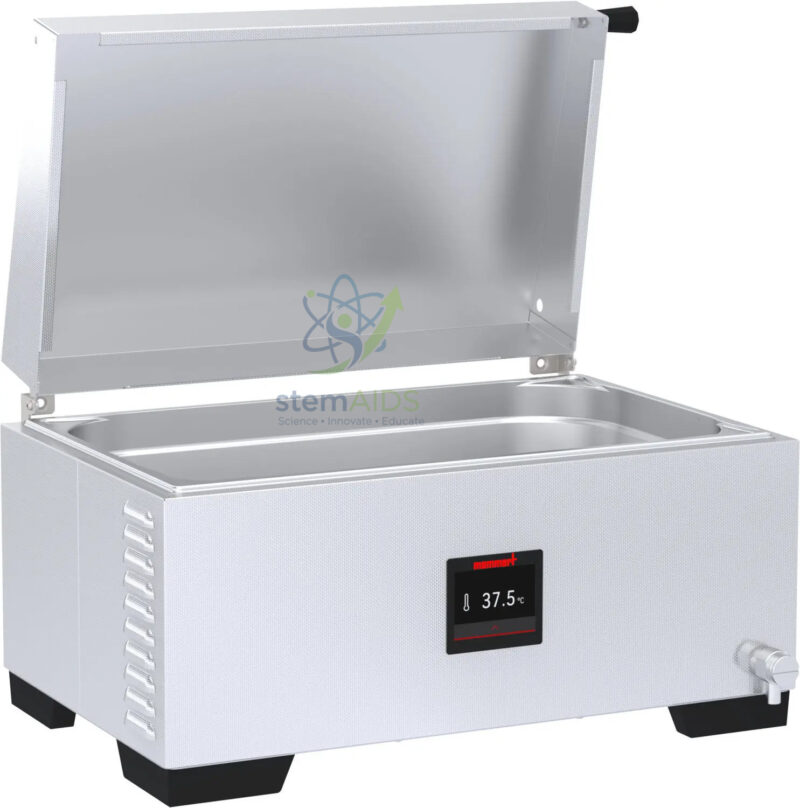
Quick Answer: The Water bath with lid is a bench-top laboratory water bath: a heated stainless steel tank of water, closed by a lid, that brings tubes, flasks and bottles to a set temperature by indirect heating. The pictured unit has a digital display, a lift-up lid and a drain tap.
How a Water Bath with Lid Holds Samples at Temperature
Water carries heat far better than air, so a vessel standing in a warmed tank reaches the bath temperature quickly and evenly, without the hot spots of a hotplate. That is why this water bath with lid is the usual choice for jobs where overshooting matters: thawing frozen stocks, keeping molten agar liquid before pouring, holding enzyme reactions at 37 °C or warming culture media before use.
The lid does more than keep dust out. An open tank loses heat and water from its surface all the time, and at higher set points the losses grow quickly: the heater works harder, the level drops and vapour drifts over the bench. Closing the lid traps a warm, humid layer over the water, which slows evaporation, steadies the temperature and spares you hourly top-ups on long runs.
In the listing photo the bath is a rectangular stainless steel unit with a lift-up lid, a digital temperature display on the front panel and a drain tap at the side for emptying. Tank volume, temperature range and control accuracy are not given in the product title, so they are settled at the enquiry stage rather than guessed here. Other baths and accessories sit in General Lab Products.
Applications
- Holding melted agar or gelatine media at pouring temperature until plates are poured
- Incubating enzyme reactions and serological tests at a fixed temperature, often 37 °C
- Thawing frozen reagents, sera and cell stocks gently
- Warming buffers and media before use, and school practicals on temperature and reaction rate
Specifications
| Type | Bench-top laboratory water bath with lid |
| Heating | Indirect: vessels stand in heated water |
| Tank and lid | Stainless steel, as pictured |
| Controls | Digital display on the front panel, as pictured |
| Draining | Side drain tap, as pictured |
| Volume, range and power supply | Confirm at enquiry |
Care & Handling
- Fill the tank with distilled or deionised water; tap water leaves scale on the tank and heater.
- Keep the water above the minimum mark before switching on, and top up with warm water during long runs.
- Lift the lid away from you so the steam vents behind it rather than towards your face.
- Drain through the tap regularly, wipe the tank dry and leave the lid propped open so the tank does not stay damp.
Why Choose LabEquip
Microbiology, biochemistry and teaching labs buy covered water baths for media preparation and incubations that run for hours. For tube work on a smaller scale, LabEquip also lists the Water bath 100 °C – 16 tubes, and tank sizes for this model are confirmed through the contact page.
Frequently Asked Questions
Why use a water bath instead of a hotplate?
Water surrounds the vessel and transfers heat evenly, so samples approach the set temperature without local overheating. A hotplate heats from the base only and can scorch media or crack thick glass. For gentle, steady warming the water bath is the safer method.
Should the lid stay closed during use?
Yes, as much as the work allows. The lid cuts evaporation and heat loss, which keeps the temperature steadier and the water level up. Open it only to add or remove vessels, lifting it away from you so steam escapes behind the lid.
What water should go in the bath?
Distilled or deionised water is recommended because it leaves little scale on the heater and tank. Avoid salt solutions, which can corrode stainless steel, and never run the bath dry.
How do I stop algae and bacteria growing in the water?
Change the water regularly, clean the tank when you do and consider a bath additive sold for the purpose. Keeping the lid closed between uses also limits what falls into the water.
Can the water bath boil samples?
That depends on the maximum set temperature, which the title does not state. Many general water baths stop short of boiling; for boiling-water steps choose a model rated for it and keep the lid on to limit steam.
How deep should vessels sit in the water?
The water should reach at least the level of the liquid inside each vessel so the whole sample is heated. Tall flasks may need weighting or a rack, and short tubes can be raised on a grid so they do not tip.
Last Updated: October 2026




Reviews
There are no reviews yet.