








In Stock
Rotating disc digital agitator
$253.24
Quick Answer: The Rotating disc digital agitator is a tube rotator with a vertical disc that holds tubes around its face and turns them end over end, with speed set on a digital control for consistent mixing and incubation.
How the Disc Agitator Mixes
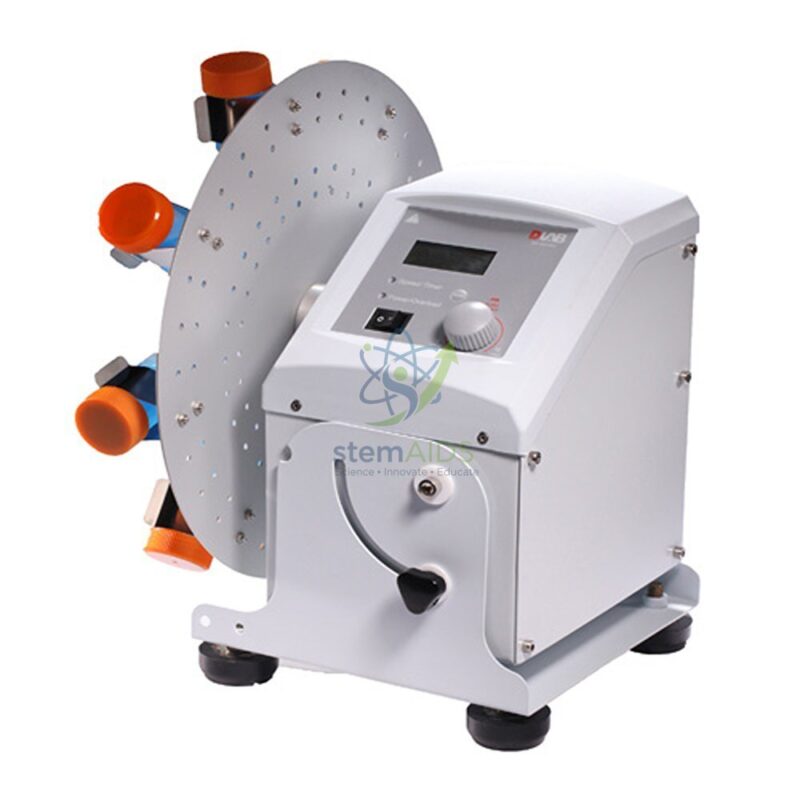
In the photo, a large perforated disc stands upright beside a control housing with a display, and tubes are held at the disc’s edge. As the disc turns, every tube passes through upright, horizontal and inverted positions on each revolution, so its contents tumble end over end. That slow inversion keeps suspensions even and brings reagents into contact without foam or shear.
A disc carries more small tubes in a compact footprint than a drum, and discs can be exchanged to suit other tube sizes; a separate Disc for rotary disc digital shaker is listed for this purpose, and its fit with this unit should be confirmed. Digital control means the speed can be set to a number and repeated, which matters when a protocol states the mixing conditions.
For a simpler, knob-set unit of the same style, the Rotary disc analog agitator covers routine mixing. Speed range, timer and disc capacity for this digital model are not stated in its title.
Laboratory Uses
- Immunoprecipitation and pull-down incubations, where beads must stay suspended with antibody for an hour or more
- Mixing many small tubes of blood or plasma samples at one speed
- Labelling or binding reactions in tubes that need slow, steady inversion
- Washing resins or beads between buffer changes
Specifications
| Type | Disc rotator for end-over-end tube mixing |
| Control | Digital, as titled |
| Disc orientation | Vertical, as pictured |
| Tube mounting | Tubes held around the disc face |
| Speed range, timer and tube capacity | Confirm at enquiry |
Care & Handling
- Arrange tubes symmetrically around the disc so it turns without wobble.
- Check clip grip regularly and replace clips that no longer hold tubes firmly.
- Remove the disc for cleaning if it detaches, and disinfect it after biological samples.
- Stop the rotator before loading or unloading; never reach into a turning disc.
Why Choose LabEquip
Molecular biology groups and clinical training labs buy a digital disc agitator for incubations that run for set times at set speeds. Spare discs and related rotators are in General Lab Products; ask through the contact page about disc sizes.
Frequently Asked Questions
Why hold tubes on a disc rather than in a drum?
A disc fits many small tubes in a compact space and keeps each one visible. A drum suits larger tubes and bottles lying lengthwise. The mixing principle, end-over-end inversion, is the same.
Can the disc be changed for different tube sizes?
Disc rotators are usually designed around interchangeable discs, and a separate disc is listed on this site. Confirm that a disc fits this particular unit before ordering it.
Is it suitable for overnight incubations at 4 °C?
Disc rotators are often run in cold rooms for overnight binding steps. Move the unit in and let it settle before switching on, and let it dry out before use after returning it to a warm room, so condensation does not reach the electronics.
How full should each tube be?
Leave a clear air gap at the top of each tube. The bubble has to travel from end to end as the tube inverts; a tube filled to the brim barely mixes.
What happens if the disc is unbalanced?
It may wobble, run noisily and wear the motor bearing. Place tubes of similar weight opposite each other and add water-filled balance tubes where needed.
How should the disc be cleaned after a leak?
Stop the unit, remove the tubes and wipe the disc and clips with a disinfectant suited to the sample, then with water. Dry it before refitting so moisture does not reach the drive.
Last Updated: September 2026
You must be logged in to post a review.
Bestsellers




Reviews
There are no reviews yet.