



















In Stock
Reflux Condenser
₹5,640.00
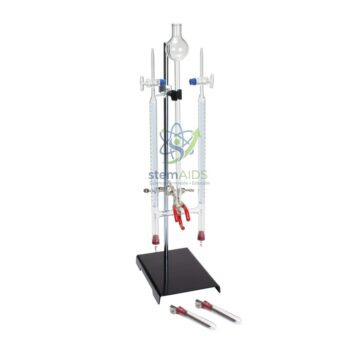
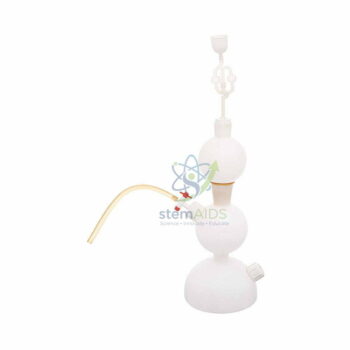
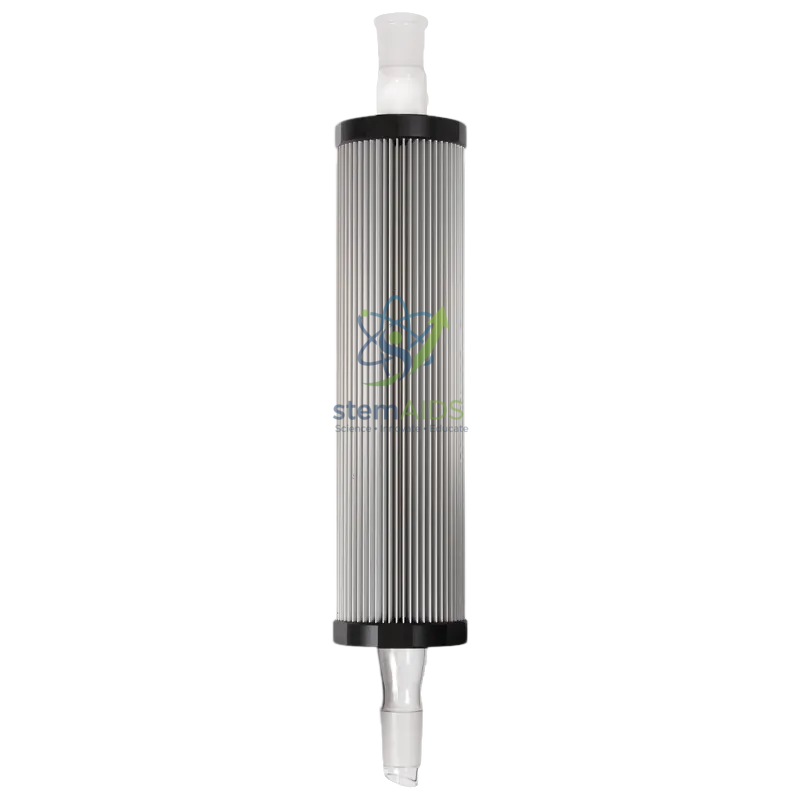
Quick Answer: The Reflux Condenser is a vertical condenser fitted above a boiling flask so that solvent vapour cools, turns back into liquid and drips back into the flask. The listing photograph shows a finned, air-cooled body between two glass ground joints, the waterless style of condenser.
How Refluxing Works
Heating under reflux lets a reaction run at the boiling point of its solvent for as long as needed without the solvent boiling away. Vapour rises from the flask into the condenser, meets a cool surface, condenses and runs back down. The condenser stays open at the top, so the system is never sealed and pressure cannot build up.
Most school and college labs know the water-cooled types: the straight Liebig condenser, the bulbed Allihn and the coiled Dimroth, all of which need a steady flow of tap water through an outer jacket. The unit in this listing photograph looks different. A glass joint at the bottom and top frames a cylinder of closely spaced metal fins with black end caps. Condensers built this way are cooled by room air: the fins draw heat out of an inner glass tube and shed it to the surrounding air, so no water hoses are connected.
Air-cooled designs remove the risk of a burst hose flooding the bench, and they save water on long reactions. Very volatile solvents with low boiling points can still escape an air-cooled condenser, so for those a water-cooled condenser remains the safer choice. The listing does not state the joint sizes or the exact design.
Applications
- Heating a reaction mixture under reflux in a 250 mL round-bottom flask on a hotplate stirrer
- Ester, amide and other preparations in college organic chemistry practicals
- Dissolving a solid in boiling solvent before hot filtration and recrystallisation
- Long reactions where running tap water through a condenser for hours is wasteful
Specifications
| Product type | Condenser for heating under reflux |
| Design (from photo) | Finned air-cooled body between two glass ground joints |
| Cooling | No water supply shown; cooled by surrounding air |
| Mounting | Vertically above a boiling flask |
| Joint sizes and design details | Confirm at enquiry |
Setting Up and Caring for the Condenser
- Clamp the condenser near its middle as well as supporting the flask; the joint alone should not carry its weight
- Never close the top of the condenser; a drying tube is the most that should be fitted
- Grease or sleeve ground joints lightly so they do not seize after heating
- Clean the inner tube with solvent after use and let it dry fully before storage
Why Choose LabEquip
Condensers of this kind are bought by chemistry departments setting up organic practicals and by labs moving away from water-cooled glassware to save water. LabEquip supplies condensers with matching flasks, clamps and stands from our general lab products range, and can confirm joint sizes against your existing glassware through the contact page.
Frequently Asked Questions
What does a reflux condenser do?
It cools the vapour rising from a boiling flask so that it condenses and runs back into the flask. The reaction can then boil for hours without losing solvent.
Does this condenser need cooling water?
The listing photograph shows a finned, air-cooled design with no water connections, which works without a water supply. If your work needs a water-cooled model, a Liebig, Allihn or coil condenser is the usual alternative.
Which solvents suit an air-cooled condenser?
Air-cooled condensers handle many common solvents at moderate heating rates. Very low-boiling solvents can pass through them, so for those use a water-cooled condenser or reduce the heating rate.
Why must the top of the condenser stay open?
Heating a sealed system builds pressure that can burst the glassware. The open top lets air move freely while the cooled surface stops the vapour from escaping.
How do I clamp a reflux condenser correctly?
Clamp the flask neck to a stand rod first, fit the condenser into the flask joint, then add a second clamp around the condenser body so the joint carries no sideways load.
What joint size does the condenser have?
Joint sizes are not given in the listing. Tell us the joint on your flask and we will confirm whether this condenser matches or suggest an adapter.
Last Updated: September 2026
You must be logged in to post a review.
Bestsellers




Reviews
There are no reviews yet.