
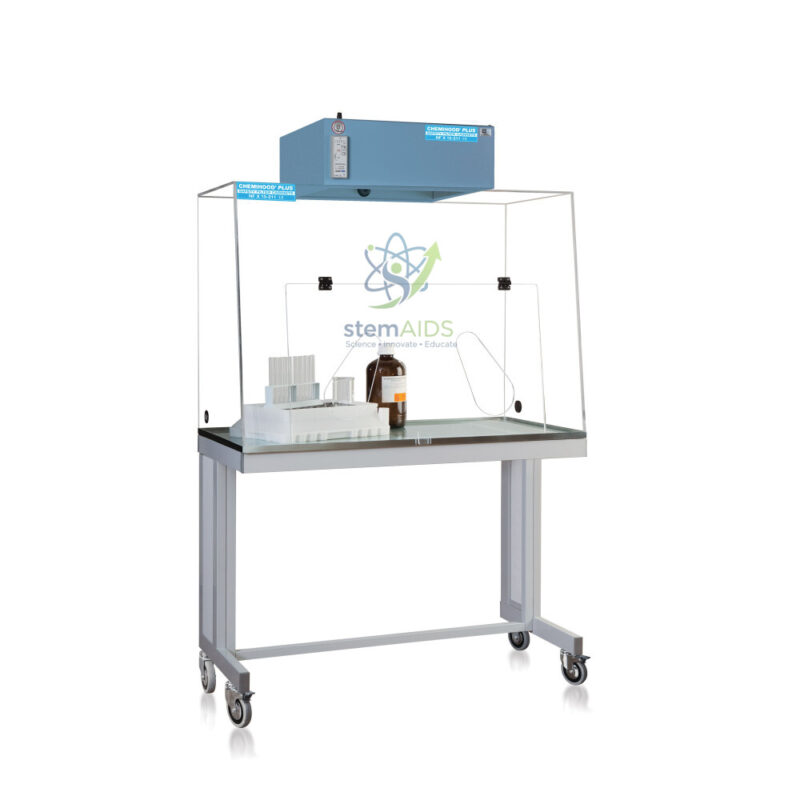
Quick Answer: The Chemihood’plus filtering ventilation hood is a ductless enclosure with transparent panels and a filter unit on top, shown in the photo on a wheeled frame. It filters fumes from the work area and returns the air to the room, so it can be used where no exhaust duct exists.
A Filtering Hood Built Around Mobility
In the photograph the Chemihood’plus stands on a wheeled frame with a lower shelf rather than on a fixed bench. A mobile enclosure suits labs where one protected work area must serve several rooms or groups during a week, such as a school science block where the same teacher demonstrates in different classrooms. Because the unit is not tied to ductwork, it can be wheeled to where it is needed and plugged in.
Filtering hoods of this kind rely on molecular filtration: gas and vapour molecules are captured on an adsorbent medium, usually activated carbon, sometimes treated for particular chemical families. Each filter grade is matched to a group of chemicals, so the work planned for the hood decides which grade is fitted.
Transparent sides let students follow a demonstration from several angles while vapours stay inside the enclosure. Wheel the unit into position before use, lock the castors if the frame has brakes, and let the fan run briefly before opening any container.
Where a Mobile Filtering Hood Helps
- Teacher demonstrations with small amounts of odorous or irritant reagents in classrooms without fume cupboards
- Moving a protected work area between laboratories as timetables change
- Preparing dilutions of volatile reagents in small analytical or QC labs
- Temporary fume control during lab renovation while fixed hoods are out of use
Moving, Filters & Care
- Move the hood only with the fan off and containers removed or closed
- Check filter suitability whenever the hood moves to a room that uses different chemicals
- Keep the power cable off the floor where wheels or people could catch it
- Clean the transparent panels with a soft cloth and mild detergent to keep them clear
Specifications
| Product | Ductless filtering ventilation hood |
| Name in title | Chemihood’plus |
| As pictured | Clear-panelled enclosure with top filter module, on a wheeled frame with lower shelf |
| Filtration | Adsorbent filter selected for the chemicals handled |
| Frame inclusion and filter grades | Confirm at enquiry |
Why Choose LabEquip
Schools and small labs that share one hood between rooms are the typical buyers of a mobile filtering unit. LabEquip supplies the Chemihood’plus alongside other ductless options in its general lab products range, such as the filtration hood without connection; send the chemicals you plan to handle via the contact page so the filter can be matched.
Frequently Asked Questions
Why choose a mobile filtering hood?
A hood on a wheeled frame can serve several rooms, which suits schools and labs whose timetables change. It needs only a power socket where it is used, since the filtered air returns to the room.
What is molecular filtration?
It is the capture of gas and vapour molecules on an adsorbent filter medium, most often activated carbon, sometimes treated to hold acids, ammonia or formaldehyde. It differs from particle filtration, which traps dust and aerosols.
Is the filtering ventilation hood suitable for classroom demonstrations?
Yes, for small-scale demonstrations with chemicals the fitted filter can retain. The transparent panels let a class watch from several sides while the vapour stays inside the enclosure.
Do I need to change the filter when moving rooms?
Only if the new room’s work uses chemicals the fitted filter is not suited to. Check the chemical list against the filter each time the hood is moved.
Can the hood be used while it is being moved?
No. Close all containers and switch the fan off before moving it, then reposition it, lock the wheels if brakes are fitted and restart the fan before opening anything.
How is a filtering hood different from a laminar flow cabinet?
A filtering hood protects the user by drawing fumes away and through a chemical filter. A laminar flow cabinet blows filtered air over the work to keep samples clean and is not designed to protect against chemical vapours.
Last Updated: October 2026






Reviews
There are no reviews yet.