










In Stock
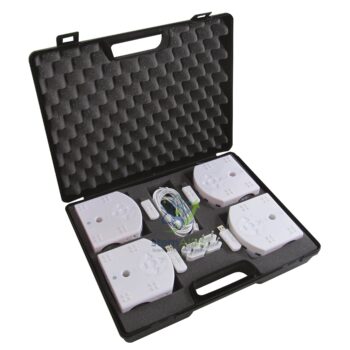
Wireless Motion Sensor Redy
Capteur Redy Mouvement High-Frequency Ultrasonic Transducer: Enables precise student evaluation of damping effects and phase shifts in harmonic oscillators at the "Analyze" cognitive level.
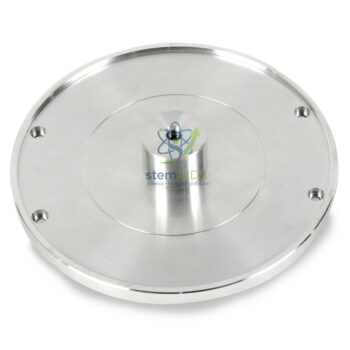
Integrated Multi-Axis Mounting Thread: Supports ruggedized attachment to standard dynamics tracks, ensuring repeatable experimental results in vocational engineering practicums.
$74.22
Quick Answer: The Redy wireless motion sensor measures the distance to a moving object, usually by timing ultrasonic echoes, and logs it wirelessly so that position, velocity and acceleration graphs build up live. A wireless motion sensor is the standard tool for kinematics practicals in physics.
Distance From Echo Timing
Motion sensors in school data-logging generally send out short pulses of ultrasound and time the echo from the nearest object. Half the round-trip time multiplied by the speed of sound gives the distance. Repeated many times a second, this produces a position against time graph, and the software differentiates it to show velocity and acceleration.
The most memorable use needs no apparatus at all: a student walks towards and away from the sensor, trying to match a given distance graph, and learns what slope means by feel. With a trolley on a ramp, the velocity graph becomes a straight line whose gradient is the acceleration; with a ball dropped beneath the sensor, successive bounces show energy being lost.
Sensors of this kind have a minimum distance, inside which echoes cannot be timed, and struggle with small, soft or angled targets. The title does not state the range or whether there is a narrow-beam setting. For motion along a string, where echoes are unreliable, the wireless pulley sensor is an alternative.
Specifications
| Measures | Distance to an object over time |
| Derived | Velocity and acceleration, calculated by the software |
| Principle | Usually ultrasonic echo timing in sensors of this kind |
| Output | Wireless live graphing |
| Minimum and maximum range | Confirm at enquiry |
Applications
- Matching distance and velocity graphs by walking
- Acceleration of a trolley on an inclined ramp
- Free fall and bouncing of a ball
- Oscillation of a mass on a spring or a pendulum bob
- Collisions between trolleys on a track
Care & Handling
- Aim the sensor squarely at a flat, hard target; tilted or soft surfaces scatter the echo.
- Clear the path of other objects such as bench edges, clamp stands and hands.
- Keep the object beyond the minimum distance for the whole run.
- Protect the sensor face from knocks and falling objects when it points upward.
Why Choose LabEquip
Physics departments teaching motion graphs, Newton’s laws and oscillations buy motion sensors for every practical group. LabEquip supplies this one under its chemistry lab equipment listing; range and mounting clamps can be discussed on the contact page.
Frequently Asked Questions
How does an ultrasonic motion sensor measure distance?
It sends a pulse of ultrasound, times how long the echo takes to return from the object, and multiplies half that time by the speed of sound. Repeating this rapidly gives position over time.
Why is my velocity graph noisy?
Velocity is calculated from changes in position, so small errors in distance become larger jumps. Use a large, flat target, keep the path clear and apply smoothing in the software if it offers it.
How close can an object be to the motion sensor?
Ultrasonic sensors cannot time echoes from very close objects, because the pulse is still being sent when the echo arrives. Keep the object beyond the minimum stated for the sensor throughout the run.
Can it track a falling ball?
Yes. Mount the sensor facing down above the drop zone, protect it with a guard, and release a ball beneath it. The graphs show constant acceleration and the loss of height with each bounce.
Why does the reading suddenly jump to a wrong distance?
The sensor has picked up an echo from something else, such as a bench, wall or person nearby. Narrow the beam if the sensor allows, or move the set-up away from clutter.
Does temperature affect the readings?
The speed of sound rises with air temperature, so distances shift slightly in a very warm or cold room. Many systems let you set the temperature or the speed of sound for better accuracy.
Last Updated: September 2026
You must be logged in to post a review.
Bestsellers





Reviews
There are no reviews yet.