


In Stock
Stirring Rod, Plastic, Policemen
Autoclavable Polypropylene Architecture: Manufactured from medical-grade, non-reactive polymers that withstand aggressive reagents and maintain structural integrity during repeated steam sterilization cycles at 121°C.
Integrated Spatula Geometry: The terminal "policeman" end is precision-molded to a tapered, semi-flexible edge, facilitating the exhaustive scraping of microscopic residues and precipitates from the internal curvatures of beakers and flasks.
₹185.00
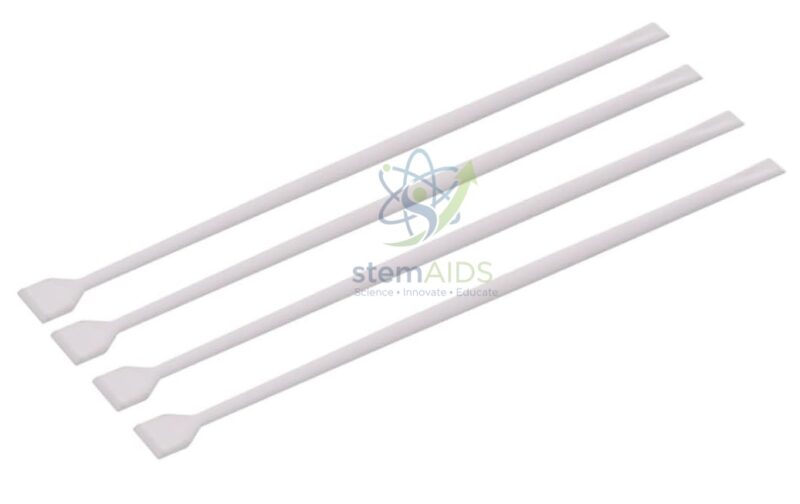
Quick Answer: A plastic stirring rod with policeman is a rod with one end shaped as a flat scraper, used to push precipitate or crystals off the walls and base of a beaker so that none is lost during transfer. The listing photo shows rods with a flat, paddle-shaped tip on one end.
What a Policeman Tip Does
In quantitative analysis, every particle of precipitate counts. After a barium sulfate or silver chloride precipitate has been filtered, fine solid clings to the inside of the beaker, where a round rod simply slides over it. A policeman, originally a rubber sleeve pushed onto a glass rod, gives a flat edge that follows the curve of the glass and wipes the solid loose so it can be washed into the filter.
The rods in this listing appear, from the photo, to be one-piece plastic with a flat, blade-like tip rather than a separate rubber cap. A single piece cannot slip off and get lost in the beaker, and the plain end can still be used for stirring. The blade is firmer than soft rubber, so use it with a light touch.
For plain mixing, the simpler plastic stirrer does the job without the flattened end; for hot solutions, keep a glass rod to hand, because plastic softens with heat.
Specifications
| Item | Stirring rod with policeman (scraper) end |
| Material | Plastic, as titled |
| Tip form | Flat, paddle-shaped blade, as shown in the listing photo |
| Other end | Plain round rod in the photo, usable for stirring |
| Length and blade width | Confirm at enquiry |
Care & Handling
- Clean the blade edge thoroughly; precipitate trapped at the tip is carried into the next determination.
- Rinse the tip with wash liquid into the filter after scraping, so solid left on the rod is not lost.
- Keep the rods away from hot plates and flames, and out of solvents that attack plastics.
- Discard a rod once the blade edge becomes nicked or rough.
Applications
- Recovering precipitate from beaker walls in gravimetric analysis, such as sulfate or chloride determinations
- Transferring crystals from an evaporating basin after crystallisation
- Scraping moist solid from a filter paper or watch glass into a weighing bottle
- Stirring suspensions in which solid settles and sticks to the base
Why Choose LabEquip
College analytical chemistry labs, and schools teaching gravimetric practicals, buy policeman rods to go with their filtration glassware. They sit in LabEquip’s chemistry lab equipment range, and the contact page is the place to ask about lengths and quantities.
Frequently Asked Questions
What is a policeman in chemistry?
It is a flexible or flat-edged tip on a stirring rod, used to scrape solid from the inside of a vessel during quantitative transfers. The name comes from its job of making sure nothing escapes.
How is a policeman used during filtration?
After pouring off most of the liquid, scrape the walls and base of the beaker with the tip, then rinse the loosened solid and the tip itself into the filter with a stream from a wash bottle. Repeat until the beaker is clean.
Why use a plastic policeman rather than a rubber one?
A one-piece plastic rod has no separate sleeve to slip off or perish over time, and it is easy to clean. Soft rubber moulds more closely to curved glass, so some analysts keep both.
Can the rod scratch glassware?
The plastic is softer than glass, so it does not normally scratch it. Grit or dried precipitate caught on the blade can, so keep the tip clean and rinse it between uses.
Is it suitable for hot solutions?
It should not be used in boiling liquids or near a flame, because plastics soften with heat. Let digested precipitates cool somewhat before scraping, or use a glass rod with a rubber policeman for hot work.
Can the plain end be used for stirring?
Yes. In the listing photo the opposite end is a plain round rod, so one tool can stir a precipitation and then scrape the beaker when the solid is transferred.
Last Updated: September 2026
You must be logged in to post a review.
Bestsellers





Reviews
There are no reviews yet.