







In Stock
Reaction plate for Sérénit electric burner
₹965.00
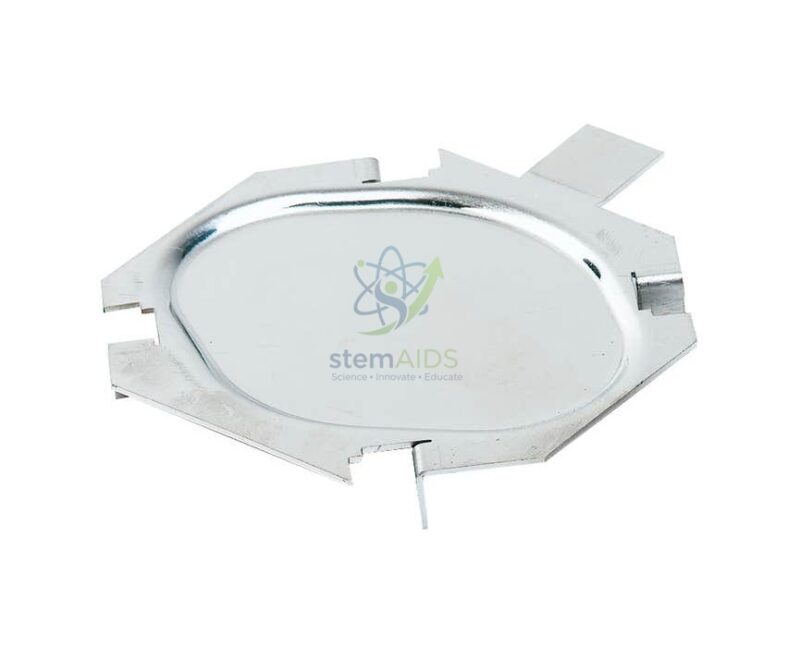
Quick Answer: The Serenit reaction plate, listed as ‘Reaction plate for Sérénit electric burner’, is a shallow, dished metal plate that rests over the burner’s heating element. The listing photo shows a bright metal dish with an angular rim, bent locating tabs and a flat handle tab, used to heat small quantities of solids in full view of a class.
A Shallow Dish That Sits on the Heat
On a gas burner, a solid is usually heated in a crucible on a pipe-clay triangle or in a test tube held in the flame. The Sérénit electric burner has a flat spiral element instead of a flame, and this plate is made to rest over it. In the photo the plate has a shallow circular well pressed into its centre, a rim cut into straight segments, small tabs bent downwards to locate it on the burner, and a flat tab projecting from one side for lifting.
Because the well is open and shallow, everyone around the bench can see what happens to the sample: blue crystals turning white as their water of crystallisation is driven off, a solid melting and then charring, or a powder changing colour as it decomposes. Thin metal passes heat into the sample quickly, so changes begin soon after the burner is switched on.
The reaction plate has a different job from the solid fuel burning plate, which holds fuels such as charcoal while they burn. This one is for heating and decomposing small samples to watch a chemical change. Anything that releases irritant or toxic gas belongs in a fume cupboard, whichever plate is used.
Applications
- Heating blue hydrated copper(II) sulfate until it turns white, then adding a drop of water to reverse the change
- Comparing how sugar, salt and candle wax behave when heated: melting, charring or no visible change
- Thermal decomposition of green copper(II) carbonate to black copper(II) oxide as a class demonstration
- Drying a small portion of a damp, heat-stable solid before weighing
Specifications
| Item | Reaction plate for the Sérénit electric burner |
| Form | Shallow dished well with a segmented rim (photo) |
| Fitting | Bent tabs that locate the plate on the burner (photo) |
| Handling | Flat projecting tab for lifting with tongs (photo) |
| Finish | Bright metal, as photographed |
Care & Handling
- Seat the Sérénit reaction plate on the burner while both are cold, and check that the tabs hold it level.
- Use small amounts; the tip of a spatula of solid is enough to see a change.
- Lift the plate only with tongs by its handle tab, and set it down on a heat-resistant mat to cool.
- Scrape out residues once cold and wash the plate before the next class; soak stubborn deposits rather than scouring hard.
Why Choose LabEquip
Teachers who have moved to Sérénit electric burners but still want to show dehydration and thermal decomposition reactions buy this plate. LabEquip includes it in the chemistry range, and you can match plate numbers to your burners through the contact page.
Frequently Asked Questions
What can be heated on the reaction plate?
Small amounts of solids such as hydrated salts, carbonates, sugar or wax. Keep each sample to a spatula tip, and heat anything that gives off irritant gases only in a fume cupboard.
Can liquids be heated on it?
The well is shallow, so only a few drops fit and they may spit as they boil. For solutions, use an evaporating basin or a small beaker supported safely over the burner instead.
Will the plate fit burners other than the Sérénit?
It is listed for the Sérénit electric burner, and its tabs are shaped to locate on that unit. Fit on other burners should not be assumed, because a plate that is not seated properly can slide off a hot element.
How is it different from the solid fuel burning plate?
The solid fuel plate holds fuels such as charcoal or wood while they burn. The reaction plate is a dished well for heating and decomposing small samples, where the aim is to watch a chemical change rather than a combustion.
Why does blue copper sulfate turn white on the plate?
Blue copper(II) sulfate crystals contain water of crystallisation. Heating drives that water off and leaves white anhydrous copper(II) sulfate; adding a drop of water back restores the blue colour and gives out heat.
How should the plate be cleaned?
Let it cool completely, scrape off loose residue, then wash it with warm water and detergent. Soaking loosens baked-on deposits; avoid harsh scouring, which roughens the surface so that later residues stick.
Last Updated: September 2026
You must be logged in to post a review.
Bestsellers





Reviews
There are no reviews yet.