






In Stock
Economy Calorimeter
₹1,000.00
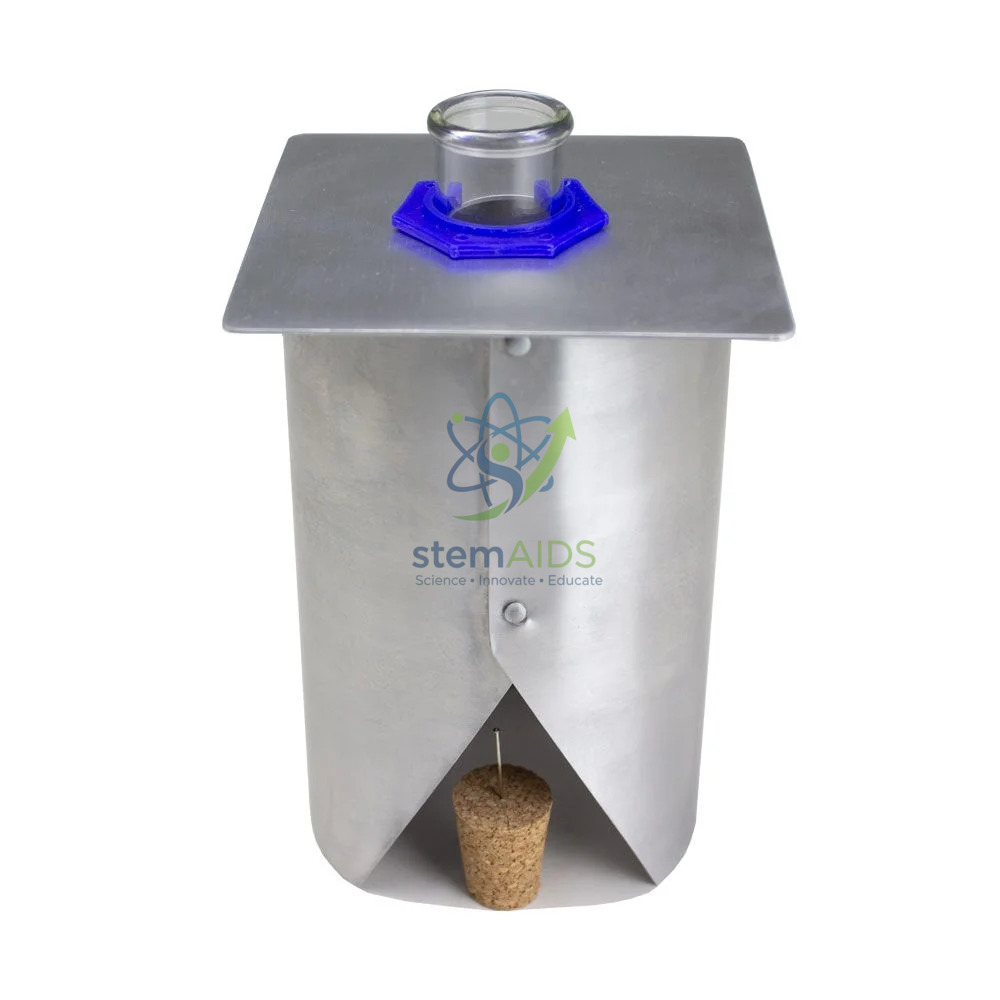
Quick Answer: The Economy Calorimeter is a simple food calorimeter for estimating the energy stored in food. The listing photo shows a metal chimney with a flat top plate, a glass tube held in a blue collar on top, and a cork with a pin at the base, where a food sample is burned so that its heat warms water in the tube.
Burning Food to Heat Water
Food energy practicals follow a simple sequence. Weigh a small, dry piece of food, fix it on the pin in the cork, set it alight and let its flame heat a measured mass of water in the tube above. From the temperature rise, the mass of water and the specific heat capacity of water, students calculate the energy transferred, then divide by the mass of food that burned.
The economy calorimeter improves on holding a boiling tube over a burning snack in open air. The metal chimney surrounds the flame and guides the hot gases up to the water tube, while the triangular opening at the base lets air in and gives access for lighting the sample. In the photo the water container is a glass tube seated in a blue holder in the top plate, and the sample holder is a pin fixed in a cork below.
Results always come out lower than the values printed on food packets, because heat escapes through the chimney walls and with the exhaust gases, some food may not burn completely, and the glass itself absorbs heat. Discussing those losses, and how laboratory bomb calorimeters reduce them, is often the most valuable part of the practical.
Applications
- Comparing the energy content of snacks such as crisps, crackers and puffed cereals
- Calculating energy per gram of food from temperature rise and loss in mass
- Evaluating experimental error and heat loss in a combustion practical
- Comparing the energy released by small samples of fuels such as candle wax
Specifications
| Item | Simple food (combustion) calorimeter |
| Chimney | Metal body with flat top plate and an opening at the base (photo) |
| Water container | Glass tube held in a blue collar on top (photo) |
| Sample holder | Cork with a mounting pin (photo) |
| Thermometer | Not shown; use a laboratory thermometer or temperature probe |
| Dimensions and tube volume | Confirm at enquiry |
Care & Handling
- Check the class for food allergies before choosing samples for the food calorimeter, and leave out nuts if anyone is allergic.
- Burn only small, dry samples, with a heat-resistant mat under the calorimeter.
- Let the chimney cool fully before handling, as the metal stays hot after the flame goes out.
- Clean soot from the glass tube between runs so that each trial starts from the same condition.
Why Choose LabEquip
Biology and chemistry teachers covering food energy, respiration and energy transfer buy economy calorimeters so that each group can run its own trials. LabEquip lists it among its chemistry lab equipment; class-set numbers can be discussed on the contact page.
Frequently Asked Questions
How is energy content calculated with this calorimeter?
Multiply the mass of water by its specific heat capacity, 4.18 joules per gram per degree Celsius, and by the temperature rise. Divide that energy by the mass of food burned to get joules per gram.
Why are results lower than the values on food packets?
Heat escapes to the air and into the chimney, some food does not burn completely, and the glass absorbs heat. Packet values come from methods that capture far more of the energy.
Which foods work well?
Dry, oily foods that burn steadily, such as crisps, crackers or puffed cereal. Moist foods are hard to light and tend to go out before they have burned completely.
How much water should go in the tube?
Use a measured mass of water that leaves space above it, weighed on a balance rather than estimated. Keep the same mass for every trial so that results can be compared fairly.
Why does the design include a chimney?
The chimney channels hot gases up to the water container and shields the flame from draughts. That cuts heat loss compared with holding a tube over a flame in open air, giving more consistent results.
Can nuts be used as samples?
Nuts burn well and are traditional in this practical, but they must be avoided if anyone in the room has a nut allergy. Crisps or cereals work as substitutes.
Last Updated: September 2026
You must be logged in to post a review.
Bestsellers





Reviews
There are no reviews yet.