









In Stock
Cuvettes, Plastic
High-Transmission Optical Architecture: Manufactured from medical-grade, virgin polystyrene (PS) or PMMA, providing an ultra-clear light path with minimal absorbance and high signal-to-noise ratios across the 340nm to 900nm spectrum.
Precision-Molded 10mm Path Length: Engineered using advanced high-tolerance injection molding to ensure absolute wall thickness uniformity and dimensional stability, facilitating seamless compatibility with all standard spectrophotometers and automated analyzers.
$1.58
Quick Answer: Plastic cuvettes are small, square-section sample cells moulded from clear plastic, used to hold a solution in the light path of a colorimeter or spectrophotometer. They are inexpensive, usually disposable, and suit readings in the visible range.
Clear Faces, Ribbed Sides
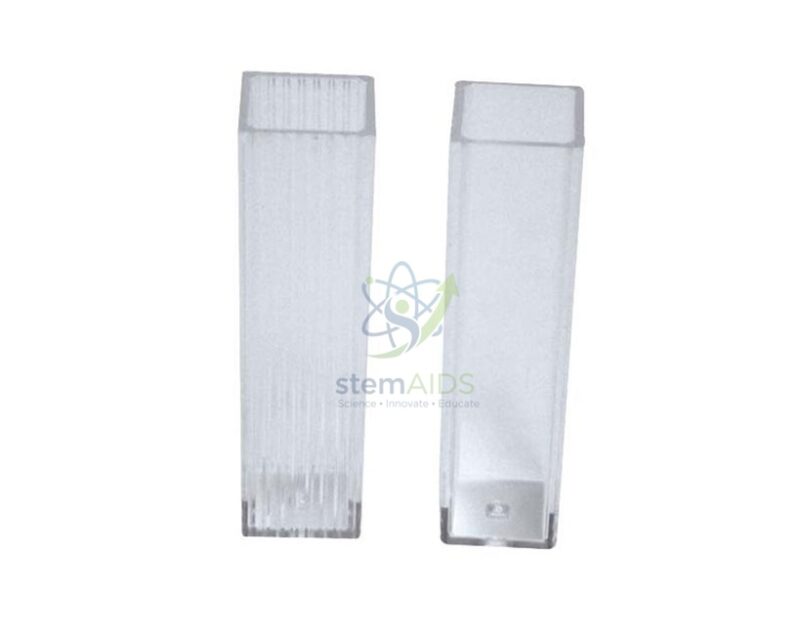
The listing image shows two cuvettes of the familiar square design: two opposite walls are smooth and clear, and the other two are ribbed. The clear faces are the optical windows through which the light beam passes. The ribbed sides give a grip that keeps fingerprints off the windows and show which way round the cell must go into the holder.
The title does not state the plastic or the path length. Most disposable cells are polystyrene, which transmits well across roughly 340 to 800 nm, or PMMA (acrylic), which reaches a little further into the near ultraviolet. Below about 300 nm neither is suitable and quartz cells are used. Standard cells have a 10 mm internal path length, but confirm that this matches your instrument and method.
Both plastics are attacked by many organic solvents; acetone, for example, dissolves polystyrene. They are intended for aqueous solutions, as in most school and college colorimetry. Filling with a Pasteur pipette avoids splashing the clear faces.
Specifications
| Item | Square-section cuvette with two clear optical faces |
| Material | Clear plastic (commonly polystyrene or PMMA); type to be confirmed |
| Useful range | Visible light; not for deep ultraviolet work |
| Use | Usually disposable, single use |
| Path length and volume | Confirm at enquiry |
Applications
- Measuring the absorbance of copper(II) sulfate standards to plot a calibration graph
- Following the rate of a reaction by colour change, such as the fading of crystal violet in alkali
- Estimating protein by the biuret method, or glucose with colorimetric reagents, in biology labs
- Measuring the turbidity of bacterial cultures at 600 nm
Care & Handling
- Hold cuvettes by the ribbed sides only, and wipe the clear faces with lint-free tissue before each reading.
- Fill to about three-quarters so the light beam passes through liquid, not the meniscus.
- Use the same cell, or a matched one, for the blank and the samples in a series.
- Discard scratched cuvettes, since scratches scatter light and raise the reading.
Why Choose LabEquip
Colorimetry now features in school and college chemistry and biology, and disposable cells spare technicians from cleaning quartz. LabEquip lists these in its chemistry lab equipment range; send your instrument details and quantity through the contact page.
Frequently Asked Questions
Which way round does a cuvette go into the instrument?
The clear faces must line up with the light beam. Most holders have an arrow or mark showing the beam direction; the ribbed or frosted sides face sideways and are the ones you hold.
Can plastic cuvettes be used for ultraviolet measurements?
Only down to their lower limit, roughly 340 nm for polystyrene and around 300 nm for PMMA. Measurements such as DNA absorbance at 260 nm need quartz cells or special UV-transparent plastic cells.
Can I use acetone or ethanol in plastic cuvettes?
Acetone and many other organic solvents attack polystyrene and acrylic. Dilute aqueous ethanol is often tolerated, but for solvent-based samples use glass or quartz cells.
Can disposable cuvettes be reused?
They can be rinsed and reused for non-critical class work, but scratches and residues build up and affect readings. For accurate results, use a new cell for each series.
How full should a cuvette be?
Fill to about three-quarters of its height, enough for the beam to pass through liquid well below the meniscus. Overfilling risks spills into the instrument’s sample compartment.
What is a blank and why is it needed?
A blank is a cell containing the solvent or reagent without the coloured substance. Setting the instrument to zero absorbance with the blank removes the effect of the cell and solvent from each reading.
Last Updated: September 2026
You must be logged in to post a review.
Bestsellers





Reviews
There are no reviews yet.