












In Stock
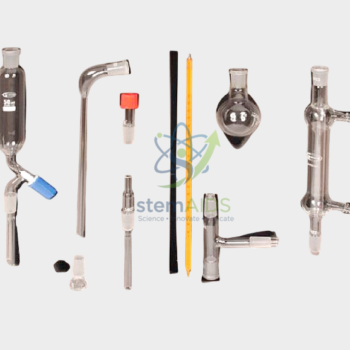
Cone Adapters, Right Angle Connection With Stop-cock
Integrated High-Precision Stopcock: Features a precision-bore glass or chemically inert PTFE plug designed for localized flow titration and airtight isolation within pressurized or vacuum-driven glass assemblies.
CNC-Ground Standard Taper Interfaces: Utilizes automated grinding technology to produce high-vacuum matte finishes on conical joints, ensuring leak-proof hermetic seals when integrated with standardized modular borosilicate apparatus.
₹560.00
Quick Answer: A cone adapter with stopcock is a glass fitting with a ground-glass cone, a stopcock tap and a side tube bent at a right angle. It connects a flask or apparatus to a gas or vacuum line and lets the connection be opened or closed at the joint, isolating the vessel without disconnecting the tubing.
Isolating a Vessel at the Joint
The tap is what separates this fitting from the plain angle and straight types. With the stopcock open, gas or vacuum passes between the tubing and the flask; turning it closes the flask off, so the flask can be taken away from the line, kept under an inert atmosphere or left under reduced pressure while the tubing is moved elsewhere. The right-angle side tube lets the tubing leave horizontally, which suits a flask clamped in a rack or standing beside a manifold.
The classic use is evacuate-and-refill: a flask containing an air-sensitive solid or solvent is connected, evacuated, then refilled with nitrogen or argon, and the cycle is repeated a few times before the tap is closed. The same fitting holds a dried flask under vacuum while it cools, lets air or gas into an evacuated flask gently, and vents pressure in a controlled way.
The title does not state the joint size, whether the stopcock key is glass or PTFE, or the bore of the tap. Glass keys need a thin film of grease; PTFE keys run dry. For lines that do not need a tap, see the angled cone adapter.
Applications
- Evacuate-and-refill cycles for storing or reacting air-sensitive materials under nitrogen
- Keeping an oven-dried flask under vacuum or dry gas while it cools
- Admitting air slowly to an evacuated flask after drying
- Isolating one flask from a shared gas or vacuum manifold
Specifications
| Joint end | Ground-glass cone |
| Control | Stopcock to open or close the line at the joint |
| Side tube | Right-angle connection for tubing |
| Uses | Inert gas and vacuum lines, isolating flasks, controlled venting |
| Joint size and stopcock key material | Confirm at enquiry |
Care & Handling
- Turn the stopcock gently; forcing a stiff glass key can break the barrel, and warm water around the barrel often frees it.
- Grease glass keys sparingly in two bands on either side of the bore, keeping the bore itself clear.
- Store with glass keys removed or loosened and a slip of paper in the barrel, and keep each key with its own adapter.
- Open the tap slowly when letting gas into an evacuated flask, so powders are not blown about.
Why Choose LabEquip
Research groups and advanced college labs that handle moisture- or air-sensitive chemistry use stopcock adapters on almost every flask. LabEquip provides this fitting from its chemistry lab equipment section; send the joint size and preferred key material through the contact page.
Frequently Asked Questions
Why choose an adapter with a stopcock?
The stopcock lets you close the flask off at the joint. You can then disconnect the tubing, move the flask, or keep it under vacuum or inert gas without air getting in.
Are stopcock keys in glass or PTFE preferable?
PTFE keys need no grease, so there is no grease contamination, and they rarely seize, but they must not be overtightened. Glass keys seal very well when lightly greased, but can stick if left unused or with dried grease.
How do I free a stuck glass stopcock?
Soak the barrel in warm water, then tap the key gently with a wooden handle while trying to turn it. Never use pliers or great force. Gentle warming of the barrel with a hair dryer can also soften old grease.
What does evacuate and refill mean?
It is a method of replacing the air in a flask with an inert gas. The flask is evacuated through the adapter, filled with nitrogen or argon, and the cycle is repeated two or three times so that very little air remains.
Can the adapter hold a flask under vacuum overnight?
A well-greased or PTFE stopcock and a sound ground joint can hold vacuum for long periods, but slow leaks at joints are common. Check the seal and secure the cone with a clip if a flask must be left sealed.
Which way should the tap point when open?
On most stopcocks the handle lines up with the flow path when open and lies across it when closed. Check by looking through the bore before use, since some designs differ.
Last Updated: September 2026
You must be logged in to post a review.
Bestsellers






Reviews
There are no reviews yet.