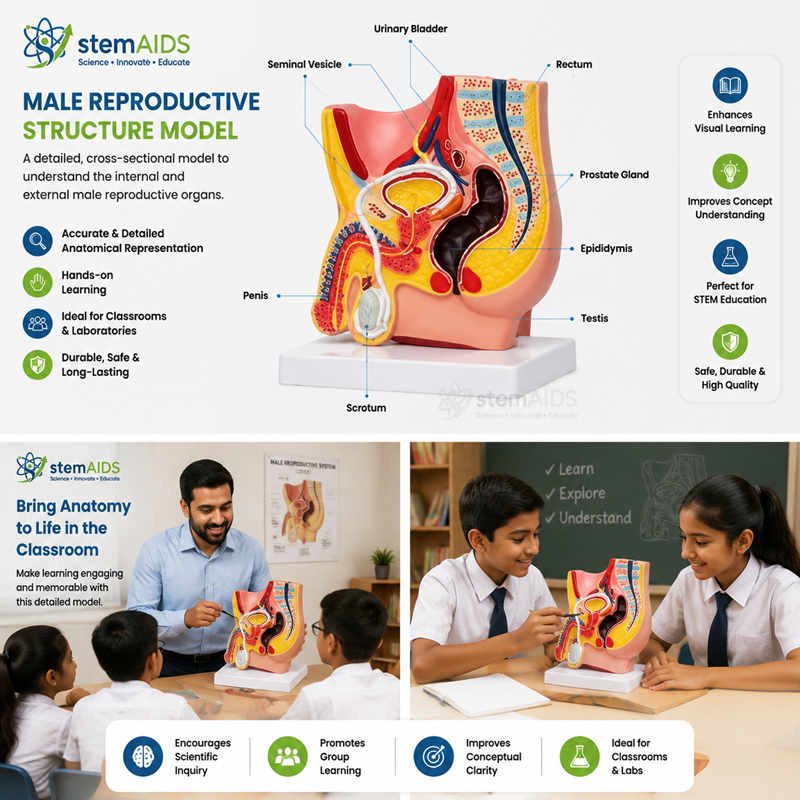
Quick Answer: The Male Reproductive Structure Model is a three-dimensional male reproductive system model for school and college biology, showing the general structure of the male reproductive organs during lessons on human reproduction and reproductive health.
Teaching Human Reproduction Clearly
Human reproduction is taught at several stages: in puberty and adolescence lessons in middle school, in the reproduction chapter around Class 10, and in more depth in senior biology. At each stage a physical model gives the teacher a neutral, scientific reference, which helps a class focus on correct terms rather than on embarrassment.
A lesson on the male system usually starts with the testes, where sperm and the hormone testosterone are produced, and explains why they sit in the scrotum outside the abdomen: sperm develop most successfully a little below normal body temperature. The route of sperm is then traced through the epididymis, where they mature and are stored, along the vas deferens, past the seminal vesicles and prostate gland, which add fluid to form semen, and out through the urethra.
Senior classes add the seminiferous tubules, spermatogenesis and hormonal control, while health lessons use the same structures to explain hygiene, sexually transmitted infections and why some conditions affect fertility.
Classroom Applications
- Puberty lessons on physical changes and the role of testosterone
- Tracing the pathway of sperm from the testes to the urethra
- Comparing male and female gametes and where each is produced
- Reproductive health sessions led by a biology teacher or school nurse
Specifications
| Item | Male reproductive structure model, three-dimensional |
| Body system | Male reproductive system |
| Curriculum use | Human reproduction, puberty and reproductive health |
| Intended users | Biology teachers in schools and colleges |
Care & Handling
- Keep the model in a closed cabinet between lessons so it comes out only for planned, supervised teaching.
- Dust it with a soft brush; avoid spray cleaners and solvents.
- Set it on a non-slip mat during group work so it cannot be knocked off a desk.
Why Choose LabEquip
Schools almost always teach this topic with both systems side by side, so the model is usually ordered with the Human Female Reproductive Anatomy Model. You will find both in our Anatomy Models section; the LabEquip contact page is the place to request the number you need.
Related Products
- Human Female Reproductive Anatomy Model: The female reproductive model, so both systems can be compared side by side in one unit.
- Human Reproductive System, Charts, School Education: Reproductive system wall charts with labelled male and female organs for revision.
- Human Male Genital Organs: A male genital organs model with partly sectioned views of the testis and accessory glands.
- Human Adult Male Pelvis Structural Model: A male pelvis model that shows the bony ring surrounding the reproductive and urinary organs.
Frequently Asked Questions
What are the main parts of the male reproductive system?
The male reproductive system is made up of the two testes, held in the scrotum, where sperm and testosterone are produced; the epididymis, where sperm mature; the vas deferens or sperm ducts; the seminal vesicles and prostate gland, which add fluid; and the urethra and penis. The Male Reproductive Structure Model gives a neutral reference for naming each part.
Why are the testes outside the body in the scrotum?
Sperm develop best at a temperature a little below normal body temperature. Holding the testes in the scrotum, outside the abdomen, keeps them cooler, and small muscles draw them closer to the body in cold conditions to keep the temperature steady.
What is the pathway of sperm from the testes to the urethra?
Sperm are made in coiled tubules inside the testes and move into the epididymis, where they mature and are stored. During ejaculation they travel along the vas deferens, receive fluid from the seminal vesicles and prostate gland to form semen, and leave the body through the urethra. Tracing this route on the model is a common labelling task.
Which hormone controls male puberty?
Testosterone, made in the testes, brings about the changes of male puberty: growth of the reproductive organs, a deeper voice, facial and body hair and greater muscle mass. Its production is triggered by hormones released from the pituitary gland in the brain, which senior biology students study under hormonal control.
How can a model help teach reproduction to a class sensitively?
A model gives the class a neutral, scientific object to focus on, so the teacher can use correct terms calmly and students can ask about structures rather than about people. Agreeing ground rules at the start, keeping questions anonymous where possible and pairing the model with a labelled chart all help keep the lesson factual and comfortable.
Should the male and female reproductive models be taught together?
Many teachers introduce both systems in the same unit so they can compare them directly: sperm and eggs as gametes, testes and ovaries as the organs that make them, and testosterone, oestrogen and progesterone as the main hormones. Using the male and female models side by side makes these comparisons concrete before the lesson moves on to fertilisation.
Last Updated: November 2026