





In Stock
Conductivity Tester
$5.87
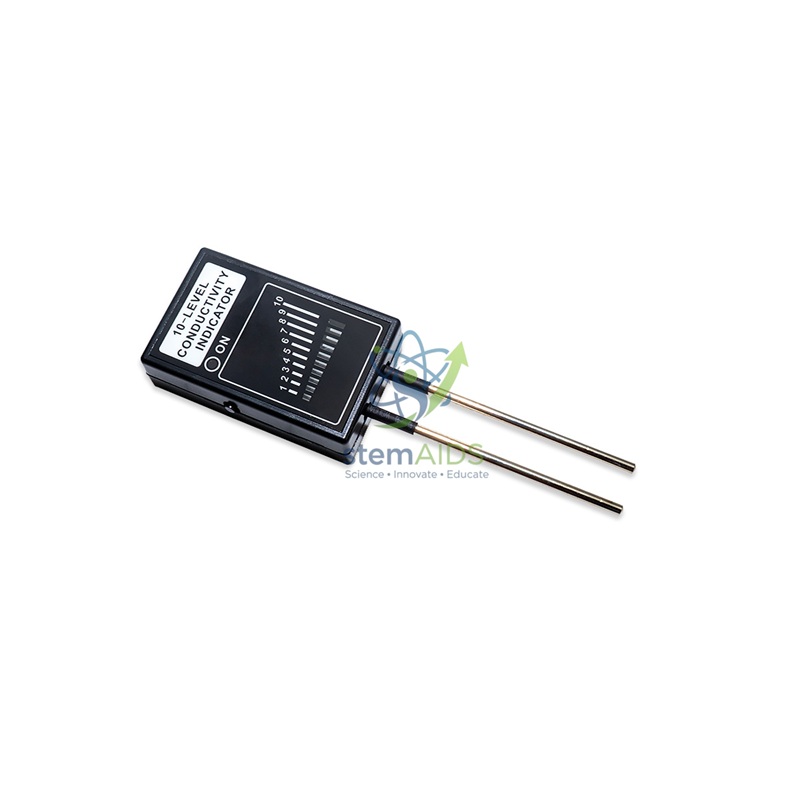
Quick Answer: The conductivity tester is a handheld probe that shows how well a solution or wet sample conducts electricity. The listing photo shows a black unit labelled ’10-Level Conductivity Indicator’, with an ON lamp, a ten-step bar display and two metal prongs that are dipped into the sample.
From Lit Bars to Ions in Solution
This handheld tester answers a simple question quickly: does this liquid carry a current, and roughly how well? With both prongs in a sample, the tester applies a small voltage between them and the display lights more bars as more current flows. Distilled water should light very few bars, while a strong salt solution lights many more.
The reason is ions. Ionic compounds such as sodium chloride dissolve into charged particles that move between the prongs, while sugar and ethanol dissolve as neutral molecules and conduct hardly at all. Comparing equal concentrations of hydrochloric and ethanoic acids shows the difference between strong and weak electrolytes, because the weak acid is only partly ionised.
The ten levels are a comparison scale, not a calibrated reading. For values in microsiemens per centimetre, a laboratory conductivity meter is required, or the wireless conductivity sensor, which logs readings to a device. The tester’s strength is speed: one dip gives a visible answer that the whole group can see at once.
Specifications
| Item | Handheld conductivity tester |
| Display | Ten-level bar indicator with ON lamp (photo) |
| Probe | Two parallel metal prongs (photo) |
| Output | Relative conductivity level, not a calibrated value |
| Power source | Confirm at enquiry |
Applications
- Sorting solutions into strong, weak and non-electrolytes
- Showing that solid salt does not conduct while its solution does
- Comparing tap, distilled, rain and mineral water samples
- Tracking how conductivity rises as more salt is dissolved in water
Care & Handling
- Rinse the tester’s prongs with distilled water and dry them between samples to avoid carrying ions across.
- Dip only the prongs, never the body of the tester, into liquids.
- Switch the tester off at the end of each session.
- Wipe deposits off the prongs with a soft cloth rather than scraping them with metal tools.
Why Choose LabEquip
Lower-secondary science teachers and chemistry departments teaching electrolytes buy conductivity testers because students get a visible answer in seconds. LabEquip lists this tester in its chemistry lab equipment; ask about sets for group work on the contact page.
Frequently Asked Questions
What does the 10-level display show?
It shows relative conductivity: more bars light as the sample conducts better. The levels let samples be ranked and compared, but they are not calibrated units.
Why does distilled water barely register?
Distilled water contains very few ions, so almost no current flows between the prongs. Dissolving an ionic substance such as salt adds ions and the reading rises.
Why does sugar solution not conduct?
Sugar dissolves as whole, uncharged molecules. With no ions to carry charge between the prongs, the current stays close to zero, just as in pure water.
How is a conductivity tester different from a laboratory conductivity meter?
A tester gives a quick relative indication for classifying samples. A laboratory conductivity meter uses a calibrated cell and temperature compensation to report conductivity in microsiemens or millisiemens per centimetre.
Can it test solids?
Only in some cases. Dry salt crystals do not conduct because their ions cannot move, although the same salt conducts once dissolved. A piece of metal touching both prongs does conduct, because metals carry current through free electrons.
How should the prongs be cleaned?
Rinse them with distilled water after every sample and wipe them dry. Residue from the previous solution adds ions to the next sample and gives a falsely high reading.
Last Updated: September 2026
You must be logged in to post a review.
Bestsellers





Reviews
There are no reviews yet.