







In Stock
Cobalt Glass Plates
₹235.00
Quick Answer: Cobalt glass plates are square pieces of deep blue glass used as filters in flame tests. Viewed through cobalt glass, the strong yellow glow of sodium is absorbed, so the faint lilac flame colour of potassium can be seen even in a sample contaminated with sodium.
Why Flame Tests Need Blue Glass
Sodium is almost everywhere: in tap water, on fingers and as an impurity in many salts. In a flame test even a trace of it gives an intense yellow-orange colour that swamps weaker colours, and potassium’s lilac is one of the weakest. Cobalt-coloured glass absorbs strongly in the yellow part of the spectrum, where sodium’s emission lies, while letting violet and some deep red light through. Through the glass a potassium flame appears violet to crimson-purple, and the sodium glare disappears.
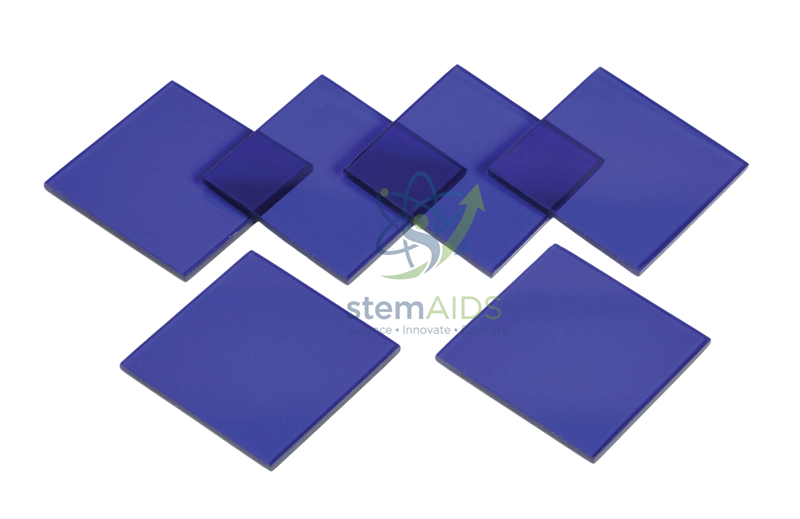
The listing photo shows several flat, square plates of deep blue glass. In use, a student holds one plate close to the eye, well away from the heat, while a partner introduces the sample on a flame-test wire. Where sodium contamination is heavy, looking through two plates together filters more strongly.
Cobalt glass is a quick qualitative filter, not a spectroscope. Record each flame colour both with and without the glass, because colours such as calcium’s brick-red and lithium’s crimson also look different through it, and students should learn which observation belongs to which condition.
Applications
- Confirming potassium in flame tests on salts contaminated with sodium
- Qualitative inorganic analysis practicals identifying unknown metal ions
- Demonstrating light absorption by coloured glass, comparing a flame seen with and without the filter
Specifications
| Item | Cobalt blue glass filter plates |
| Form | Flat square plates of deep blue glass (photo) |
| Function | Absorbs the yellow light of sodium in flame tests |
| Main use | Detecting potassium in the presence of sodium |
| Plate size and quantity | Confirm at enquiry |
Care & Handling
- Hold the cobalt glass plates away from the flame; glass heated along one edge can crack.
- Clean them with water and a soft cloth, since fingerprints and soot reduce the light reaching the eye.
- Store the plates flat, separated by paper, so that their faces are not scratched.
- Check the edges for chips before handing plates to students.
Why Choose LabEquip
Chemistry teachers running flame tests for qualitative analysis, from secondary school to first-year college, are the buyers of cobalt glass plates. LabEquip lists them in its chemistry range; enquiries for class sets go through the contact page.
Frequently Asked Questions
Why is cobalt glass used in flame tests?
It absorbs the bright yellow light from sodium, which otherwise masks other flame colours. Through the glass, the lilac of potassium becomes visible even when some sodium is present.
What colour does a potassium flame look through cobalt glass?
It appears violet to crimson-purple, because the glass passes the violet and deep red parts of the potassium emission while blocking the sodium yellow.
Can cobalt glass identify every metal ion?
No. It is mainly used to pick out potassium when sodium is present. Ions such as lithium, calcium, copper and barium are identified from their flame colours without the filter.
How close to the flame should the plate be held?
Hold it close to your eye and at a comfortable distance from the flame, so that the glass stays cool. Glass heated unevenly at one edge can crack.
Why does sodium contaminate so many flame tests?
Sodium compounds are present in tap water, dust and sweat, and sodium gives an extremely intense yellow emission. Even a trace on the wire or in the sample produces a strong yellow flash.
How can contamination on the flame-test wire be reduced?
Dip the wire in clean hydrochloric acid and hold it in the flame, repeating until the flame shows no colour, before each test. Separate wires for different samples help further.
Last Updated: September 2026
You must be logged in to post a review.
Bestsellers





Reviews
There are no reviews yet.