



In Stock
Chemistry Labware Kit
$7.33
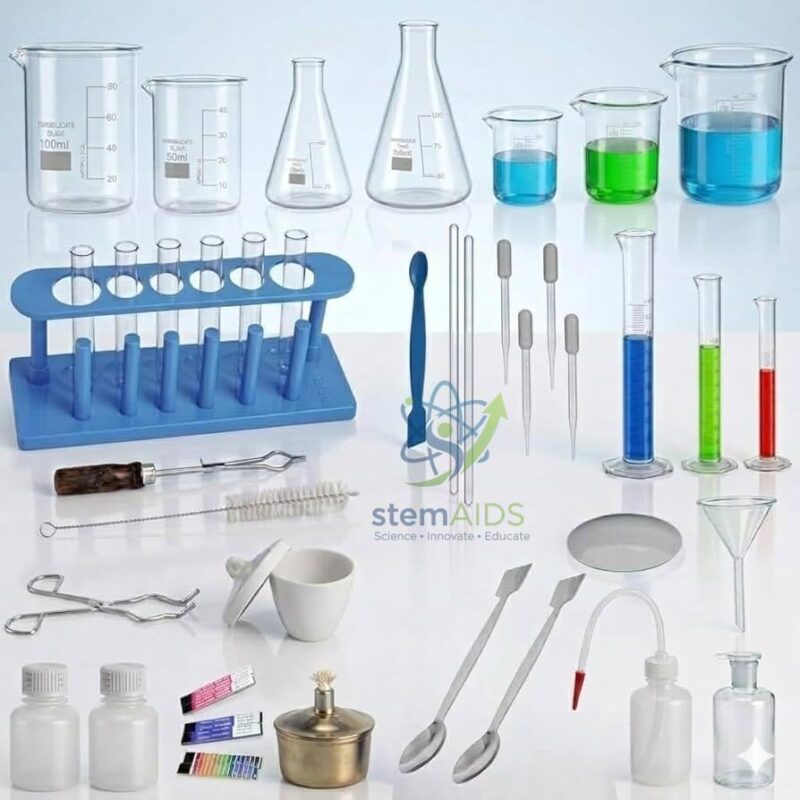
Quick Answer: The chemistry labware kit is a starter set of glassware, measuring vessels and handling tools for basic school chemistry practicals. Its listing image shows beakers, conical flasks, measuring cylinders, test tubes in a rack, droppers, a funnel, a crucible and hand tools, although the picture looks illustrative, so the actual contents should be confirmed.
A Starter Set for Everyday Practicals
Most lower-secondary chemistry practicals call on the same handful of items: something to measure a liquid, something to mix or heat it in, a way of holding a test tube, and tools for moving solids. A labware kit brings those together so that a new laboratory, a science club or an extra teaching room can start running practical lessons without assembling everything item by item.
The listing image shows a typical selection: graduated beakers and conical flasks, measuring cylinders, test tubes in a plastic rack, a test-tube holder and brush, plastic droppers, glass rods, spatulas, a porcelain crucible with lid, crucible tongs, a watch glass, a funnel, a wash bottle, bottles, indicator papers and a spirit lamp. The picture appears to be an illustration rather than a photograph of the packed kit, so treat it as a guide to the kind of contents rather than a packing list.
Used together, pieces like these cover the core skills of a first chemistry course: reading a meniscus in a measuring cylinder, dissolving and filtering, heating a small sample, using an indicator and recording observations. For clamping and supporting apparatus over a heat source, the chemistry hardware assortment is the natural companion.
Applications
- Setting up a new or temporary chemistry room for lower-secondary practicals
- Science clubs and after-school sessions that need a self-contained set of basic apparatus
- Introductory skills lessons on measuring volumes, dissolving, filtering and heating
- Replacing a mixed collection of worn items with one matched set
Specifications
| Item | Starter kit of chemistry labware for school practicals |
| Vessels shown | Beakers, conical flasks, measuring cylinders, test tubes with rack (image) |
| Small tools shown | Droppers, glass rods, spatulas, test-tube holder, brush (image) |
| Heating items shown | Crucible with lid, crucible tongs, spirit lamp (image) |
| Exact contents and quantities | Confirm at enquiry |
Care & Handling
- Inspect the glassware in the chemistry labware kit for chips and star cracks on arrival and before each use; set damaged pieces aside.
- Rinse items straight after use, wash with detergent and a brush, and finish with a distilled-water rinse.
- Heat only items intended for heating, and never plastic pieces such as droppers, bottles or the rack.
- Store glassware in a drawer or tray with dividers so that pieces cannot roll against each other.
Why Choose LabEquip
Schools opening a new lab and teachers equipping a science club are the usual buyers of a starter kit like this. LabEquip lists it with its chemistry lab equipment and can help match quantities to class size through the contact page.
Frequently Asked Questions
What does the chemistry labware kit contain?
The listing image shows beakers, flasks, measuring cylinders, test tubes with a rack, droppers, spatulas, a crucible, tongs, a funnel and bottles. The image appears illustrative, so ask for the exact contents and quantities when you enquire.
Is the kit suitable for heating experiments?
Some items are meant for heating, such as the porcelain crucible, and the image includes a spirit lamp. Plastic items must never be heated, and glassware should be checked for its heat rating before use over a flame.
Which skills can students practise with it?
Measuring liquid volumes, dissolving and filtering, heating a small sample, testing with indicator paper and transferring solids with a spatula. These are the core practical techniques of a first chemistry course.
How should the glassware be cleaned?
Rinse it straight after use, wash with warm water, detergent and a suitable brush, then rinse with distilled water and leave to drain. Residues that dry on are much harder to remove, so do not leave items unwashed overnight.
What should be added for clamping apparatus?
A kit of this kind is mainly vessels and small tools. For tripods, clamps, rings and gauzes, add a hardware set such as the chemistry hardware assortment.
Is one kit enough for a whole class?
One kit suits a demonstration bench or a small group. For a full class working in groups, plan on one kit per group, or add extra beakers, tubes and cylinders to a single kit.
Last Updated: September 2026
You must be logged in to post a review.
Bestsellers





Reviews
There are no reviews yet.