













In Stock
Human Small Spine Model with Fold-Out Guide
₹1,450.00
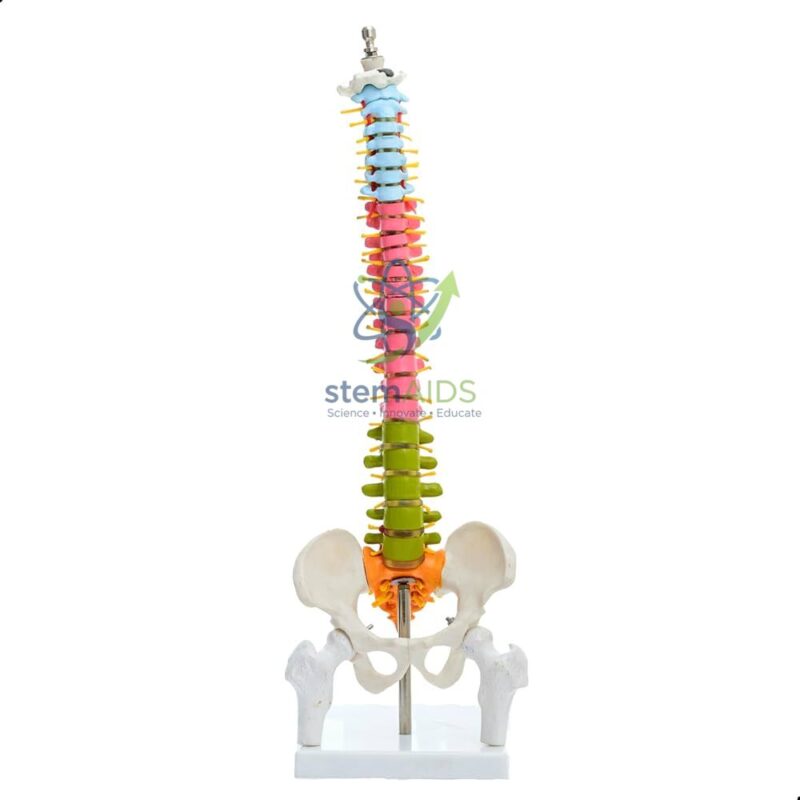
Quick Answer: The Human Small Spine Model with Fold-Out Guide is a reduced-size model of the human vertebral column supplied with a printed fold-out guide. The listing photograph shows the column standing on a base with the pelvis attached and the spinal regions picked out in different colours, for teaching vertebral regions, curves and spine anatomy at the desk.
The Whole Column at Desk Size
A life-size spine is too tall to pass around a classroom. A small spine model keeps every region of the column in view at once while fitting on a desk, which makes it well suited to group work and revision. Students can count down from the skull end: seven cervical vertebrae in the neck, twelve thoracic vertebrae carrying the ribs, five large lumbar vertebrae in the lower back, then the sacrum, formed from five fused vertebrae, and the small coccyx at the tail end.
Seen from the side, the column is not straight. The neck and lower back curve forwards and the chest and sacral regions curve backwards, giving an S-shape that absorbs shock and keeps the head balanced over the pelvis. The chest and sacral curves are present at birth; the neck and lower back curves develop as a baby lifts its head and then learns to stand. The colour-coded regions in the listing photograph make these zones easy to separate at a glance.
The fold-out guide named in the title is a printed key that names the parts, so students can check their answers without a separate textbook. The model’s height, how the vertebrae are joined, whether discs, nerves or the spinal cord are shown and the language of the guide are not stated. For a larger model that includes the spinal cord, see the vertebral column with partial spinal cord.
Specifications
| Model of | Human vertebral column with pelvis, reduced size |
| Mounting | On a base, per the listing photograph |
| Regions | Cervical, thoracic, lumbar, sacrum and coccyx; colour-coded in the listing photograph |
| Guide | Printed fold-out guide, per the title |
| Height, discs and guide language | Confirm at enquiry |
Applications
- Counting and naming vertebrae by region in secondary biology
- Explaining the spinal curves and how they develop from infancy
- Introducing slipped discs and posture in health education
- Desk-top revision for nursing, physiotherapy and sports-science students
Care & Handling
- Carry the model by its base, not by the column, which can bend or detach at the joints.
- Keep the fold-out guide with the model; it is easily lost when stored separately.
- Dust with a soft brush and store under cover, away from heat and sunlight.
Why Choose LabEquip
Small spine models are chosen by schools and training centres that want every group to have its own spine on the table. LabEquip lists this one in Biology Lab Products with larger vertebral models, including the lumbar vertebrae model for close study of individual bones. Confirm size and guide details through the LabEquip contact page.
Frequently Asked Questions
How many vertebrae are in each region of the spine?
There are seven cervical, twelve thoracic and five lumbar vertebrae. Below them the sacrum is five vertebrae fused into one bone, and the coccyx is a few small fused vertebrae at the base.
Why does the spine curve instead of being straight?
The S-shape spreads loads and absorbs shock when walking and jumping. It also keeps the head and upper body balanced over the pelvis with little muscular effort.
What does the fold-out guide provide?
It is a printed key that names the parts shown on the model, so students can identify vertebrae and regions on their own. Its level of detail and language can be confirmed with LabEquip before ordering.
How does a small spine model compare with a full-size one?
It shows the same regions and curves at a scale that fits on a desk and is easy to pass around. Fine details of individual vertebrae are easier to study on larger models or on single-vertebra sets.
Where do disc problems most often occur?
Most often in the lower lumbar region, between the last lumbar vertebrae and the sacrum, where the load is greatest and the spine bends most. The model helps students locate this area.
Does the model show the spinal cord and nerves?
The title and listing photograph show the bony column and pelvis only. For teaching the spinal cord and nerve roots, choose a vertebral column model that includes the cord.
Last Updated: September 2026
You must be logged in to post a review.
Bestsellers




Reviews
There are no reviews yet.