
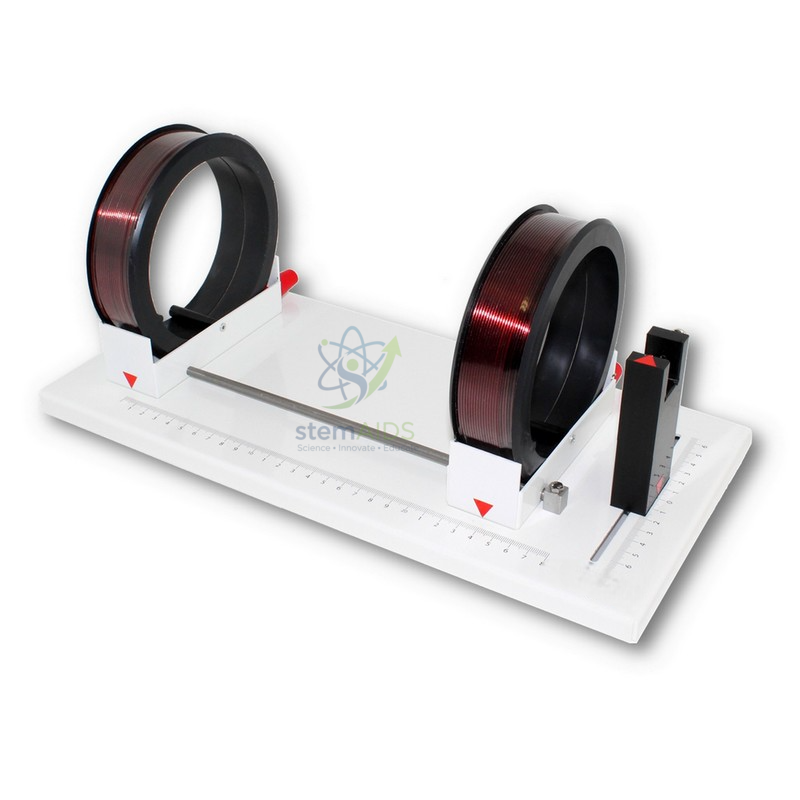
Quick Answer: These variable-spacing flat coils are a pair of short, flat coils mounted face to face on a graduated base, so the distance between them can be changed while the magnetic field along their common axis is measured. Setting the spacing equal to the coil radius gives the Helmholtz arrangement, where the field in the middle is nearly uniform.
The Field of One Flat Coil
A flat circular coil carrying current produces a magnetic field that is strongest at its centre, B = μ₀NI/2R for N turns of radius R, and falls away along the axis on either side. One coil alone therefore gives a field that changes from place to place, which is a problem for experiments that need a steady field over a region.
In the product photograph the two coils stand upright on a white base with a scale along its edge and a carriage with a black probe holder between them. Each coil can be slid along the base, so the gap can be set to any value within the base length.
Two Coils and the Helmholtz Condition
With both coils carrying current in the same direction, their fields add along the axis. If the coils are far apart, the field dips in the middle; if they are very close, it peaks there. Exactly between these lies the Helmholtz spacing, equal to the coil radius, where the dip and the peak cancel and the field in the central region is nearly uniform.
The variable-spacing flat coils let students find this condition experimentally rather than accept it. Mapping the field for several spacings and plotting the results side by side shows the change from dip to flat to peak very clearly.
Investigations
- Mapping the axial field of a single flat coil
- Finding the spacing that gives the most uniform field between two coils
- Showing the zero-field midpoint and steady gradient when the currents oppose
- Checking that the field at the centre is proportional to the current
Specifications
| Product | Pair of flat coils with variable spacing |
| Mounting | Base with scale; coils slide to set the gap |
| Accessory in photograph | Carriage with probe holder between the coils |
| Arrangements | Helmholtz spacing, wider or narrower gaps, aiding or opposing currents |
| Number of turns and coil radius | Confirm at enquiry |
Care & Handling
- Connect the coils in series so both carry exactly the same current
- Keep the current within the coil rating and switch off between readings so the windings stay cool
- Slide the coils gently and tighten any locks without force
- Keep steel objects away from the measuring region to avoid distorting the field
Why Choose LabEquip
Colleges and advanced-level schools use variable-spacing coils to teach field superposition with real data instead of diagrams. LabEquip supplies them with the maximum flux coil and the protected solenoid among its physics equipment; turn and radius details can be confirmed through the contact page.
Frequently Asked Questions
What is the Helmholtz spacing?
It is a separation between the two coils equal to their radius. At this spacing, with equal currents in the same direction, the field in the central region between the coils is nearly uniform.
What happens if the coils carry opposing currents?
The fields cancel at the midpoint, giving zero field there, with a field that increases steadily in either direction along the axis. This arrangement is used where a steady field gradient is wanted.
How is the field between the coils measured?
A Hall-effect probe connected to a teslameter is moved along the axis on the carriage. Zero the meter with the coil current off so the background field is removed from the readings.
Why should the coils be connected in series?
In series both coils carry exactly the same current, which the Helmholtz condition requires. In parallel, small differences in coil resistance would give unequal currents.
Why do the coils warm up during long runs?
The current heats the windings as it flows through their resistance. Switching off between readings and keeping the current moderate keeps the coils cool and the resistance steady.
Can the coils be used for electron beam experiments?
Helmholtz coils are commonly used to deflect electron beams, but the coil size must suit the tube. Whether this pair fits a particular tube should be checked against the tube’s dimensions.
Last Updated: October 2026




Reviews
There are no reviews yet.