










Sale
In Stock
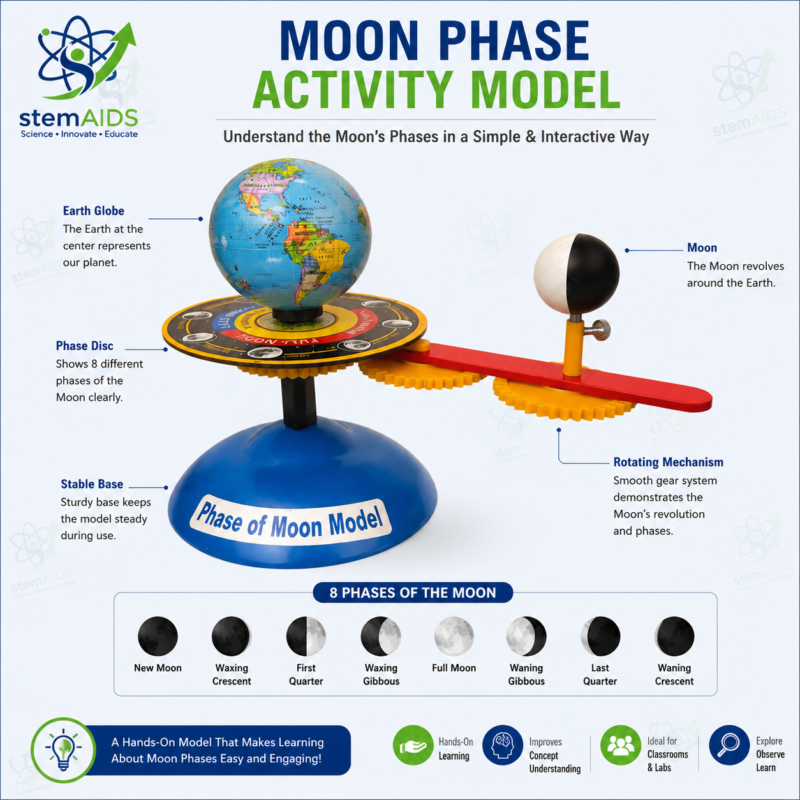
Moon Phase Activity Model
Original price was: ₹600.00.₹290.00Current price is: ₹290.00.
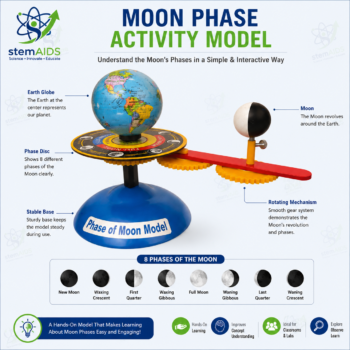
Quick Answer: The Moon Phase Activity Model is a hands-on teaching aid that students use themselves to work out why the Moon’s shape changes during the month. Instead of watching a demonstration, they position the Moon relative to Earth and the Sun, predict the phase and record what they see.
Learning the Lunar Cycle by Doing It
Phases are easy to recite and surprisingly hard to explain. A moon phase activity model puts the explanation in students’ hands: working in pairs or small groups, they place the Moon at a point in its orbit, work out which part of its sunlit half faces Earth, and then sketch or match the resulting shape. Repeating this round the orbit builds the sequence from new moon to full and back again, and students discover the pattern rather than memorising it.
That active approach is the main difference from the Phases of Moon Working Model, a mechanical model the teacher operates in front of the class. Many schools use the working model to introduce the idea and then the activity model for group practice and assessment, because a student who can place the Moon correctly for a waning crescent has clearly understood the geometry.
Linking the Activity to the Real Sky
The activity becomes more convincing when it is tied to observation. Over four weeks students can keep a Moon diary, drawing the shape each clear evening and noting when it rises. The activity model then explains what they recorded: why a first-quarter Moon is high in the south at sunset, and why the full Moon rises in the east just as the Sun sets in the west.
Specifications
| Type | Student activity model for the lunar cycle |
| Learning focus | Positions of Sun, Earth and Moon for each phase |
| Format | Hands-on use by pairs or small groups |
| Level | Upper primary and middle-school science |
| Components and size | Confirm at enquiry |
Classroom Activities
- Group work placing the Moon for a named phase and checking each other’s answers
- Predicting the phase that follows a given one, then testing with the model
- Supporting a month-long Moon observation diary
- Short assessment tasks where students explain one phase using the model
Care & Handling
- Hand out one moon phase activity model per group and collect it with all parts counted at the end of the lesson.
- Keep small pieces in a labelled bag or tray so sets stay complete.
- Clean surfaces with a dry cloth; keep printed parts away from water.
Why Choose LabEquip
Teachers who want every group working with its own model, rather than watching one demonstration, tend to order several of these. LabEquip includes the activity model in its Astronomy Lab Kits section; send class-set quantities through the LabEquip contact page.
Frequently Asked Questions
How is the activity model different from a working model?
A working model has moving parts that the teacher turns to demonstrate the cycle to the whole class. An activity model is designed for students to handle, place and record the phases themselves, which makes it better for group work and checking understanding.
Why does the full Moon rise at sunset?
At full moon the Moon lies on the opposite side of Earth from the Sun. As Earth turns, the Sun sets in the west at about the same time the Moon rises in the east, and the Moon stays up all night.
Can the Moon be seen during the day?
Yes. Around first quarter it is visible in the afternoon sky, and around last quarter it can be seen in the morning. Spotting it in daylight surprises many students and makes a good starting question.
What does gibbous mean?
A gibbous Moon is more than half lit but not yet full. It occurs between first quarter and full moon while waxing, and between full moon and last quarter while waning.
In what order do the phases come?
New moon, waxing crescent, first quarter, waxing gibbous, full moon, then waning gibbous, last quarter and waning crescent before the next new moon. The whole sequence takes about 29.5 days.
How can students check their model against the real Moon?
Ask them to keep a Moon diary for a month, drawing its shape and noting the time and direction each clear evening. Comparing the drawings with the model shows that their predicted sequence matches the sky.
Last Updated: September 2026
You must be logged in to post a review.
Bestsellers
Sale

Sale
Sale
Sale
Sale
Sale
Sale


Reviews
There are no reviews yet.