
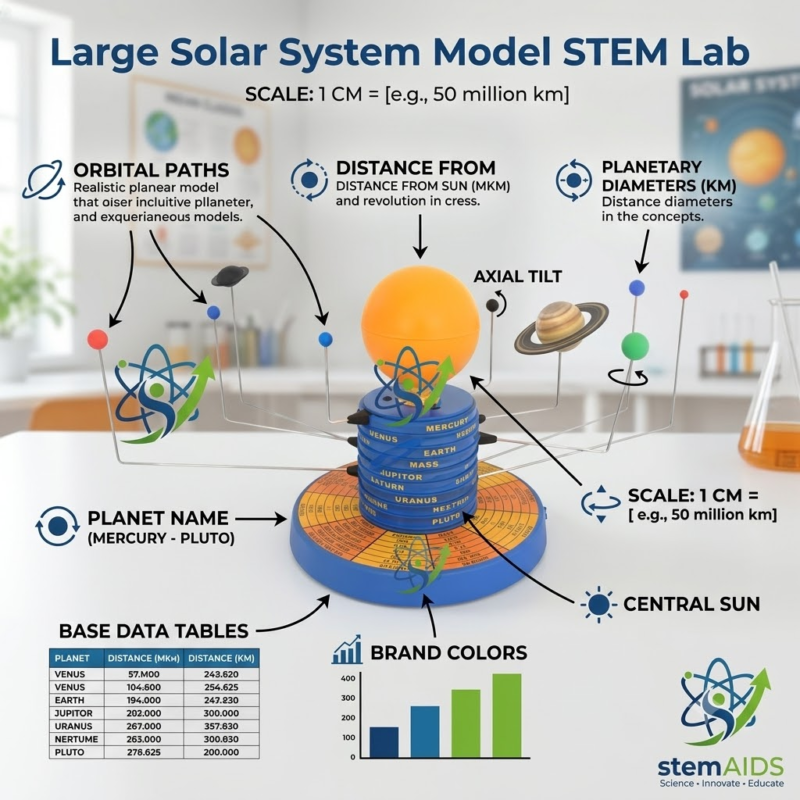
Quick answer: The Large Solar System Model is an enlarged-format astronomy display representing the Sun and all eight planets — Mercury, Venus, Earth, Mars, Jupiter, Saturn, Uranus and Neptune — for classroom demonstrations, exhibitions and group astronomy instruction.
Product Description
The LabEquip Large Solar System Model represents the Sun and the eight recognised planets in the Solar System. Its enlarged presentation is intended to make each body easier to identify during classroom demonstrations, exhibitions and astronomy activities, especially with larger groups of students.
The model supports instruction on planetary order, and the distinction between terrestrial and giant planets.
Specifications
| Specification | Detail |
|---|---|
| Product name | Large Solar System Model |
| Brand | LabEquip |
| Product category | Astronomy laboratory apparatus; large-format Solar System model |
| Bodies represented | Sun, Mercury, Venus, Earth, Mars, Jupiter, Saturn, Uranus, Neptune |
Suggested Use
- Set up the model on a stable surface or mounting point visible to the whole class or group.
- Use it to point out planetary order moving outward from the Sun.
- Discuss the difference between terrestrial planets (Mercury, Venus, Earth, Mars) and giant planets (Jupiter, Saturn, Uranus, Neptune).
- Use during exhibitions, science fairs or group demonstrations where visibility from a distance matters.
Care & Maintenance
- Dust each planet component periodically to keep colours and surface details visible.
- Handle larger components carefully to avoid dropping or denting.
- Store components in a padded or protective container when not in use.
- Keep away from direct sunlight and excess heat to reduce fading or warping.
Why Choose LabEquip
For related Solar System teaching resources, see our Hanging Planetary System Display, Planisphere, or visit the LabEquip homepage to browse our full catalogue of astronomy lab kits.
Related Products
- Hanging Planetary System Display: A hanging display of the planets for permanent ceiling display in the classroom between lessons.
- Solar System Working Model: A working model in which the planets move around the Sun, for teaching revolution and orbit speed.
- Sun Structure Model: Shows the internal layers of the Sun, the largest body in the model.
- Astronomical Telescope F36050: A small refracting telescope for seeing Jupiter’s moons and Saturn’s rings for real.
Frequently Asked Questions
Which bodies are included in the Large Solar System Model?
It represents the Sun and the eight planets: Mercury, Venus, Earth, Mars, Jupiter, Saturn, Uranus and Neptune. Its enlarged format is meant for demonstrations and exhibitions, where each body needs to be recognised from across a room or hall.
What is the difference between the terrestrial planets and the giant planets?
The four inner planets, Mercury, Venus, Earth and Mars, are small and rocky with solid surfaces. The four outer planets are giants: Jupiter and Saturn are mostly hydrogen and helium gas, while Uranus and Neptune contain more ices. The giants also have many moons and ring systems.
Which is the largest planet and which is the smallest?
Jupiter is the largest planet, more than eleven times Earth’s diameter. Mercury is the smallest of the eight planets. Placing the two side by side on a large model makes the difference memorable, and students can then rank the rest by size.
How much bigger is the Sun than the Earth?
The Sun’s diameter is about 109 times Earth’s, so more than a million Earths would fit inside it by volume. Even a large classroom model cannot show this at true scale alongside the planets, which is a useful point to make when presenting the model.
Do any planets other than Saturn have rings?
Yes. Jupiter, Uranus and Neptune all have ring systems, but they are thin and dark and were only discovered with spacecraft and modern telescopes. Saturn’s rings are bright because they are made largely of water ice, which reflects sunlight well.
How can a large solar system model be used at a science exhibition?
Set it where visitors can walk around it and give each student presenter one or two planets to explain, covering size, distance from the Sun and a key fact. A short quiz card, such as asking visitors to find the hottest planet, Venus, keeps people engaged with the display.
Last Updated: November 2026



Reviews
There are no reviews yet.