
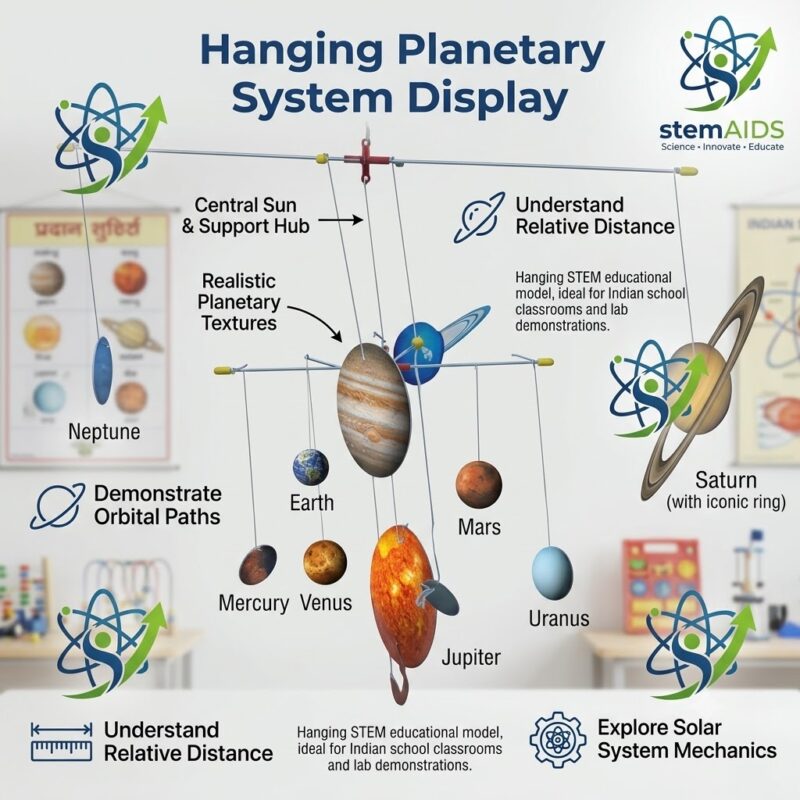
Quick answer: The Hanging Planetary System Display is a suspended classroom model that presents the Sun and planets in a three-dimensional arrangement, helping students understand planetary order and Solar System structure beyond a flat diagram.
Product Description
The LabEquip Hanging Planetary System Display provides a three-dimensional representation of the Solar System for science education. The suspended format allows learners to view planetary relationships vertically and observe the arrangement of celestial bodies in a way a flat diagram cannot show.
The display supports lessons on planetary sequence, Solar System structure, inner and outer planets, and basic space-science concepts.
Specifications
| Specification | Detail |
|---|---|
| Product name | Hanging Planetary System Display |
| Brand | LabEquip |
| Product category | Astronomy laboratory apparatus; suspended Solar System model |
| Primary function | Presenting the Sun and planets in a suspended classroom display |
Suggested Use
- Suspend the display from a ceiling fixture or classroom mounting point at a suitable height.
- Use it as a visual reference while teaching planetary order and Solar System structure.
- Point out the relative sequence of inner and outer planets around the Sun.
- Combine with other astronomy models for a broader space-science lesson.
Care & Maintenance
- Dust the suspended components periodically to keep colours and details visible.
- Check mounting hardware and strings periodically for wear before hanging or rehanging the display.
- Store components carefully when not displayed to avoid tangling or damage.
- Keep away from direct sunlight to reduce fading over time.
Why Choose LabEquip
For related Solar System teaching resources, see our Planisphere, or visit the LabEquip homepage to browse our full catalogue of astronomy lab kits.
Related Products
- Solar System Working Model: A working solar system model in which the planets can be moved to show revolution around the Sun.
- Large Solar System Model: A large solar system model for desk-level demonstrations and exhibitions where students can see each body up close.
- Sun Structure Model: A Sun structure model that explains the star at the centre of the planetary display.
- Planisphere: A planisphere for finding where in the night sky the bright planets can be spotted.
Frequently Asked Questions
How should a hanging planetary system display be mounted in a classroom?
Hang it from a secure ceiling point or beam, high enough that students cannot knock it but low enough to be read from the floor. Keep it clear of ceiling fans and open windows, which make the planets spin and tangle, and check the cords and fixings each time it is put up again.
What is the order of the planets from the Sun?
Mercury, Venus, Earth, Mars, Jupiter, Saturn, Uranus and Neptune. A memory sentence helps, such as My Very Educated Mother Just Served Us Noodles. With a hanging display, students can walk outwards from the Sun and name each planet as they pass under it.
Do the planets really line up in a row like in a display?
No. Each planet moves around the Sun at its own speed, so they are spread around their orbits and almost never sit in a line. Displays and mobiles arrange them in a row or spiral so all can be seen. A good discussion is to ask where each planet would really be today.
Which planets can be seen with the naked eye?
Mercury, Venus, Mars, Jupiter and Saturn are all visible without a telescope when they are well placed. Venus is the brightest and is often called the evening or morning star. Uranus is at the limit of vision under very dark skies, and Neptune needs binoculars or a telescope.
What keeps the planets moving around the Sun?
Gravity. The Sun’s pull keeps bending each planet’s path into an orbit, while the planet’s own motion stops it falling straight in. The farther a planet is from the Sun, the weaker the pull and the slower it travels, which is why the outer planets take many years to complete one orbit.
Is a hanging solar system display suitable for younger children?
Yes, because it is a display rather than a hands-on kit: younger pupils learn the names, colours and order of the planets just by looking up at it every day. Hang it out of reach and use it as a reference while teaching, rather than taking it down for handling.
Last Updated: November 2026





Reviews
There are no reviews yet.