
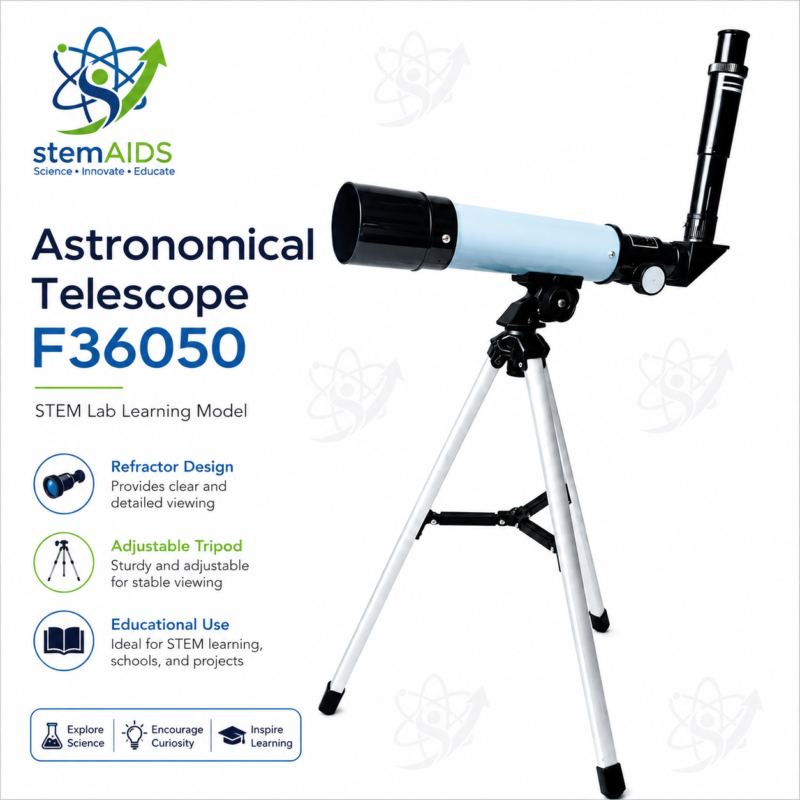
Quick Answer: The Astronomical Telescope F36050 is a small refracting telescope in which an objective lens gathers light and an eyepiece magnifies the image. In this common model code, 360 stands for a 360 mm focal length and 50 for a 50 mm objective, a size used for first views of the Moon, bright planets and star clusters.
How a Small Refractor Forms Its Image
A refracting telescope has no mirrors. The objective lens at the front bends incoming light to a focus near the back of the tube, forming a small, real, inverted image; the eyepiece then works like a magnifying glass on that image. Changing the eyepiece changes the magnification, while the objective decides how much light is collected and how fine the detail can be.
With a 50 mm objective and a 360 mm focal length, the F36050 works at roughly f/7.2, a moderate focal ratio that gives a reasonably wide, bright field at low power. That makes the Moon easy to find and follow, which matters for students using a simple altazimuth mount. It also sets realistic limits: a 50 mm instrument shows the rings of Saturn as a small ellipse and the four largest moons of Jupiter as points of light, but faint galaxies stay out of reach from a town.
Because the image through a refractor is upside down, sky views are unaffected but landscapes look inverted unless an erecting lens is fitted. Teachers often use this to open a discussion of how lenses form real and virtual images, linking the observing session back to ray diagrams from the optics syllabus.
Specifications
| Type | Refracting (lens) telescope for beginners |
| Model code | F36050: 360 mm focal length, 50 mm objective in the usual naming pattern |
| Focal ratio | About f/7.2 (360 divided by 50) |
| Magnification | Set by the eyepiece: telescope focal length divided by eyepiece focal length |
| Image orientation | Inverted through a plain eyepiece; an erecting lens corrects it for land views |
| Mount, tripod and eyepieces supplied | Confirm at enquiry |
What Students Can Observe
- Craters, mountain ranges and the day-night line (terminator) on the Moon, clearest a few days either side of first quarter
- Jupiter as a small disc with its four Galilean moons changing position from night to night
- The phases of Venus and the ring system of Saturn under steady skies
- Open star clusters such as the Pleiades, and double stars for astronomy club sessions
- Distant daytime targets, for aligning the finder and practising focusing
Care & Handling
- Keep the dust caps on the objective and eyepiece whenever the astronomical telescope F36050 is not in use.
- Blow loose dust off lenses with a rubber blower first; wipe only with lens tissue and a drop of lens cleaner, never with clothing.
- Bring the telescope in from a cold night with caps on and let it warm up before uncapping, so dew does not form on the optics.
- Carry the tube separately from the tripod and check the mounting screws before each session.
Why Choose LabEquip
Schools setting up an astronomy club, and teachers who want students to see the Moon for themselves after studying it from diagrams, usually start with a small refractor of this size. LabEquip lists it with teaching models in the Astronomy Lab Kits range, so it can be ordered with the Phases of Moon Working Model used for the indoor lesson. Send quantities and questions about accessories through the LabEquip contact page.
Frequently Asked Questions
What does F36050 mean on this telescope?
In the naming pattern used for beginner refractors, the first three digits give the focal length and the last two the objective diameter, both in millimetres: 360 mm and 50 mm. Dividing one by the other gives a focal ratio of about f/7.2.
How much magnification does it give?
Magnification depends on the eyepiece. Divide the 360 mm focal length by the eyepiece focal length: a 20 mm eyepiece gives 18x and a 6 mm eyepiece 60x. Low power is brighter, steadier and much easier for students to aim.
Can students look at the Sun through it?
No. Pointing any telescope at the Sun can cause instant, permanent eye damage and can overheat the eyepiece. Solar viewing needs a purpose-made full-aperture solar filter fitted over the front of the tube, used under direct teacher supervision.
Why does the image appear upside down?
A refractor with a simple eyepiece produces an inverted image, which makes no difference when viewing the Moon or planets. For landscapes an erecting lens or erect-image diagonal turns the view the right way up.
How do I line up the finder?
Do it in daylight. Centre a distant treetop or tower in the main telescope at low power, then adjust the finder screws until the same object sits in the finder crosshairs. At night the finder will then point where the telescope points.
Why do stars look blurred or wobbly?
Common causes are a telescope that has not cooled to outdoor temperature, viewing over warm roofs or roads, and too much magnification for the conditions. Wait 15 to 20 minutes after setting up, use lower power and check the focus again.
Last Updated: September 2026




Reviews
There are no reviews yet.