
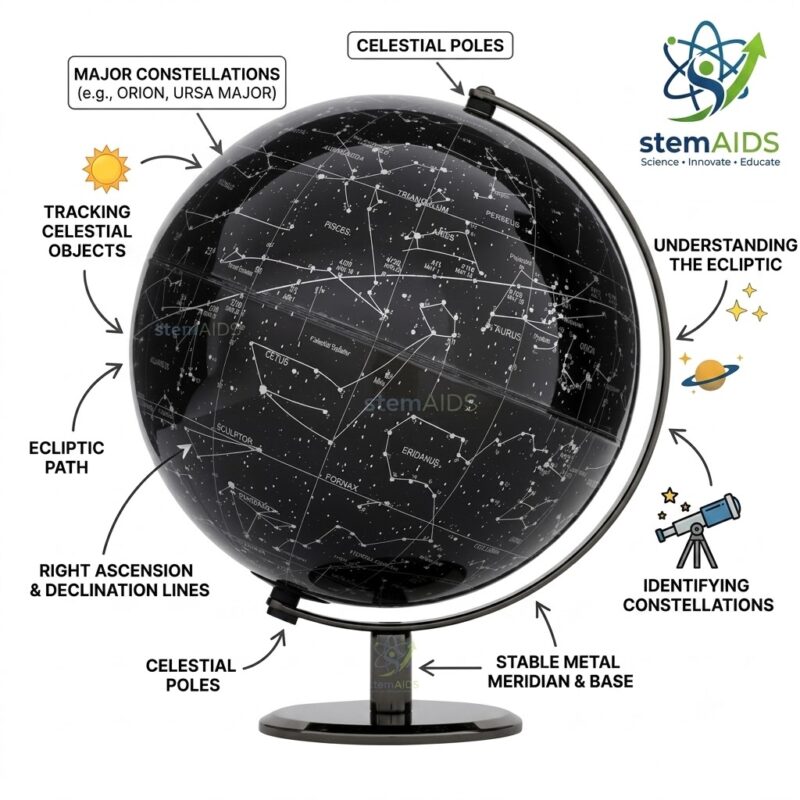
Quick answer: The Astronomical Globe Model represents stars, constellations and celestial reference features on a spherical surface, giving students the spatial context of the celestial sphere that a flat star chart cannot fully provide.
Product Description
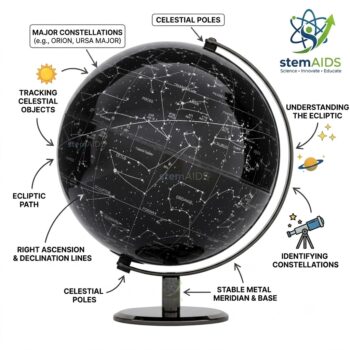
The LabEquip Astronomical Globe Model provides a three-dimensional reference for studying how celestial objects appear to surround Earth. Teachers can use it to introduce constellations, celestial poles, the celestial equator and other represented astronomical reference features.
A spherical model gives learners spatial context that a flat star chart cannot fully reproduce, supporting lessons on celestial coordinates and the apparent motion of stars.
Specifications
| Specification | Detail |
|---|---|
| Product name | Astronomical Globe Model |
| Brand | LabEquip |
| Product category | Astronomy laboratory apparatus; celestial sphere globe model |
| Primary function | Representing stars, constellations and celestial reference features spatially |
Suggested Use
- Use the globe to point out constellations and their relative positions on the celestial sphere.
- Introduce the celestial poles and celestial equator as reference lines.
- Rotate the globe to demonstrate the apparent daily motion of stars.
- Compare the spherical model with a flat star chart to discuss the benefits of each format.
Care & Maintenance
- Handle the globe carefully to avoid scratching the printed surface.
- Dust the globe periodically to keep constellation markings visible.
- Store the globe on a stable stand or in a protective case when not in use.
- Keep away from direct sunlight to reduce fading of printed details.
Why Choose LabEquip
For related astronomy teaching resources, see our Planisphere, or visit the LabEquip homepage to browse our full catalogue of astronomy lab kits.
Related Products
- Planisphere: A rotating star chart for taking outdoors once students understand the full sky on the globe.
- Star Constellation Viewing Model: A constellation model for practising the shapes of star patterns before an observing session.
- Celestial Globe: A celestial globe offered as an alternative sky globe for comparing layouts and markings.
- Political World Globe: A political globe of Earth for comparing the terrestrial equator and poles with their celestial counterparts.
Frequently Asked Questions
What is an astronomical globe and what does it show?
An astronomical globe, also called a celestial globe, is a model of the sky drawn on a sphere, with Earth imagined at its centre. This model represents stars, constellations and reference features such as the celestial poles and celestial equator, so students can see how the star patterns surround us in every direction.
Why do the constellations look back to front on a celestial globe?
From Earth we look at the sky from inside the celestial sphere, but on a globe we view it from outside. Many star globes therefore show constellations as mirror images of how they appear overhead. Pointing this out early saves confusion when students compare the globe with the real night sky or a star chart.
How is an astronomical globe different from a planisphere?
The globe shows the whole sky in three dimensions, including stars that never rise for your location, which makes it good for explaining celestial coordinates and the sky’s apparent rotation. A planisphere is a flat rotating chart set for one band of latitude and shows only the stars above the horizon at a chosen date and time, so it is the one to take outdoors.
What are the celestial equator and the celestial poles?
They are Earth’s equator and axis projected out onto the sky. The north celestial pole lies very close to the Pole Star, which is why that star seems to stay still while others circle it. The celestial equator divides the sky into northern and southern halves and is the starting line for declination, the sky’s version of latitude.
How can an astronomical globe show which stars are visible from my latitude?
Tilt the globe so the celestial pole sits above an imagined horizon at an angle equal to your latitude. Turning the globe about its axis then shows which stars rise and set, which circle the pole without setting and which never come above the horizon from your location.
Which lessons is an astronomical globe used for?
It supports lessons on constellations, the celestial sphere, celestial coordinates (right ascension and declination), the apparent daily motion of the stars and why different constellations are seen in different seasons. It suits middle-school geography and science as well as senior physics and astronomy clubs.
Last Updated: November 2026





Reviews
There are no reviews yet.