Quick Answer: This four stroke petrol engine model is a teaching aid representing a spark-ignition engine, showing how the piston, valves, crankshaft and camshaft move through the intake, compression, power and exhaust strokes. Automotive and mechanical trainees use it to understand the Otto cycle before working on real engines.
The Four Strokes in Order
Intake: the piston moves down with the inlet valve open, drawing a petrol-air mixture into the cylinder. Compression: both valves close and the rising piston squeezes the mixture into the combustion chamber. Power: the spark plug fires near the top of the stroke and the expanding gases drive the piston down. Exhaust: the exhaust valve opens and the rising piston pushes the burnt gases out.
The crankshaft turns twice for each complete cycle, so only one stroke in four delivers work, and the flywheel carries the engine through the other three. Following the model through a full cycle lets trainees see exactly where each valve opens and closes relative to the piston.
Valve Timing and Ignition
Because each valve operates once per cycle, the camshaft runs at half crankshaft speed through gears, a chain or a toothed belt with a 2:1 ratio. In real engines the inlet valve opens slightly before top dead centre and the exhaust valve closes slightly after it, so both are briefly open together. Students meet this valve overlap when they draw timing diagrams.
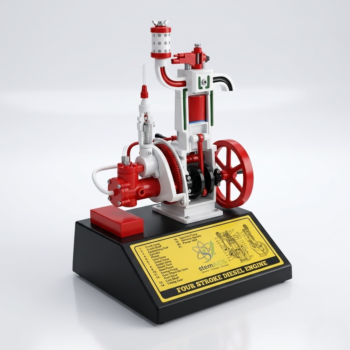
The spark is timed before top dead centre, because the mixture takes a short time to burn and peak pressure should arrive just after the piston passes the top. Comparing this model with the four stroke diesel engine model shows the key difference: a diesel has no spark plug and ignites injected fuel in air heated by much higher compression.
Specifications
| Item | Teaching model of a four-stroke spark-ignition (petrol) engine |
| Cycle shown | Intake, compression, power and exhaust (Otto cycle) |
| Parts normally represented | Piston, connecting rod, crankshaft, inlet and exhaust valves, camshaft drive, spark plug |
| Crank to camshaft ratio | 2:1, with two crankshaft turns per cycle |
| Construction (sectioned, hand-turned or motorised) and size | Confirm at enquiry |
Training Uses
- Explaining the Otto cycle and the order of strokes in automotive and motor-mechanic courses
- Locating top and bottom dead centre and drawing valve timing diagrams
- Identifying the main moving parts of an engine and how they are linked
- Comparing four-stroke with two-stroke cycles, and spark with compression ignition
Care & Handling
- If the mechanism is turned by hand, rotate it in the engine’s normal direction and never force it past a stiff point
- Keep the model covered between lessons, since dust settles in an exposed mechanism
- Lubricate moving parts only as the supplier advises, as excess oil collects grime
- Lift and carry the model by its base or stand, not by the cylinder or moving parts
Why Choose LabEquip
ITIs, polytechnics and TVET institutes buying engineering lab equipment for automobile and mechanical trades use this four stroke petrol engine model to teach engine operation before trainees strip and rebuild real engines. LabEquip lists it with its TVET lab equipment, alongside the two stroke gasoline engine model for comparing the two cycles; contact LabEquip to confirm the model’s construction and size.
Frequently Asked Questions
What are the four strokes of a petrol engine?
Intake, compression, power and exhaust. The piston draws in a petrol-air mixture, compresses it, is driven down when the spark plug ignites the mixture, and then pushes the burnt gases out. Two turns of the crankshaft complete one cycle.
Why does the camshaft turn at half the speed of the crankshaft?
Each valve has to open once per cycle, and a four-stroke cycle takes two crankshaft revolutions. Driving the camshaft through a 2:1 gear, chain or belt ratio makes each cam lift its valve once in every two turns of the crank.
How does a four-stroke petrol engine differ from a diesel engine?
A petrol engine compresses a fuel-air mixture and ignites it with a spark plug. A diesel compresses air alone to a much higher pressure, which makes it hot enough to ignite fuel sprayed in by an injector, so it needs no spark plug.
How does a four-stroke engine differ from a two-stroke?
A two-stroke completes its cycle in one crankshaft revolution, using ports in the cylinder wall instead of a valve train, and gives a power stroke every turn. A four-stroke has a power stroke every second turn but separates intake and exhaust more cleanly.
Is the model a working engine?
It is listed as a model, meaning a teaching aid for showing the working cycle rather than a running engine. Whether the mechanism is sectioned to show the inside, turned by hand or driven by a motor is not stated, so confirm it with LabEquip.
What is valve overlap?
Near the end of the exhaust stroke the inlet valve starts to open before the exhaust valve has closed, so both are open for a short time and the outgoing gases help draw in the fresh charge. On a timing diagram it appears as the angle around top dead centre where both valves are open.
Last Updated: October 2026