
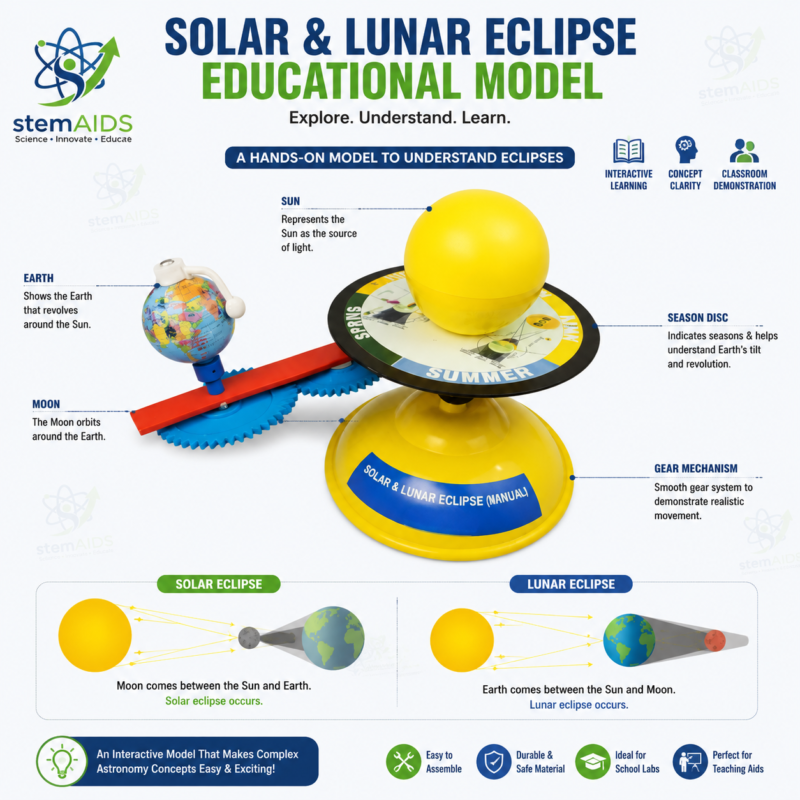
The solar and lunar eclipse educational model is an astronomy teaching aid used for demonstrating how the alignment of the Sun, Earth and Moon produces solar and lunar eclipses. It helps students and teachers observe shadow formation, orbital position and eclipse geometry through a controlled classroom activity.
Recommended product image ALT text: Solar and lunar eclipse educational model showing Sun, Earth and Moon alignment for classroom astronomy demonstrations.
Product Description
The STEMAids Solar and Lunar Eclipse Educational Model provides a physical reference for comparing two different astronomical alignments. A solar eclipse occurs when the Moon passes between the Sun and Earth. A lunar eclipse occurs when Earth passes between the Sun and Moon.
The model helps learners examine how shadows form and why eclipses do not occur during every lunar orbit. Teachers can use it to introduce the umbra, penumbra, eclipse path and orbital-plane alignment. The model’s construction, movement system, illumination method and scale must be confirmed from the approved product specification.
Key Features
- Dual-eclipse capacity: supports demonstrations of both solar and lunar eclipses.
- Three-body representation: shows the positional relationship between the Sun, Earth and Moon.
- Shadow demonstration: helps explain the formation of the umbra and penumbra.
- Concept comparison: clearly distinguishes a solar eclipse from a lunar eclipse.
- Hands-on astronomy learning: allows learners to observe how changing alignment affects illumination.
- Reusable teaching resource: suitable for lessons, revision, exhibitions and astronomy clubs.
- Misconception correction: helps distinguish eclipses from the regular phases of the Moon.
- Controlled demonstration: teaches eclipse principles without requiring direct observation of the Sun.
Technical Specifications
|
Specification |
Detail |
|
Product name |
Solar and Lunar Eclipse Educational Model |
|
Brand |
STEMAids |
|
Product type |
Educational astronomy demonstration model |
|
Teaching capacity |
Solar eclipse and lunar eclipse demonstrations |
What’s Included in the Kit
Confirm the final packing list before publication. The supplied configuration may include:
- Solar and Lunar Eclipse Educational Model assembly
- Sun or illumination-source representation
- Earth globe or sphere
- Moon sphere and supporting arm
- Orbit track, rotating mechanism or positioning supports
- Base or demonstration platform
- Labels, activity sheet or operating guide
Applications / Uses
- Demonstrating the alignment required for a solar eclipse.
- Demonstrating the alignment required for a lunar eclipse.
- Explaining total, partial and annular solar eclipses conceptually.
- Introducing total, partial and penumbral lunar eclipses.
- Comparing the umbra and penumbra.
- Distinguishing eclipses from ordinary lunar phases.
- Supporting astronomy exhibitions and Earth-space science lessons.
Extend the lesson with STEMAids educational science models, practical physics laboratory products, visual educational charts and project-based STEM kits.
How to Use the Solar and Lunar Eclipse Educational Model
- Place the model on a stable surface in a room where shadows can be seen clearly.
- Identify the components representing the Sun, Earth and Moon.
- For a solar eclipse, position the Moon between the Sun and Earth.
- Observe the Moon’s shadow falling on the Earth representation.
- For a lunar eclipse, position Earth between the Sun and Moon.
- Observe the Moon entering Earth’s shadow.
- Change the alignment slightly to compare complete and partial shadow coverage.
Safety note: Never look directly at the real Sun or through binoculars, telescopes or lenses without certified solar-viewing equipment. Disconnect electrical illumination before adjusting or storing the model.
Care & Maintenance
- Clean the spheres and base with a soft, dry cloth.
- Move arms, gears and orbital supports gently without forcing them.
- Keep electrical parts away from liquids if illumination is included.
- Store the model in a dry cabinet away from heat and direct sunlight.
Why Choose STEMAids
STEMAids manufactures and supplies educational science models, laboratory products, STEM kits and teaching-learning resources. Its catalogue supports practical and visual instruction in schools and institutional learning environments. The company supplies educational customers in India and abroad and supports institutional requirements. Buyers should confirm the model mechanism, materials and supplied components in the approved quotation.
Frequently Asked Questions
What is a solar and lunar eclipse educational model used for?
It is used to demonstrate the different Sun-Earth-Moon alignments that produce solar and lunar eclipses. It also supports lessons on shadows and orbital geometry.
What is the difference between a solar and lunar eclipse?
A solar eclipse occurs when the Moon passes between the Sun and Earth. A lunar eclipse occurs when Earth passes between the Sun and Moon.
Why does an eclipse not happen every month?
The Moon’s orbit is tilted relative to Earth’s orbital plane. Most new and full moons therefore pass above or below the precise alignment required for an eclipse.
Is the model suitable for schools?
Yes. It is suitable for supervised astronomy, Earth science, geography and general science lessons.
Does the model include a working light source?
The illumination configuration has not been verified. Confirm whether a lamp is built in, supplied separately or required from the classroom.
Can the model demonstrate the umbra and penumbra?
It can be used to explain these shadow regions when the supplied illumination and geometry produce visible shadow boundaries. Confirm the model’s demonstration capability before publication.
Contact STEMAids to confirm the model’s dimensions, illumination system and operating mechanism, or explore the complete Educational Science Models range.


Reviews
There are no reviews yet.