
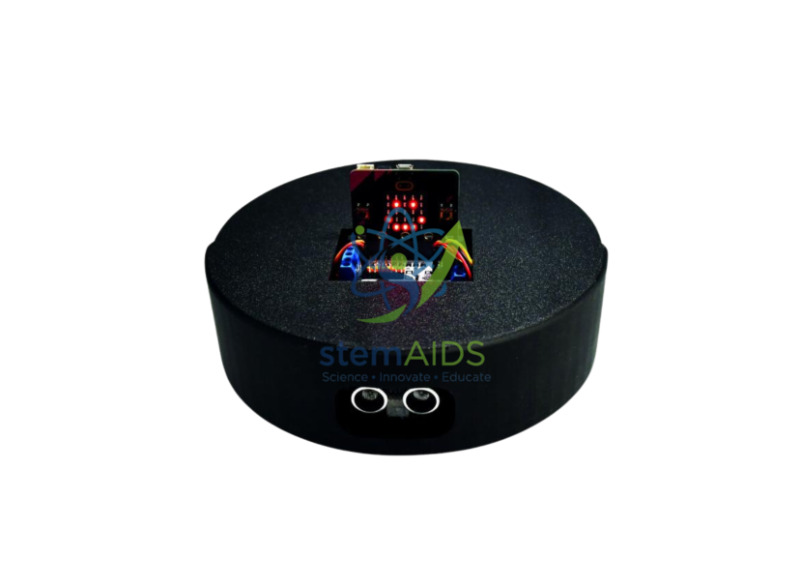
The 3D Robotic Lawnmower Kit with micro:bit Board by StemAids is an educational robotics kit designed to help students learn block programming, robot assembly, motor control, sensor-based movement, fault identification, and automation logic. It is a classroom-friendly STEM kit that demonstrates the working principle of an autonomous robotic lawnmower model using the BBC micro:bit platform.
This kit allows students to build and program a small robotic vehicle that can move, detect obstacles, follow boundary lines, and demonstrate automated navigation concepts. It is suitable for learning how modern robotic machines use sensors, motors, controllers, and programmed decision-making to perform a task.
The product is intended for educational simulation and STEM learning. It is not designed as a real grass-cutting lawnmower. It helps learners understand the technology behind robotic lawnmowers in a safe, practical, and classroom-appropriate format.
Key Features
- Educational robotic lawnmower model based on micro:bit V2
- Helps students learn block programming and robotics logic
- Includes micro:bit motor shield for motor control activities
- Equipped with two geared motors and wheels for robotic movement
- Includes Grove ultrasonic sensor for obstacle detection projects
- Includes two Grove line followers for path and boundary detection activities
- Continuous rotation mini servo supports mechanical movement demonstrations
- Useful for learning fault identification, repair, testing, and improvement
- Supports assembly-based learning, soldering practice, and project development
- Suitable for STEM labs, robotics classes, coding workshops, and innovation labs
Product Specifications
| Product Name | 3D Robotic Lawnmower Kit with micro:bit Board |
|---|---|
| Brand | StemAids |
| Product Type | Educational Robotic Lawnmower STEM Kit |
| Controller Board | BBC micro:bit V2 board |
| Motor Driver | Motor shield for micro:bit |
| Drive System | Two double-output geared motors with output shafts |
| Wheels | Two wheels included |
| Sensors Included | One Grove ultrasonic sensor and two Grove line followers |
| Servo Motor | One continuous rotation mini servomotor |
| Power Supply | 9V 1200 mAh battery with 9V battery clip |
| Other Components | Switch, wires, Grove cables with female pins, screws |
| 3D Printed Parts | 3D printed body parts are not supplied in the standard kit and may need to be printed or purchased separately |
| Assembly Requirement | Ready to assemble and solder |
| Programming Method | Block programming using micro:bit-compatible platforms; Python may be used depending on classroom setup |
| Learning Concepts | Robotics, Automation, Sensors, Motor Control, Line Following, Obstacle Detection, Fault Finding, STEM Engineering |
| Recommended Use | School STEM Labs, Robotics Labs, Technology Classes, Coding Workshops, Project-Based Learning |
| User Level | Beginner to Intermediate |
Kit Contents
- One micro:bit V2 board
- One motor shield for micro:bit
- Two double-output geared motors
- Two motor gearbox output shafts
- One switch
- Two wheels
- One Grove ultrasonic sensor
- Two Grove line followers
- One continuous rotation mini servomotor
- One 9V 1200 mAh battery
- One 9V battery clip
- One set of wires
- One set of Grove cables with female pins
- One set of screws
- 3D printable body parts or printed body parts may be required separately
How to Use 3D Robotic Lawnmower Kit with micro:bit Board
- Check All Components: Verify the micro:bit V2 board, motor shield, geared motors, wheels, ultrasonic sensor, line followers, servo motor, battery, wires, cables, and screws before starting.
- Prepare the 3D Body Parts: Print the required 3D model parts using a 3D printer or use compatible printed parts if available separately.
- Assemble the Chassis: Fix the motors, shafts, wheels, switch, battery holder, and structural parts according to the assembly guide.
- Install the micro:bit Board: Connect the micro:bit V2 board with the motor shield and mount it securely on the robotic lawnmower model.
- Connect the Sensors: Attach the Grove ultrasonic sensor for obstacle detection and the two Grove line followers for path or boundary detection.
- Connect the Servo Motor: Connect the continuous rotation mini servo as per the project requirement and wiring instructions.
- Open the Programming Platform: Use a micro:bit-compatible block programming platform such as MakeCode to create the robot control program.
- Program Movement Logic: Add commands for forward movement, turning, stopping, obstacle response, line detection, and boundary-following behavior.
- Upload the Program: Transfer the code to the micro:bit board and power the robot using the 9V battery.
- Test and Improve: Place the model on a test surface, observe its movement, identify faults, correct wiring or code errors, and improve the robot’s performance.
Educational Benefits
The StemAids 3D Robotic Lawnmower Kit with micro:bit Board helps students understand how autonomous robots are designed, assembled, programmed, tested, and improved. It combines mechanical assembly, electronic wiring, sensor use, motor control, coding, and troubleshooting in one practical learning activity.
This kit supports experiential learning by encouraging students to build a working model instead of only studying robotics theory. Learners can observe how a robot detects a line, avoids obstacles, responds to programmed conditions, and corrects movement based on sensor input. It is also useful for teaching fault finding, repair methods, logical thinking, and engineering design improvement.
Applications
- Autonomous robot learning project
- micro:bit robotics classroom activity
- Line-following and boundary-detection experiment
- Obstacle detection and avoidance project
- STEM lab automation demonstration
- 3D printing and robotics integration activity
- Fault finding and repair practice
- School technology and innovation lab project
- Robotics competition preparation
- Project-based learning for coding and engineering design
Why Choose StemAids 3D Robotic Lawnmower Kit with micro:bit Board?
StemAids offers practical STEM learning products that help students connect coding with real-world engineering models. The 3D Robotic Lawnmower Kit with micro:bit Board by StemAids is designed to make robotics education more active, visual, and project-oriented. It gives learners the opportunity to assemble components, connect sensors, write code, test movement, identify faults, and improve the robot through repeated experimentation.
For schools and training institutions, this kit is useful because it covers multiple learning areas in one project, including microcontroller programming, sensor-based automation, motor control, 3D printed model construction, and troubleshooting. It is a strong choice for STEM labs, robotics workshops, innovation labs, and classroom activities aligned with hands-on learning.
SEO Keywords
3D Robotic Lawnmower Kit with micro:bit Board, StemAids Robotic Lawnmower Kit, micro:bit Robotics Kit, Educational Robotic Lawnmower Model, STEM Robotics Kit, micro:bit Robot Kit for Schools, 3D Printed Robotics Kit, Autonomous Robot Learning Kit, Line Follower Robot Kit, Obstacle Detection Robot Kit.
FAQ
1. What is the 3D Robotic Lawnmower Kit with micro:bit Board?
It is an educational STEM robotics kit that uses a micro:bit V2 board, motor shield, motors, sensors, and 3D printable parts to build a robotic lawnmower model for learning automation and programming.
2. Which brand offers this product?
This product is offered under the StemAids brand for STEM robotics, coding, technology education, and project-based learning.
3. Is this a real grass-cutting lawnmower?
No, this is an educational robotic lawnmower model. It is intended for classroom learning, robotics experiments, and automation demonstrations, not for real grass cutting.
4. Does the kit include the micro:bit board?
Yes, this version includes a micro:bit V2 board.
5. Are 3D printed body parts included?
The standard kit is supplied ready to assemble and solder, but the 3D printed body parts are not included. They may need to be printed separately or purchased as compatible printed parts.
6. What sensors are included in the kit?
The kit includes one Grove ultrasonic sensor for obstacle detection and two Grove line followers for path or boundary detection activities.
7. What can students learn from this kit?
Students can learn block programming, robotics assembly, motor control, line following, obstacle detection, sensor logic, fault identification, repair, and automation principles.
8. Is soldering required?
Yes, the kit is supplied ready to assemble and solder. Teacher supervision is recommended during soldering and assembly activities.
9. Can this kit be used in school STEM labs?
Yes, it is suitable for school STEM labs, robotics labs, coding classes, technology workshops, and innovation lab activities.
10. Which programming method is suitable for beginners?
Beginners can start with block programming using a micro:bit-compatible platform such as MakeCode. Advanced users may explore Python depending on the classroom setup.
Safety and Classroom Use Note
This kit should be assembled and tested under teacher or trainer supervision. Students should follow safe soldering practices, correct battery polarity, proper wiring methods, and avoid using the model as a real cutting device. It is designed for educational robotics and automation demonstrations only.




Reviews
There are no reviews yet.