

In Stock
RFID Module with Card and Badge
$2.93
Quick Answer: The RFID Module with Card and Badge is a radio-frequency identification reader board supplied with a tag card and a key-fob badge, used with Arduino and similar microcontrollers to read tag IDs without contact. It lets students build and study systems such as attendance loggers and access-control demonstrations.
How Contactless Identification Works
An RFID reader drives a coil antenna that sets up an alternating magnetic field around the board. The card and badge contain a tiny chip and their own coil but no battery: when either is held close, the field induces enough current in the tag coil to power the chip, which then answers by modulating the field with its stored identification number. The reader decodes that number and passes it to the microcontroller. Because the link relies on near-field coupling between coils, the working distance is short, typically a few centimetres.
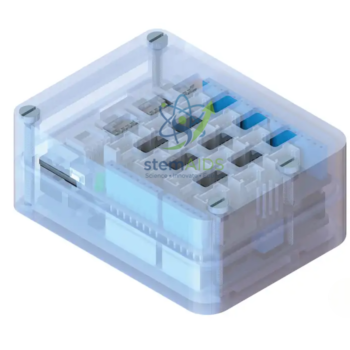
The listing image shows an RC522-type reader board, a common choice in schools. Boards of that type work at 13.56 MHz with MIFARE-type cards, connect to Arduino over the SPI bus and run from a 3.3 V supply; the supplied version should be checked before wiring. A widely used open-source Arduino library for the RC522 reads the unique ID of each tag in a few lines of code, so a first working sketch is quick to achieve.
Projects That Teach Real Systems
With the RFID module with card and badge, a class can register the two tags as authorised and make an LED, buzzer or servo respond only to them, a clear model of a door-entry system. Adding the Micro-SD Card Module turns it into an attendance logger that writes each tag ID with a time stamp. These projects bring in programming decisions, data handling and questions of privacy and security.
Specifications
| Contents | RFID reader module, one card tag and one badge (key-fob) tag |
| Tags | Passive, battery-free |
| Controller | Arduino or similar microcontroller board |
| Reader type shown in listing image | RC522-type, 13.56 MHz, SPI interface |
| Supply voltage and header pins | Confirm at enquiry (RC522 boards normally run at 3.3 V) |
Applications
- Access-control demonstrations with a servo lock, relay or LED indicator
- Class attendance or library-loan logging with data saved to a card
- Teaching wireless power transfer and near-field communication
- Robotics and automation projects that identify objects or stations by tag
Care & Handling
- Power the RFID module with card from the supply voltage marked for its board; RC522-type readers can be damaged by 5 V on the supply pin.
- Handle the board by its edges and store it in an antistatic bag.
- Keep tags away from strong magnets and do not bend the card sharply, which can break the embedded antenna.
Why Choose LabEquip
Teachers of electronics, ICT and robotics use RFID projects because they connect coding to systems students meet every day. LabEquip lists this kit in its TLM Kits, where controllers such as the Arduino Nano are also listed. Ask about lab quantities through the contact page.
Frequently Asked Questions
How can the card work without a battery?
The reader’s coil creates an alternating magnetic field. Held near it, the coil in the card picks up enough energy by induction to power its chip, which then sends back its ID by changing the field. This is called passive RFID.
Which supply voltage does the module need?
RC522-type reader boards, the type shown in the listing image, run at 3.3 V and can be damaged by 5 V on the supply pin, so confirm the board version when you enquire. Most Arduino boards provide a 3.3 V pin for this purpose.
How does it connect to an Arduino?
RC522-type readers use the SPI bus: MOSI, MISO, SCK and a chip-select pin, plus a reset pin, 3.3 V and ground. On an Arduino Uno the SPI pins are 11, 12 and 13. A widely used open-source RC522 library handles the communication.
Why does the card only read when it is very close?
The reader and tag communicate by near-field magnetic coupling between their coils, which falls off rapidly with distance. With small antennas like these, reliable reading usually needs the tag within a few centimetres of the board.
Is a card ID secure enough for a real door lock?
No. Basic tag IDs can be copied, so projects that grant access on the ID alone are for learning only. That weakness is itself a good discussion topic on how real security systems add encryption and authentication.
Can it be combined with other modules?
Yes. SPI lets several devices share the same data lines with separate chip-select pins, so the reader can work alongside a micro-SD card module for logging, and a real-time clock, display or servo can be added for complete projects.
Last Updated: September 2026
You must be logged in to post a review.
Bestsellers





Reviews
There are no reviews yet.