






Sale
In Stock
Water Wheel Dynamo Model
Original price was: $9.59.$4.68Current price is: $4.68.
Quick Answer: The Water Wheel Dynamo Model is a small hydroelectric demonstrator: water poured or piped into its inlet turns an enclosed wheel, and the wheel’s shaft drives a dynamo that lights an LED. It shows the chain of energy transfers from moving water to rotation to electricity.
From Falling Water to a Glowing LED
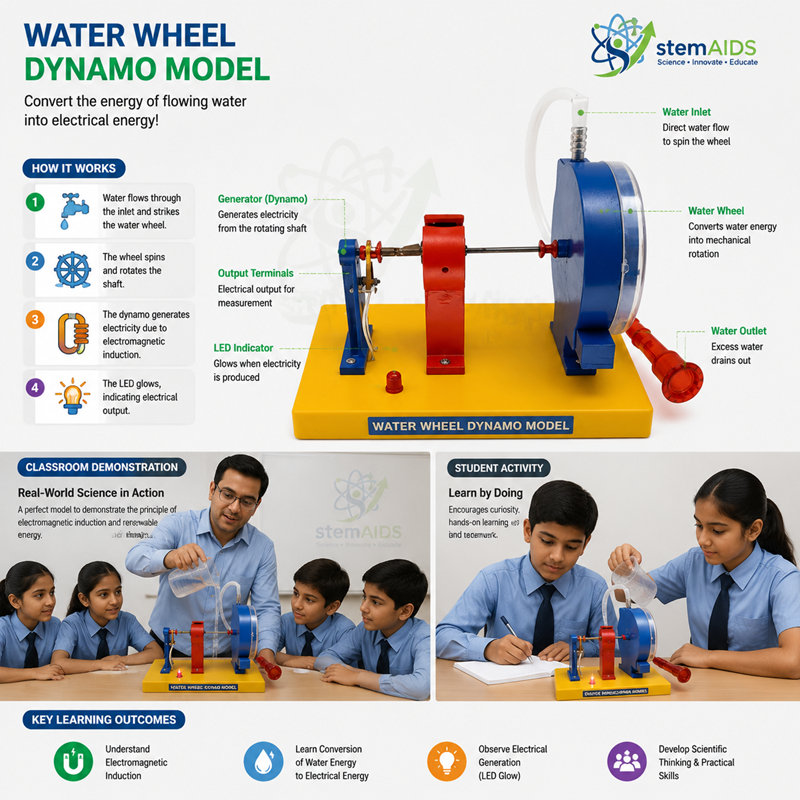
The listing image of the water wheel dynamo model shows a wheel housed in a round casing with a transparent front, so the paddles can be seen turning. A flexible tube feeds water in at the top and a spout carries it out at the side. A horizontal shaft runs from the wheel through a bearing post to a small dynamo at the far end, and an LED is fitted on the base. In the classroom scenes, water is poured into the inlet from a jug.
The model follows the same chain as a hydroelectric station. Water held at a height has gravitational potential energy, which becomes kinetic energy as it falls into the inlet. The moving water pushes the paddles and sets the wheel and shaft spinning. Inside the dynamo a magnet and a coil turn relative to each other, the changing magnetic flux induces a voltage, and the resulting current lights the LED. Power depends on both the height the water falls through and the rate at which it flows, so pouring from higher, or faster, gives a brighter glow.
Only a small fraction of the water’s energy reaches the LED; the rest is lost as splashing, bearing friction and heating in the dynamo coil. Discussing where it goes leads naturally to efficiency and to why real stations use carefully designed turbines. For the same dynamo principle driven by hand, compare the Bicycle Dynamo Power Generation Model. The water supply arrangement and tubing should be confirmed at enquiry.
Specifications
| Model type | Water-driven wheel and dynamo demonstrator |
| Wheel | Enclosed wheel with transparent front, as pictured |
| Water path | Inlet tube at the top and outlet spout at the side |
| Generator | Small dynamo driven by the wheel shaft |
| Output indicator | LED on the base |
| Water supply method and tubing | Confirm at enquiry |
Care & Handling
- Stand the model in a tray or beside a sink so that outflow and splashes are caught.
- Keep water away from the dynamo and LED wiring.
- Use clean, cold water; grit wears the bearings and hot water can distort plastic parts.
- Drain the casing and let the model dry after each use.
Applications
- Showing the energy transfers in hydroelectric power generation
- Comparing the height and flow rate of water with LED brightness
- Discussing renewable energy, efficiency and energy losses
- Serving as a working model at science exhibitions
Why Choose LabEquip
Teachers covering energy resources and electricity generation use the water wheel dynamo model to make hydroelectric power something students can operate themselves, and it is a popular choice for exhibition tables. LabEquip supplies it through the STEM kits range, and our contact page can answer questions about connecting it to a tap.
Frequently Asked Questions
What energy changes take place in the model?
Water at a height has gravitational potential energy, which becomes kinetic energy as it falls into the inlet. The water turns the wheel, the shaft turns the dynamo, the dynamo produces electrical energy, and the LED converts that into light.
How does the dynamo produce electricity?
Inside the dynamo a magnet and a coil rotate relative to each other. The changing magnetic flux through the coil induces a voltage by electromagnetic induction, and that voltage drives a current through the LED.
Why does pouring from higher up make the LED brighter?
Water falling a greater height arrives faster and carries more energy each second, so the wheel spins faster. A faster dynamo induces a larger voltage, which gives a brighter LED.
Why is only a small part of the water’s energy turned into light?
Energy is lost at every stage: in splashing and turbulence inside the casing, in friction at the bearings and as heat in the dynamo coil. Real hydroelectric plants use carefully shaped turbines to keep these losses low.
How is a real hydroelectric station different?
A power station stores water behind a dam and leads it through pipes to turbines matched to the height and flow available. The principle is the same, but the turbines are far more efficient than a simple paddle wheel and drive large generators.
Can the model run from a tap continuously?
If tubing from a tap fits the inlet and the outlet drains into a sink or tray, a steady flow gives a steady glow, which is easier to observe and measure than a single pour from a jug.
Last Updated: September 2026
You must be logged in to post a review.
Bestsellers

Sale

Sale
Sale

Sale


Reviews
There are no reviews yet.