


Sale
In Stock
Tower of Brahma
Original price was: $5.64.$2.71Current price is: $2.71.
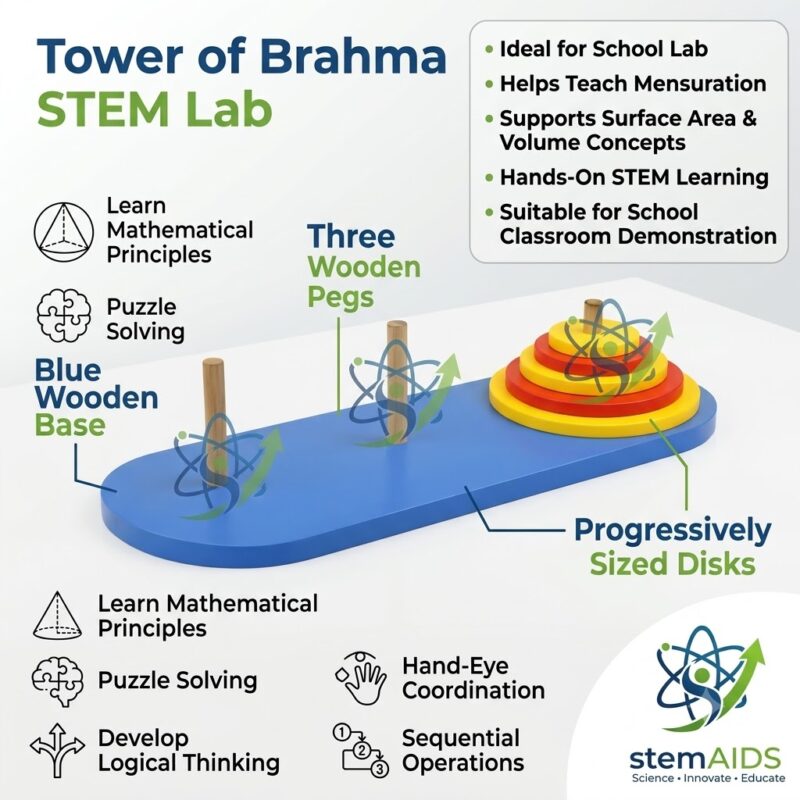
The Tower of Brahma is a mathematical puzzle used for developing logical reasoning, sequencing and problem-solving skills. It helps students, mathematics teachers and learning-centre instructors transfer a graduated stack of discs between three rods while following fixed rules and investigating patterns, algorithms, recursion and minimum-move solutions.
Product Description
The STEMAids Tower of Brahma, also known as the Tower of Hanoi, consists of three vertical rods and a set of discs with different diameters. At the beginning of the activity, the discs are arranged on one rod from largest at the bottom to smallest at the top.
The objective is to transfer the complete stack to another rod. Only one disc may be moved at a time, and a larger disc cannot be placed above a smaller disc. The puzzle supports progressive challenges because the minimum number of moves increases rapidly as discs are added. The exact disc count, construction and learner level must be confirmed from the current STEMAids specification.
Key Features
- Uses the classic three-rod format: Provides source, auxiliary and destination positions for the complete puzzle sequence.
- Develops logical reasoning: Requires learners to plan intermediate moves before transferring the full stack.
- Introduces algorithms: Demonstrates how a repeated rule can solve increasingly complex versions of one problem.
- Supports recursion learning: Shows how an n-disc problem can be reduced to smaller versions of the same problem.
- Demonstrates exponential growth: Connects the disc count with the minimum-move expression 2n − 1.
- Builds concentration and sequencing: Encourages careful movement, memory and error correction.
- Suitable for individual or group use: Supports mathematics laboratories, coding lessons, competitions and activity stations.
Technical Specifications
|
Specification |
Detail |
|
Product name |
Tower of Brahma |
|
Alternative name |
Tower of Hanoi / Lucas Tower |
|
Brand |
STEMAids |
|
Product category |
Mathematical puzzle / logical-reasoning teaching aid |
|
Setup capacity |
One three-rod disc-transfer puzzle |
|
Primary mathematical relationship |
Minimum moves for n discs = 2n − 1 |
|
Learning concepts |
Logic, algorithms, recursion, sequencing, induction and exponential growth |
|
Number of rods |
3 |
|
Intended users |
Primary and secondary students, mathematics teachers, coding instructors and learning centres |
|
Standards or certifications |
No product-specific certification publicly verified |
What’s Included in the Kit
- One base with three vertical rods
- Graduated discs
- Colour-coded or numbered disc elements
- Challenge cards or activity sheets
- Storage box, tray or pouch
- Rules, solution guide or teacher instructions
Applications and Uses
- Developing logical reasoning and structured problem-solving.
- Teaching algorithms and step-by-step procedures.
- Introducing recursive thinking in mathematics and computer science.
- Investigating powers of two and exponential growth.
- Demonstrating mathematical induction.
- Improving concentration, sequencing and visual planning.
- Conducting mathematics-club challenges and STEM competitions.
How to Use the Tower of Brahma
- Arrange all discs on one rod, with the largest at the bottom and smallest at the top.
- Select a second rod as the destination and use the remaining rod as the auxiliary position.
- Move only one disc during each turn.
- Move only the top disc from any occupied rod.
- Never place a larger disc on top of a smaller disc.
- Continue until the complete ordered stack reaches the destination rod.
- Count the moves and compare the result with 2n − 1.
- Repeat with additional discs or record the move sequence as an algorithm.
Safety and handling: Use the puzzle on a stable surface. Keep small discs away from children below the confirmed age grade and do not apply sideways force to the rods.
Care & Maintenance
- Wipe the base, rods and discs with a soft, dry or slightly damp cloth.
- Keep wooden or fibre-based components away from prolonged moisture.
- Store all discs together to preserve the complete graduated set.
- Do not force discs over bent, damaged or incorrectly aligned rods.
Why Choose STEMAids
STEMAids develops educational kits, mathematical teaching aids and science models for practical classroom learning. Buyers can explore related mathematics laboratory products, STEM learning kits, educational science models and the complete educational product range. Request the current disc count, dimensions, materials, age grade and activity guide before procurement.
Frequently Asked Questions
What is the Tower of Brahma?
It is a three-rod mathematical puzzle, more commonly called the Tower of Hanoi, in which a graduated stack of discs must be transferred according to fixed rules.
What are the rules of the puzzle?
Only one disc may be moved at a time, only the top disc may be moved, and a larger disc cannot be placed on a smaller disc.
What is the minimum number of moves?
For n discs, the minimum number of moves is 2n − 1. For example, three discs require seven moves and four discs require fifteen moves.
What does the puzzle teach?
It teaches logical reasoning, sequencing, recursion, algorithms, mathematical induction and exponential growth.
How many discs are included?
The STEMAids product configuration is not publicly verified. Confirm the supplied disc count before ordering.
Is the Tower of Brahma suitable for coding lessons?
Yes. The puzzle is widely used to introduce recursive algorithms, procedural thinking and the analysis of computational complexity.
Explore more mathematics laboratory products from STEMAids for logic, algorithms, geometry and activity-based learning.
Recommended primary image ALT text: Tower of Brahma mathematical puzzle with graduated discs and three vertical rods.
Recommended detail image ALT text: Tower of Hanoi puzzle showing coloured discs arranged from largest to smallest.
Recommended application image ALT text: Student solving a Tower of Brahma puzzle during a mathematics activity.
You must be logged in to post a review.
Bestsellers

Sale
Sale
Sale


Reviews
There are no reviews yet.