


Sale
In Stock
Step Down Electrical Transformer Apparatus
Original price was: ₹600.00.₹290.00Current price is: ₹290.00.
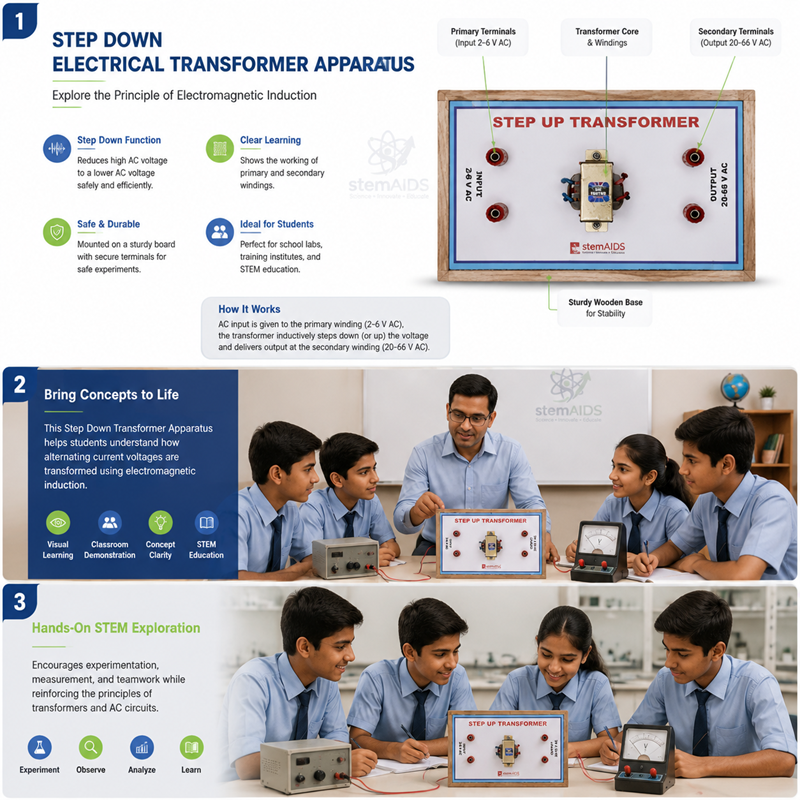
Quick Answer: The Step Down Electrical Transformer Apparatus is a board-mounted transformer for demonstrating how a transformer lowers an alternating voltage. The listing image shows a transformer core and windings in the centre of a framed board, with primary terminals on one side and secondary terminals on the other, all labelled for class use.
Reducing a Voltage by the Turns Ratio
A transformer consists of two coils, the primary and the secondary, wound on a shared iron core. Alternating current in the primary sets up a changing magnetic flux in the core, and that flux passes through the secondary, inducing a voltage there. In a step down transformer the secondary has fewer turns than the primary, so the output voltage is lower in the same ratio: Vs/Vp = Ns/Np.
Because energy cannot be created, a lower secondary voltage comes with a higher available current. For an ideal transformer the power in equals the power out, so VpIp = VsIs. Real transformers lose a little energy as heat in the windings and in the core, where the changing flux drives eddy currents, which is why cores are normally built from thin insulated laminations.
Mounting the step down transformer apparatus on an open board lets students trace which terminals belong to each winding and connect AC voltmeters to both sides. The input and output voltages and the turns ratio of this unit should be confirmed when ordering, and the input should come only from the supply its label specifies.
Specifications
| Apparatus type | Demonstration step down transformer |
| Construction | Core and windings mounted on a board, as pictured |
| Connections | Separate primary and secondary terminal pairs |
| Principle | Mutual induction; Vs/Vp = Ns/Np |
| Supply | Alternating current only |
| Voltage ratings and turns ratio | Confirm at enquiry |
Care & Handling
- Connect the primary only to the supply stated on the unit’s label, and switch off before rewiring.
- Keep liquids away from the board and the terminals.
- Allow the transformer to cool after extended use; the core and windings warm up.
- Check terminals and insulation before each class and withdraw the board if anything is loose or cracked.
Applications
- Measuring primary and secondary voltages and comparing their ratio
- Showing that a transformer gives no steady output on direct current
- Discussing power transmission, substations and low-voltage adaptors
- Estimating efficiency from input and output power
Why Choose LabEquip
Physics departments buy this board for the transformer practical because every winding and terminal is visible, unlike a sealed commercial unit. LabEquip supplies it within the STEM kits range, and the Mutual Induction Investigation Kit builds the idea of coupled coils beforehand. Contact us through the contact page.
Frequently Asked Questions
Why does a transformer not work on direct current?
A transformer relies on a changing magnetic flux to induce a voltage in the secondary. Steady direct current produces a constant flux, so after the moment of switching on, nothing is induced and the output falls to zero.
How do I calculate the output voltage?
Multiply the input voltage by the turns ratio, secondary turns divided by primary turns. For example, if the secondary has one tenth as many turns as the primary, the output voltage is one tenth of the input voltage.
If the voltage goes down, what happens to the current?
In an ideal transformer power in equals power out, so the current on the secondary side rises in the same proportion as the voltage falls. A step down transformer can therefore deliver a larger current than it draws from the supply.
Why is the core made of thin layers?
The changing flux induces eddy currents in the core itself, which waste energy as heat. Building the core from thin insulated sheets, called laminations, breaks up those current paths and keeps losses low.
Where are step down transformers used?
Local substations step down distribution voltages for homes and businesses, older plug-in adaptors and doorbell circuits use small step down transformers, and many laboratory low-voltage supplies contain one.
Why do transformers become warm?
Current in the copper windings meets resistance and produces heat, and the changing magnetic field causes small losses in the iron core. These losses mean real transformers are slightly less than fully efficient.
Last Updated: September 2026
You must be logged in to post a review.
Bestsellers


Sale

Sale

Sale


Reviews
There are no reviews yet.