

Sale
In Stock
Solar Energy Boat
Original price was: ₹700.00.₹340.00Current price is: ₹340.00.
Quick Answer: The Solar Energy Boat is a floating working model with a small solar panel, a DC motor and a propeller. Sunlight or a strong lamp falling on the panel produces electricity that spins the propeller, driving the boat across a tray or pond and showing how light energy becomes motion.
From Sunlight to Thrust
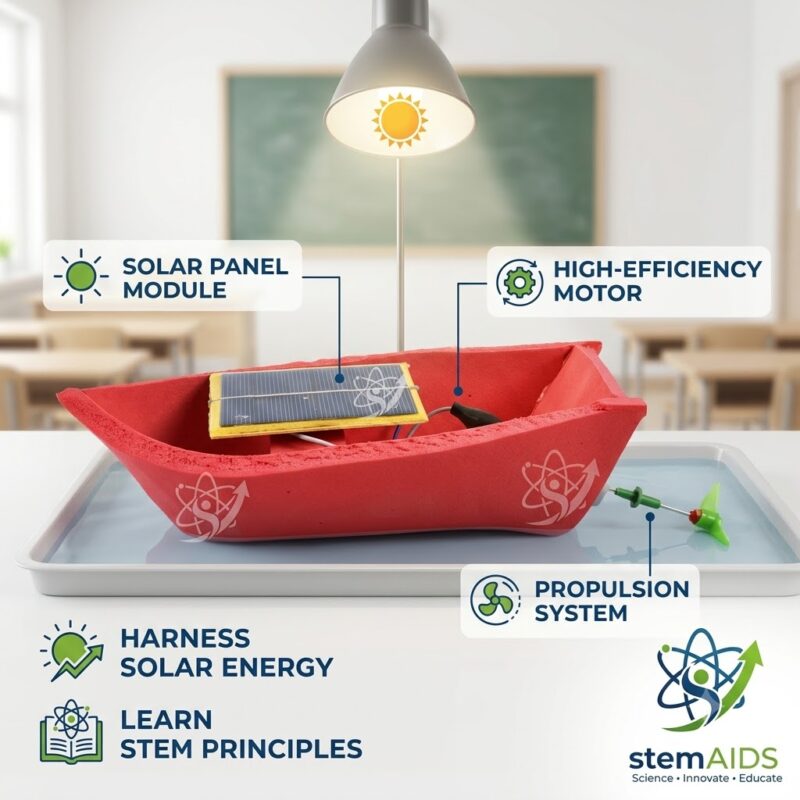
The listing image shows the solar energy boat as a red hull with a small solar panel mounted flat on the deck, a motor at the stern and a propeller that dips into the water. The solar cells convert light into direct current, the current flows to the motor, and the spinning propeller pushes water backward. By Newton’s third law the water pushes the boat forward. There is no battery in this simple arrangement, so the boat only moves while light reaches the panel.
That direct link between light and speed makes the boat a good investigation tool. Students can shade part of the panel, tilt the boat so the panel faces the Sun more directly, move a lamp closer or further away, or compare a sunny morning with a cloudy one, and see the boat’s speed change immediately. Each of these changes affects the power reaching the cells and the current they produce.
The model also gives a small-scale picture of real solar boats and ferries, and of the wider trade-offs in solar power: output depends on light intensity and angle, falls in the shade and stops at night unless energy is stored. The size of the panel and motor, and whether the boat comes assembled or as a kit, should be confirmed at enquiry.
Investigations
- Measuring how panel angle affects the boat’s speed over a fixed distance
- Comparing speeds in full sun, light cloud and lamplight
- Tracing the energy chain from light to electrical to kinetic energy
- Starting a design challenge on hull shape or propeller position
Care & Handling
- Keep the solar panel dry and wipe it gently with a soft cloth; water marks and dust reduce its output.
- Lift the solar energy boat out of the water after use and dry the motor area.
- Do not place a hot lamp close to the hull, which may soften if it is made of foam or thin plastic.
- Check that the propeller turns freely and remove any threads or hair wound around the shaft.
Specifications
| Item | Solar-powered model boat |
| Power | Small solar panel on the deck (listing image) |
| Drive | DC motor turning a propeller at the stern |
| Operating conditions | Direct sunlight or a strong lamp; calm water in a tray or pond |
| Concepts | Photovoltaic cells, energy transfer, thrust, renewable energy |
| Panel size and kit or assembled form | Confirm at enquiry |
Why Choose LabEquip
Primary and middle-school teachers choose a solar boat for renewable energy topics because the effect of light on speed is instant and obvious. LabEquip lists it in its STEM kits range with the Candle Powered Toy Boat, and further kits are in the solar energy kits section. Ask about class quantities through the contact page.
Frequently Asked Questions
Will the boat work indoors?
Yes, under a strong lamp, although it runs more slowly than in bright sunshine because indoor light is much less intense. Some lamps give out little of the light that solar cells respond to, so test the lamp first and bring it as close as is safe for the hull.
Why does the boat slow down when a cloud passes?
The solar panel’s output depends on light intensity. When cloud cuts the sunlight, the panel produces less current, the motor slows and the propeller gives less thrust. The boat’s speed is a direct indicator of the light level.
Does the angle of the panel matter?
Yes. A panel facing the Sun directly receives the most light per unit area. When the Sun is low in the sky, a flat panel catches much less, which is why fixed solar panels on buildings are tilted to suit their latitude.
Can a battery be added so it runs in the shade?
A rechargeable cell or capacitor charged by the panel could store energy, but that needs a suitable charging circuit to avoid damage. It makes a good extension project for older students discussing energy storage.
What pushes the boat forward?
The propeller pushes water backward, and by Newton’s third law the water pushes the propeller, and so the boat, forward with an equal and opposite force. Bigger or faster propellers push more water and give more thrust.
Where should the boat be tested?
A shallow tray, paddling pool or calm pond works well. Avoid moving water and wind, which make speed measurements unreliable, and supervise children near any open water.
Last Updated: September 2026
You must be logged in to post a review.
Bestsellers
Sale

Sale
Sale


Reviews
There are no reviews yet.