








Sale
In Stock
Silicon Electronic Configuration Model
Original price was: ₹650.00.₹315.00Current price is: ₹315.00.
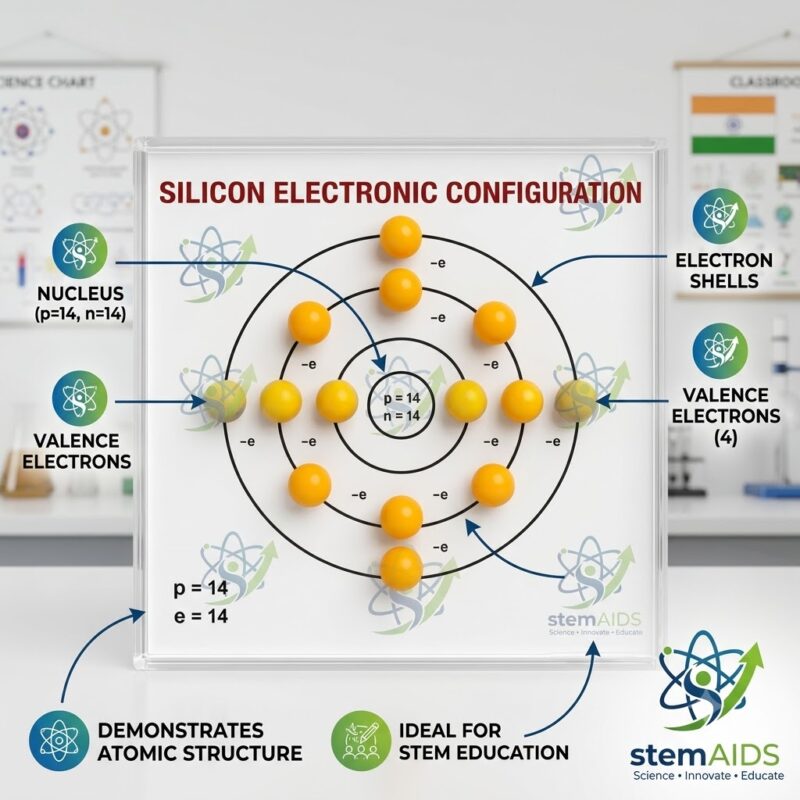
Quick Answer: The Silicon Electronic Configuration Model is a chemistry teaching display of the silicon atom, showing a nucleus of 14 protons and 14 neutrons and 14 electrons arranged in three shells as 2,8,4. Its four valence electrons explain silicon’s valency of four, its place in Group 14 and its behaviour as a semiconductor.
Silicon’s 2,8,4 Arrangement
The listing image of the silicon electronic configuration model shows the nucleus labelled with 14 protons and 14 neutrons, the most common isotope, silicon-28, surrounded by shells of beads holding two, eight and four electrons. Written with subshells, the configuration is 1s² 2s² 2p⁶ 3s² 3p², and the model can be used to move students from the simple shell picture to this fuller notation.
The four outer electrons put silicon directly below carbon in Group 14, and like carbon it usually forms four covalent bonds. In a silicon crystal each atom bonds to four neighbours in a tetrahedral network, the same arrangement as in diamond. In sand and quartz, which are silicon dioxide, each silicon bonds to four oxygen atoms in a giant structure, which is why these materials are hard and melt only at high temperatures.
Silicon is a metalloid and the basis of modern electronics. Pure silicon conducts poorly, but adding a trace of phosphorus, with five outer electrons, supplies spare electrons and makes n-type silicon, while boron, with three, leaves gaps called holes and makes p-type silicon. Joining the two types forms the diodes, transistors and solar cells found in every phone and computer, a link students find motivating.
Applications
- Teaching electron arrangements for the period 3 elements
- Explaining valency and bonding in Group 14 alongside carbon
- Introducing semiconductors, doping and solar cells in physics
- Comparing silicon dioxide with carbon dioxide in structure and properties
Specifications
| Item | Atomic structure model of silicon |
| Nucleus | 14 protons and 14 neutrons (silicon-28), as pictured |
| Electron arrangement | 2,8,4; 1s² 2s² 2p⁶ 3s² 3p² |
| Valence electrons | Four |
| Periodic table position | Group 14, Period 3 |
| Size and mounting | Confirm at enquiry |
Care & Handling
- Wipe the display with a soft, dry cloth and keep it away from damp.
- Avoid pressing on the electron beads or the shell rings.
- Store it with other element models in a labelled cupboard so the set stays together.
Why Choose LabEquip
Chemistry and physics departments both use this model, one for the periodic table and the other for semiconductor lessons. LabEquip lists it in the STEM kits range beside the Carbon Atom Structure Model, its Group 14 neighbour, and the Phosphorus Element Structure Model, the element used for n-type doping. Send your enquiry through the contact page.
Frequently Asked Questions
What is the electronic configuration of silicon?
Silicon has 14 electrons arranged 2,8,4: two in the first shell, eight in the second and four in the third, outer shell.
Why is silicon’s valency four?
It has four electrons in its outer shell and needs four more to complete it. Sharing electrons with four other atoms achieves this, so silicon typically forms four covalent bonds.
Why is silicon used in electronics?
Silicon is a semiconductor: its conductivity lies between that of a metal and an insulator and can be controlled precisely by adding tiny amounts of other elements. This makes it suitable for diodes, transistors, chips and solar cells.
How is silicon similar to carbon?
Both are in Group 14 with four outer electrons, both form four covalent bonds, and pure crystalline silicon has the same tetrahedral network as diamond. Silicon atoms are larger, so their bonds are longer and weaker than those of carbon.
Is silicon a metal or a non-metal?
It is a metalloid. Silicon has a shiny, metal-like appearance but is brittle and conducts electricity far less well than metals, so its properties fall between the two groups.
What does doping mean for silicon?
Doping means adding a very small amount of another element. Phosphorus adds extra electrons and makes n-type silicon, while boron creates holes and makes p-type silicon. Junctions between the two types are the basis of diodes and transistors.
Last Updated: September 2026
You must be logged in to post a review.
Bestsellers

Sale

Sale

Sale


Reviews
There are no reviews yet.