




In Stock
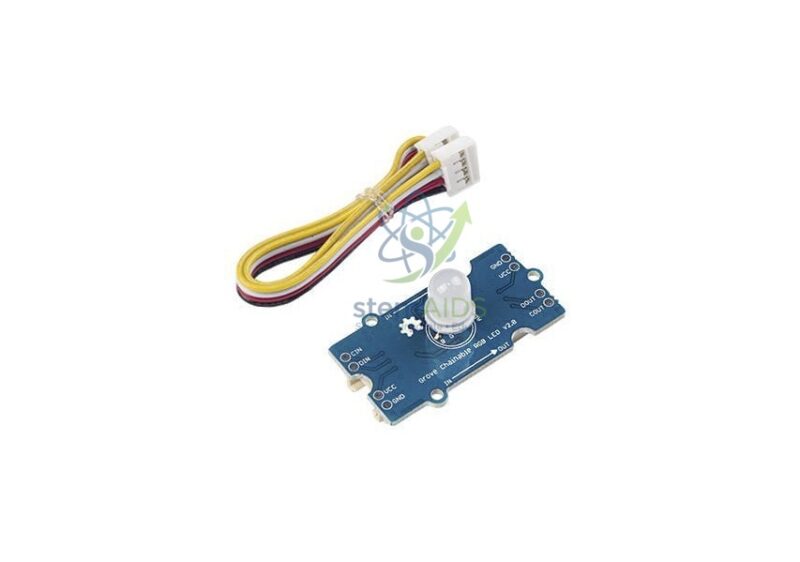
RGB LED 8mm Grove
Quick Answer: The RGB LED 8mm Grove is a Grove module carrying an 8 mm LED that contains red, green and blue light emitters in a single lens. Mixing the three produces a wide range of colours, so the module is used to teach additive colour mixing and to give projects multi-colour status lights.
Additive Colour Mixing in One Lens
Screens, stage lights and many signs make their colours by mixing red, green and blue light. The RGB LED 8mm Grove puts these three primaries of light behind one lens, where they blend: red and green make yellow, green and blue make cyan, red and blue make magenta, and all three together look close to white. Students who have learnt paint mixing are often surprised, which makes it a memorable way to introduce additive colour.
At 8 mm the LED is larger than the common 5 mm type, so the mixed colour is easier to see across a desk. In projects, colour becomes information: a temperature reading can move from blue through green to red, or a single light can show several states such as waiting, running and fault.
RGB LED modules set colour in different ways: some let a program control each channel, others use small adjusters on the board while one signal pin switches the LED on and off. Confirm how this module’s colour is set before planning coding lessons around it.
Applications
- Additive colour-mixing demonstrations in physics lessons on light
- Colour-coded indicators for readings from the Grove Temperature and Humidity Sensor
- Multi-state status lights for robots and automation models
- Mood lights and decorative projects in design and technology
Specifications
| Module | 8 mm RGB LED (red, green and blue emitters) on a Grove board |
| Connection | Grove port on a shield or Grove-ready board |
| Teaching focus | Additive colour mixing and multi-state indication |
| LED size | 8 mm, larger than standard 5 mm LEDs |
| Method of colour setting | Confirm at enquiry |
Care & Handling
- Avoid staring into the RGB LED at full brightness from close range; white light from all three channels is intense.
- Handle the module by its edges and keep it away from damp.
- Plug and unplug Grove cables with the controller switched off.
- Store it apart from single-colour LED modules so it is not mistaken for a plain LED in a class set.
Why Choose LabEquip
Physics teachers covering colour and designers building light projects both find a single RGB module more flexible than several separate LEDs. LabEquip lists it in the Stem Kits category next to single-colour modules such as the Green LED module 5 mm Grove; ask about quantities through the contact page.
Frequently Asked Questions
Why do red and green light make yellow?
When red and green light reach the eye together, they stimulate the red- and green-sensitive cone cells in much the same way as pure yellow light, so the brain sees yellow. This is additive mixing, which differs from mixing paints.
Why does mixing all three colours look white?
Red, green and blue together stimulate all three types of cone cell, which the brain reads as white. With LEDs the result may look slightly tinted, because the three emitters are not perfectly balanced.
Can I set any colour from code?
That depends on how the module sets colour. Some RGB modules give the program control of each channel, while others use on-board adjusters and a single on-off signal. Confirm the type when you enquire so lessons match the hardware.
How is an 8 mm LED different from a 5 mm LED?
The number refers to the diameter of the lens. An 8 mm LED is physically larger, so its light is easier to see, which helps when a whole group needs to notice a colour change.
How can colour show a sensor reading?
Map the reading to a colour scale in code, for example blue for cold, green for comfortable and red for hot. Students have to decide the ranges, which makes them think about what the data means.
What is the difference between common anode and common cathode RGB LEDs?
In a common anode LED the three emitters share a positive connection and each colour is switched through its negative leg; in a common cathode LED they share the negative. On a Grove module the board handles this, but it matters for bare LEDs on a breadboard.
Last Updated: September 2026
You must be logged in to post a review.
Bestsellers

Sale

Sale

Sale
Sale


Reviews
There are no reviews yet.