
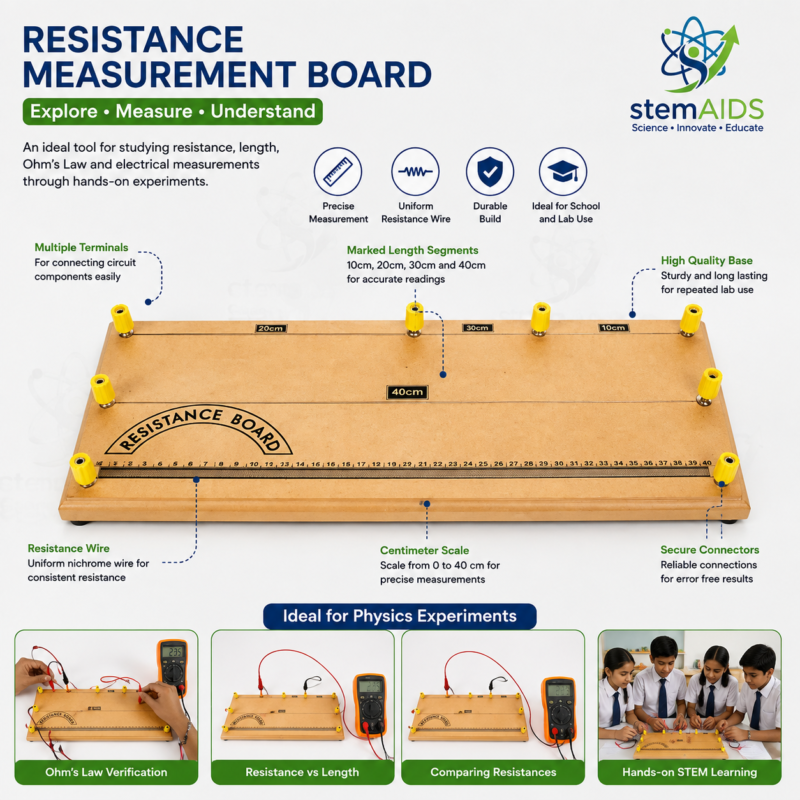
The Resistance Measurement Board is an educational electrical apparatus used to measure resistance and investigate the relationship between voltage and current. It is intended for supervised school, college and STEM laboratories, helping learners connect circuit construction, meter placement, Ohm’s law, resistor values and measurement uncertainty through practical experiments.
Product Description
The STEMAids Resistance Measurement Board provides an organized platform for connecting a test resistor, low-voltage source and suitable measuring instruments. In the voltmeter-ammeter method, students measure the potential difference across the resistor and the current passing through it, then calculate resistance by dividing voltage by current.
The board may also support direct multimeter measurements or comparison of series and parallel resistor networks, subject to its confirmed circuit layout. Accurate results require correct meter placement, secure connections, suitable ranges and limited resistor heating. Browse related physics laboratory products and educational science models.
Key Features
- Practical resistance measurement: Supports direct or voltage-current measurement methods — [confirm configuration].
- Ohm’s law verification: Allows multiple voltage and current readings to be compared for an ohmic resistor.
- Clearly arranged terminals: Provides an accessible circuit layout for supervised student wiring.
- V-I graph activity: Enables resistance to be determined from the slope of a voltage-current graph.
- Network comparison: May support series and parallel resistance experiments where selectable resistors are fitted.
- Measurement-skills training: Reinforces correct ammeter, voltmeter and multimeter use.
- Transparent accuracy limits: Lead resistance, meter loading, contact resistance and heating can influence readings.
Technical Specifications
|
Specification |
Detail |
|
Product name |
Resistance Measurement Board |
|
Brand |
STEMAids |
|
Product type |
Electrical resistance and Ohm’s law experiment board |
|
Capacity |
One experimental station |
|
Standards or certifications |
No product-specific standard or certification verified |
What’s Included in the Kit
- Resistance Measurement Board main assembly
- Test resistors or resistance specimens
- Switch, rheostat or variable control
- Ammeter and voltmeter
- Low-voltage DC source
- Connecting leads and patch cords
- Experiment instructions
Applications / Uses
- Measuring an unknown electrical resistance.
- Verifying Ohm’s law for an ohmic component.
- Plotting voltage-current characteristics.
- Comparing nominal and measured resistor values.
- Studying equivalent resistance in series and parallel circuits where supported.
- Practising correct ammeter, voltmeter and multimeter connections.
How to Use the Resistance Measurement Board
- Place the board on a dry, stable laboratory bench.
- Identify the test resistor, terminals and confirmed meter ranges.
- Connect the ammeter in series with the resistor and low-voltage source.
- Connect the voltmeter in parallel across the test resistor.
- Set the variable control to its minimum-current position before switching on.
- Record corresponding voltage and current readings at several settings.
- Calculate resistance from each voltage-current pair or determine it from the graph slope.
- Switch off the supply before changing the circuit or using an ohmmeter.
Safety and handling: Use only the specified low-voltage supply. Never connect an ohmmeter to an energized circuit. Check meter polarity and range before operation, avoid short circuits and stop the experiment if a resistor or lead becomes hot.
Care & Maintenance
- Disconnect all power before cleaning or inspecting the board.
- Keep terminals and plugs clean, dry and free from corrosion.
- Inspect leads, resistors, switches and meter protection before use.
- Store the board and accessories in a dry, dust-protected cabinet.
Why Choose STEMAids
STEMAids develops educational science models, laboratory apparatus, STEM kits and teaching-learning resources for institutional laboratories. Its official website identifies in-house research, development and quality assurance as part of its product-development process. The company also supports customized and bulk educational requirements for domestic and international buyers. Explore related STEM learning kits and general laboratory products.
Frequently Asked Questions
What is a Resistance Measurement Board used for?
It is used to measure electrical resistance and study the relationship between voltage, current and resistance in a controlled circuit.
How is resistance measured with a voltmeter and ammeter?
Measure voltage across the resistor and current through it, then divide voltage by current to calculate resistance.
How should the meters be connected?
The ammeter is connected in series with the test component. The voltmeter is connected in parallel across it.
Can an ohmmeter be used while the circuit is powered?
No. Disconnect and discharge the circuit before direct resistance measurement because an ohmmeter applies its own test signal.
Why can the measured resistance change during an experiment?
Resistor heating, contact resistance, meter loading and unstable connections can alter the measured result.
Are meters and a power supply included?
The supplied configuration was not verified. Confirm the meters, resistance range, source rating and connecting accessories before ordering.
Request the confirmed resistor range, meter configuration and power-supply details from STEMAids, then browse the Physics Lab Products category.






Reviews
There are no reviews yet.