











Sale
In Stock
Reflection of Light Experiment Kit
Original price was: $12.97.$6.37Current price is: $6.37.
Quick Answer: The Reflection of Light Experiment Kit is a school optics set for verifying the laws of reflection. A narrow beam of light is aimed at a reflecting surface over grid paper inside a clear case, and students measure the angle of incidence and the angle of reflection from the normal to show that they are equal.
Verifying the Laws of Reflection
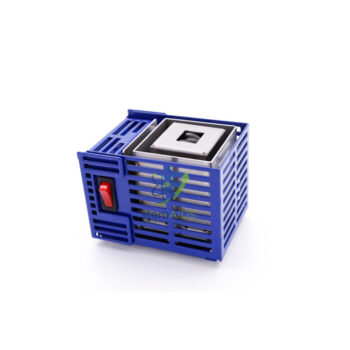
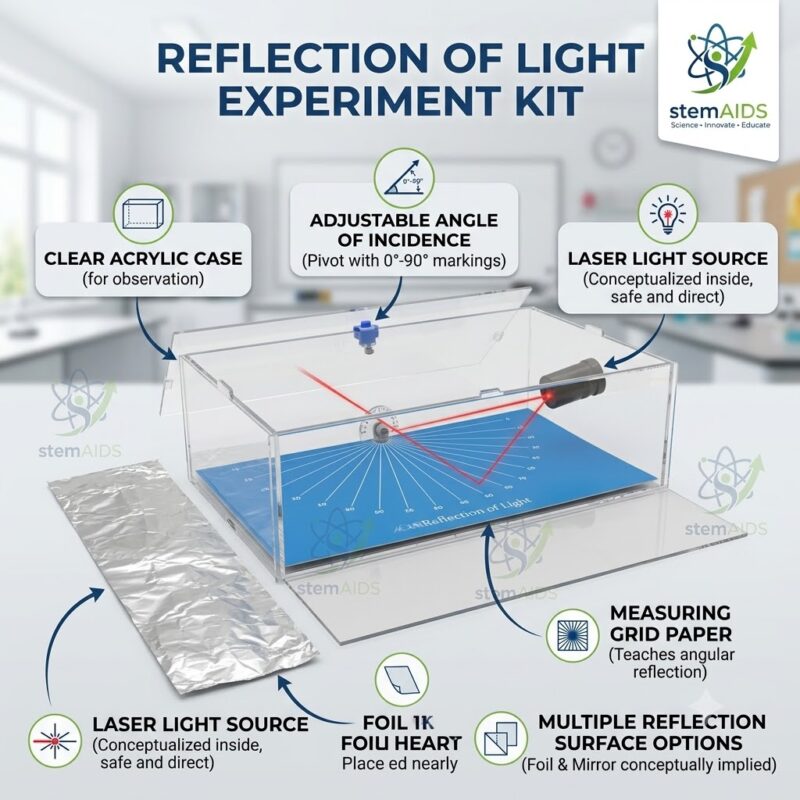
The listing image of the reflection of light experiment kit shows a clear acrylic case over measuring grid paper, a narrow light source that can be aimed at different angles of incidence, and reflecting surfaces including foil. Students draw the normal, a line at right angles to the reflecting surface, and read the angles on either side of it for several beam directions.
Two laws come out of the results. The angle of incidence equals the angle of reflection, and the incident ray, the reflected ray and the normal all lie in the same plane. Repeating the measurement at five or six angles and tabulating the pairs gives stronger evidence than a single reading, and small differences become a starting point for talking about measurement error.
Swapping the mirror for foil shows the difference between regular and diffuse reflection. Smooth foil sends the beam off in one direction like a mirror, while crumpled and flattened foil scatters it in many directions, because each tiny facet obeys the same law at a different angle. That is why we see our reflection in a mirror but not in a sheet of paper. If the light source is a laser, confirm its class at ordering and keep it at bench height so it cannot shine into anyone’s eyes.
Specifications
| Item | Laws-of-reflection experiment set |
| Light source | Narrow-beam source, as shown in the listing image |
| Measuring surface | Grid paper for drawing rays and measuring angles |
| Enclosure | Clear acrylic case for observing the beam path |
| Reflecting surfaces | Mirror and foil options |
| Light source type and power | Confirm at enquiry |
Applications
- Verifying that the angle of incidence equals the angle of reflection
- Comparing regular and diffuse reflection with smooth and crumpled foil
- Locating the image in a plane mirror by ray tracing
- Practising protractor measurement and table-and-graph recording
Care & Handling
- Never look into the light source or point it at anyone; keep the beam horizontal at bench height.
- Handle mirrors by the edges and store them so the reflecting face is not scratched.
- Clean the acrylic case with a soft damp cloth only, since solvents and rough cloths cloud acrylic.
- Replace the grid paper when it becomes marked, so old rays do not confuse new readings.
Why Choose LabEquip
Physics teachers from Class 6 upward use this set in practicals on light, and it is one of the optics experiment kits for schools that fits a single-period lab session. LabEquip lists it in the STEM kits range, and the Angle Between Two Mirrors Apparatus extends the work to multiple images. Send class-set numbers through the contact page.
Frequently Asked Questions
What are the two laws of reflection?
First, the angle of incidence equals the angle of reflection, both measured from the normal. Second, the incident ray, the reflected ray and the normal at the point of incidence all lie in the same plane.
Why are angles measured from the normal instead of the mirror surface?
The normal gives a single reference that works for flat and curved surfaces alike. Measuring from the surface also gives equal angles on a plane mirror, but the normal convention is used throughout optics, including refraction, so students learn it from the start.
What is the difference between regular and diffuse reflection?
Regular reflection happens at a smooth surface, where parallel rays stay parallel after reflecting and form a clear image. Diffuse reflection happens at a rough surface, where rays scatter in many directions, so no image forms even though each ray obeys the law of reflection.
Is a laser safe to use in a classroom?
Low-power laser pointers can be used under supervision if the beam is kept at bench level and never directed at eyes, including by reflection from shiny objects. Students should not handle the source unsupervised.
Why don’t my angles match exactly?
Small differences come from the width of the beam, the thickness of the pencil line, the exact position of the normal and reading the protractor. Taking several readings, averaging them and marking the centre of the ray carefully brings the values closer.
Can the kit be used to find the image in a plane mirror?
Yes. Trace two or more reflected rays from an object pin, extend them backward behind the mirror with dashed lines, and the point where they meet is the image. It lies as far behind the mirror as the object is in front.
Last Updated: September 2026
You must be logged in to post a review.
Bestsellers
Sale

Sale
Sale


Reviews
There are no reviews yet.