

Sale
In Stock
Primary Colours Learning Kit
Original price was: ₹1,500.00.₹740.00Current price is: ₹740.00.
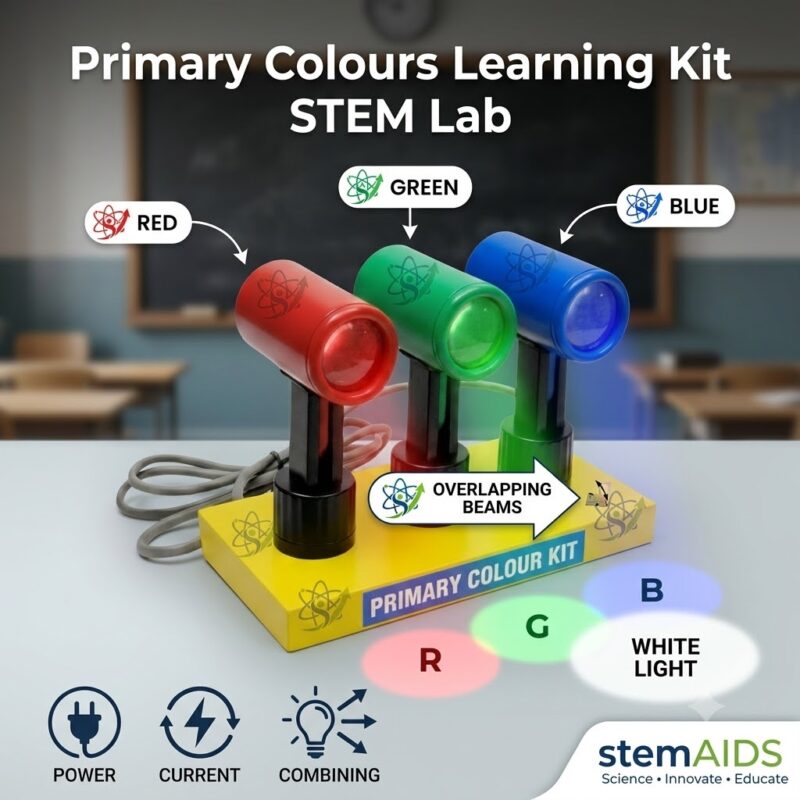
Quick Answer: The Primary Colours Learning Kit is a light-mixing apparatus with three lamps, red, green and blue, mounted on one base so that their beams overlap on a screen. Students see how the three primary colours of light combine to make yellow, cyan, magenta and white, which is the basis of every colour screen.
Mixing Coloured Light
In the listing image, the primary colours learning kit has three spotlight-style lamps, red, green and blue, on angled stems above a single base with a power lead. Aimed at a white wall or card, their beams overlap in the centre. Where red and green overlap the eye sees yellow, green and blue make cyan, and red and blue make magenta. Where all three meet, the patch looks white.
This is additive colour mixing. Our eyes have three types of colour-sensitive cone cells, responding most strongly to long, medium and short wavelengths, and the brain judges colour from how strongly each type is stimulated. Mixing red and green light stimulates the long- and medium-wavelength cones together in much the way that yellow light does, so we see yellow even though no yellow wavelength is present. Phone, television and computer screens use the same trick with tiny red, green and blue pixels.
Paints and printing inks follow different rules. They subtract colours from white light by absorbing some wavelengths, so their primaries are cyan, magenta and yellow, and mixing all three gives a dark colour rather than white. Setting the two systems side by side clears up one of the most common misconceptions in colour lessons. The type of lamps and the power supply for this kit should be confirmed at enquiry.
Care & Handling
- Switch off the lamps between demonstrations so the housings stay cool.
- Clean the lamp fronts with a soft dry cloth; scratches and dust dull the colours.
- Keep the power lead tidy and away from the edge of the bench.
- Store the primary colours learning kit in a closed box to keep dust off the lamp fronts.
Specifications
| Item | Additive colour mixing apparatus |
| Light sources | Red, green and blue lamps on one base (listing image) |
| Mixing results | Yellow, cyan, magenta and white |
| Viewing surface | White wall, screen or card |
| Concepts | Primary and secondary colours of light, colour vision, coloured shadows |
| Lamp type and power supply | Confirm at enquiry |
Lessons and Activities
- Predicting and then showing the secondary colours of light
- Making coloured shadows by placing a hand or object in the overlapping beams
- Comparing additive light mixing with mixing paints
- Examining a phone screen with a magnifier to find the red, green and blue pixels
Why Choose LabEquip
Science teachers covering light and colour, and art teachers explaining why screens and paints behave differently, both find this kit useful. LabEquip lists it in the STEM kits range, and the light and optics section has further apparatus for reflection and refraction. Ask for details on the contact page.
Frequently Asked Questions
Why do red and green light make yellow?
The eye has three kinds of cone cells, most sensitive to red, green and blue parts of the spectrum. Red and green light together stimulate the red- and green-sensitive cones in about the same proportion as pure yellow light, so the brain reads the mixture as yellow.
Why are the primary colours of light different from those of paint?
Light mixing is additive: each lamp adds wavelengths, so red, green and blue build up to white. Paint mixing is subtractive: each pigment absorbs part of white light, so cyan, magenta and yellow combine towards black. The two systems start from opposite ends.
How are coloured shadows made?
Place an object in the overlapping beams. Where it blocks one lamp, the shadow is lit by the other two and takes their mixed colour. Blocking the red lamp, for example, gives a cyan shadow. Several coloured shadows appear at once.
What surface should the beams be shone on?
A matt white wall, sheet or card gives the truest colours. A coloured or glossy surface changes the mixed colours or produces bright glare, and the room should be dimmed so the lamps are clearly visible.
Is the kit suitable for young pupils?
Yes. Younger pupils can name the colours and watch them mix, while older students explain the results with colour vision and relate them to screens and stage lighting. The lamps should be set up and switched by an adult.
How does this relate to phone and TV screens?
Each pixel on a screen is made of tiny red, green and blue elements. By changing their brightness, the screen creates millions of colours by additive mixing, exactly as the three lamps do on a larger scale.
Last Updated: September 2026
You must be logged in to post a review.
Bestsellers

Sale
Sale

Sale


Reviews
There are no reviews yet.