


Sale
In Stock
Phosphorus Element Structure Model
Original price was: $7.33.$3.55Current price is: $3.55.
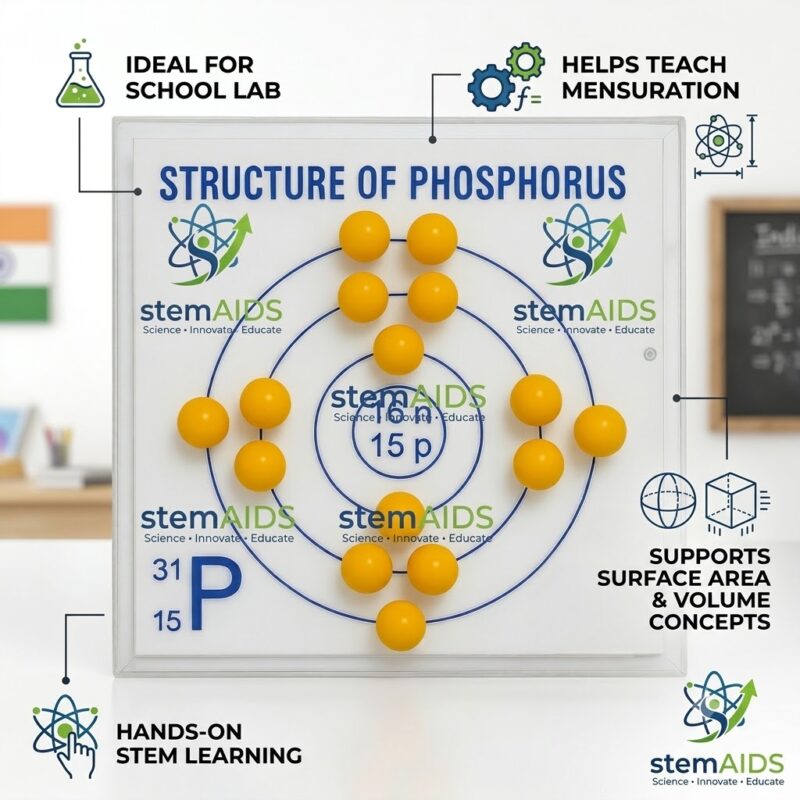
Quick Answer: The Phosphorus Element Structure Model is a chemistry display of the phosphorus atom, showing a nucleus of 15 protons and 16 neutrons, phosphorus-31, with 15 electrons arranged 2,8,5 in three shells. Its five outer electrons explain phosphorus’s place in Group 15 and its common valencies of three and five.
Reading the Phosphorus Atom
The listing image of the phosphorus element structure model shows the symbol with mass number 31 and atomic number 15, a nucleus labelled 15 protons and 16 neutrons, and electron beads spread over three rings. Counting the beads gives two in the first shell, eight in the second and five in the third, or 1s² 2s² 2p⁶ 3s² 3p³ in subshell notation.
Five valence electrons put phosphorus in Group 15 below nitrogen. Like nitrogen it can form three covalent bonds, as in phosphine and phosphorus trichloride, but because it is a larger atom in the third period it can also form five bonds, as in phosphorus pentachloride, often described as an expanded octet. Nitrogen cannot do this, which makes the pair a good example of how position in the periodic table affects bonding.
The element itself comes in forms that behave very differently. White phosphorus is waxy, glows faintly in the dark and catches fire in air, so it is stored under water, while red phosphorus is far more stable and is used on the striking strip of safety matchboxes. Phosphorus is also essential to life: it forms the phosphate backbone of DNA, carries energy in ATP and is a major plant nutrient in fertilisers.
Specifications
| Item | Atomic structure model of phosphorus |
| Nucleus | 15 protons and 16 neutrons (phosphorus-31), as pictured |
| Electron arrangement | 2,8,5; 1s² 2s² 2p⁶ 3s² 3p³ |
| Valence electrons | Five |
| Periodic table position | Group 15, Period 3 |
| Size and mounting | Confirm at enquiry |
Applications
- Teaching electron arrangement for the period 3 elements
- Comparing phosphorus with nitrogen in Group 15
- Explaining valencies of three and five with PCl₃ and PCl₅
- Linking chemistry to biology: phosphates in DNA, ATP and fertilisers
Care & Handling
- Keep the model dry and wipe it with a soft cloth only.
- Avoid knocking the beads on the outer ring when moving the model.
- Store it with the other element models so a complete period set stays together.
Why Choose LabEquip
Chemistry teachers building a set of period 3 element models usually add phosphorus between silicon and sulfur. LabEquip lists it in the STEM kits range with the Silicon Electronic Configuration Model, the element before it in the period, whose n-type doping depends on phosphorus. Send your requirements through the contact page.
Frequently Asked Questions
What is the electron arrangement of phosphorus?
Phosphorus has 15 electrons arranged 2,8,5: two in the first shell, eight in the second and five in the outer third shell.
How many neutrons does phosphorus have?
The only stable isotope, phosphorus-31, has 16 neutrons. The mass number 31 minus the atomic number 15 gives 16.
Why can phosphorus have a valency of both three and five?
With five outer electrons, phosphorus can share three to complete an octet, giving compounds such as phosphorus trichloride. Being a larger, third-period atom, it can also use all five, as in phosphorus pentachloride.
Why is white phosphorus stored under water?
White phosphorus reacts with oxygen in air and can catch fire on its own at room temperature. Keeping it under water cuts off the air. It is highly toxic and is not used in school practicals.
How is phosphorus different from nitrogen?
Both are in Group 15 with five outer electrons. Nitrogen is a small atom that forms a very stable triple-bonded gas, N2, while phosphorus is larger, is a solid, forms single bonds in P4 molecules and can form five bonds.
Why is phosphorus important to living things?
Phosphate groups form the backbone of DNA and RNA, ATP uses phosphate bonds to carry energy in cells, and bones and teeth contain calcium phosphate. Plants need it too, which is why it is a key part of fertilisers.
Last Updated: September 2026
You must be logged in to post a review.
Bestsellers


Sale
Sale
Sale
Sale


Reviews
There are no reviews yet.