











Sale
In Stock
Pendulum Time Period Apparatus
Original price was: ₹550.00.₹265.00Current price is: ₹265.00.
Quick Answer: The Pendulum Time Period Apparatus is a physics laboratory set-up for measuring the time period of a simple pendulum. A bob hangs on a thread from a rigid support, and students time its oscillations at different lengths to show how the period depends on length and to calculate the acceleration due to gravity.
Length, Period and Gravity
A simple pendulum swinging through a small angle has a period given by T = 2π√(L/g), where L runs from the pivot point down to the middle of the bob. The formula contains no mass and no amplitude, which is the striking result students can test for themselves with a pendulum time period apparatus. Changing the bob for a heavier one leaves the period unchanged, while lengthening the thread makes each swing take longer.
The standard procedure is to set a length, displace the bob through a small angle, and time twenty complete oscillations with a stopwatch, starting the count as the bob passes the centre of its swing. Repeating at five or six lengths and drawing a graph of T² (vertical) against L produces a line through the origin with a gradient of 4π²/g, so g follows from a single graph.
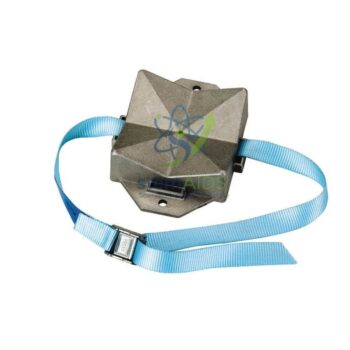
Rigid clamping at the top matters, because a support that sways adds its own motion and spoils the timing. The support type, thread and bobs supplied with this apparatus should be confirmed when ordering.
Specifications
| Apparatus type | Simple pendulum timing set-up |
| Period formula | T = 2π√(L/g), valid for small angles |
| Measured | Time for 20 oscillations at several lengths |
| Graph | T² against L, gradient 4π²/g |
| Level | Secondary school and first-year college physics |
| Stand, thread and bobs supplied | Confirm at enquiry |
Applications
- Investigating how the period depends on pendulum length
- Showing that the period is independent of bob mass
- Determining the acceleration due to gravity from a graph
- Introducing simple harmonic motion and oscillation vocabulary
- Practising timing techniques and uncertainty analysis
Care & Handling
- Clamp the support firmly to a heavy stand or bench so it cannot sway or tip.
- Check the thread for fraying and knots before each lesson, and replace it if it has stretched.
- Keep amplitudes small, both for accurate results and to stop the bob swinging into people.
- Store bobs in a box and wind the thread loosely to prevent kinks.
Why Choose LabEquip
Almost every school and college physics lab runs this practical, and the pendulum time period apparatus gives each group a set-up of its own. LabEquip offers it through the STEM kits range, and the Coupled Pendulum Experiment Kit extends the topic to energy transfer between two pendulums. Request details on our contact page.
Frequently Asked Questions
Why time 20 oscillations instead of one?
Human reaction time adds an error of a fraction of a second to every start and stop. Spreading that error over 20 oscillations makes it much smaller for each period. Dividing the total by 20 then gives an accurate value for one oscillation.
Where should the length of the pendulum be measured to?
Measure to the middle of the bob, starting where the thread leaves the clamp. The bob’s mass acts as if concentrated at its centre, so measuring only to the top of the bob gives a length that is too short.
Why must the swings be small?
The simple formula for the period assumes a small angle, usually under about ten degrees. At larger angles the period becomes slightly longer than predicted, which introduces a systematic error into the value of g.
Will a heavier bob swing faster or slower?
Neither. Gravity pulls harder on a heavier bob, but that bob also has proportionally more inertia to overcome, so its acceleration at each point of the swing is unchanged. Swapping bobs at a fixed length shows this directly.
How do I find g from the results?
Plot the square of the period on the vertical axis against length on the horizontal axis. The gradient of that line equals four pi squared over g; rearranging, g equals four pi squared over the gradient.
What length gives a period of two seconds?
A pendulum close to one metre long has a period of about two seconds, swinging one way in one second. This is called a seconds pendulum, and it was once used in clocks and proposed as a length standard.
Last Updated: September 2026
You must be logged in to post a review.
Bestsellers


Sale

Sale

Sale


Reviews
There are no reviews yet.