


Sale
In Stock
Oersted Law Teaching Apparatus
Original price was: ₹700.00.₹340.00Current price is: ₹340.00.
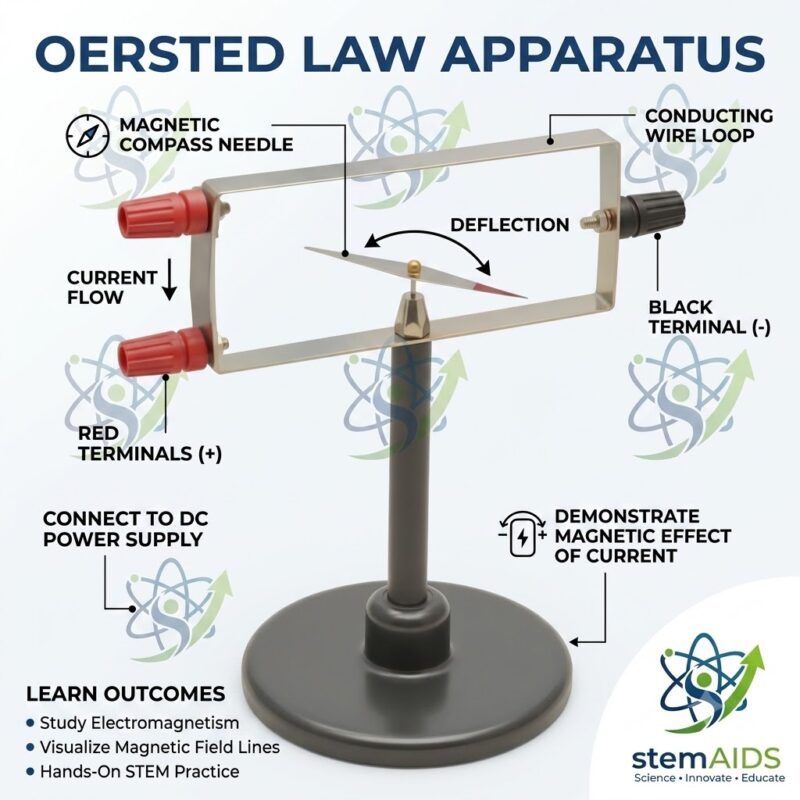
Quick Answer: The Oersted Law Teaching Apparatus demonstrates the magnetic effect of an electric current. As pictured, a rectangular conducting wire loop stands on a pillar with red and black terminals, and a compass needle pivots inside the loop; when direct current flows, the needle swings away from north.
Repeating Oersted’s 1820 Observation
In 1820 Hans Christian Oersted noticed that a compass needle moved when a nearby wire carried a current, the first evidence that electricity and magnetism are linked. The Oersted law apparatus repeats that observation in a controlled way. The loop is first turned so its long sides run north to south, parallel to the resting needle, and then the current is switched on.
The needle turns because the current creates a magnetic field around the wire, and the needle settles along the combination of that field and the Earth’s field. Reversing the leads at the terminals sends the current the other way and swings the needle to the opposite side. Since the needle sits between the upper and lower sides of the loop, where the currents run in opposite directions, both sides push it the same way, making the effect stronger than with a single straight wire.
A direct-current supply is needed, and the loop itself has very little resistance, so the circuit should include a rheostat or a current-limited supply rather than a bare cell connected straight across the terminals. The permitted current should be confirmed with LabEquip.
Applications
- Demonstrating that an electric current produces a magnetic field
- Testing how the deflection changes when the current is reversed or increased
- Practising the right-hand grip rule and the SNOW memory aid
- Introducing the galvanometer, which grew directly from this observation
Specifications
| Apparatus type | Magnetic effect of current demonstrator |
| Conductor | Rectangular wire loop on a pillar stand |
| Detector | Pivoted magnetic compass needle inside the loop |
| Connections | Red (+) and black (−) terminals |
| Supply | Direct current through a series rheostat |
| Current rating and dimensions | Confirm at enquiry |
Care & Handling
- Align the loop north to south with no current flowing before each demonstration.
- Keep steel tools, magnets and phones away from the needle; nearby iron distorts the reading.
- Switch the current on only while observing, since the loop and cells warm up quickly.
- Store the apparatus upright with the needle at rest, and avoid knocks that could damage the pivot.
Why Choose LabEquip
Teachers buy this apparatus for the lesson that opens electromagnetism, where every student needs to see a compass needle move for themselves. LabEquip includes it in the STEM kits range, and the Compass Needle on Stand is a handy extra for plotting the field around the wire afterwards. Contact us through the enquiry page.
Frequently Asked Questions
Why must the wire point north to south before switching on?
The needle already points north because of the Earth’s field. With the wire parallel to it, the field from the current acts across the needle, at right angles to the Earth’s field, and produces the largest, clearest deflection. A wire running east to west would give little or no sideways movement.
What happens when the current is reversed?
The magnetic field around the wire reverses, so the needle deflects to the other side. This shows that the direction of the field depends on the direction of the current, which the right-hand grip rule describes.
What is the SNOW rule?
SNOW stands for South to North, Over, West. If current flows from south to north in a wire above a compass needle, the north pole of the needle turns towards the west. If the wire is below the needle, the deflection is towards the east.
Why does the needle not turn a full 90 degrees?
The Earth’s magnetic field still pulls the needle towards north. The needle settles along the combined direction of the Earth’s field and the field from the current, so the angle grows with current but approaches 90 degrees only when the current’s field is much stronger than the Earth’s.
Why is a rheostat needed in the circuit?
The loop is a thick conductor with very low resistance. Connected straight to a battery, it would draw a large current, heat up and drain the cells, which is effectively a short circuit. A rheostat or current-limited supply keeps the current at a safe level and lets it be varied.
How is this apparatus related to a galvanometer?
The earliest galvanometers were built exactly like this: a compass needle inside a loop of wire, where a larger current gave a larger deflection. Winding many turns multiplies the field, which is how a sensitive current detector grew out of Oersted’s single loop.
Last Updated: September 2026
You must be logged in to post a review.
Bestsellers

Sale

Sale

Sale


Reviews
There are no reviews yet.